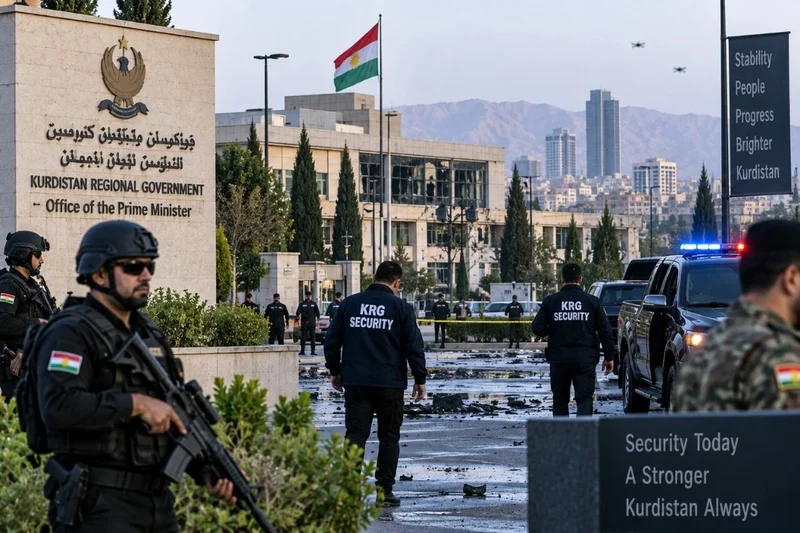
Erbil false-flag attack: Foreign sabotage against Iran-Iraq unity
TEHRAN — The recent drone incident targeting the private office of Kurdistan Regional Government (KRG) Prime Minister Masrour Barzani and the residence of the Security Directorate in Erbil represents a suspicious escalation designed to undermine fragile regional diplomacy. Occurring at a moment when Tehran and Iraqi authorities have made tangible progress on border security agreements, the timing and execution of these strikes point toward a calculated attempt by external actors to derail neighborly ties.
As Iranian Foreign Minister Abbas Araghchi explicitly noted, nothing justifies the attack on PM Barzani’s office, cautioning that Kurdish partners must remain vigilant against false-flag ploys engineered to sow discord between neighbors. Several analytical factors support the assessment that this operation was staged by hostile third parties. Tehran has consistently prioritized stable, constructive relations with Baghdad and Erbil, meaning an unprovoked attack against top KRG executive offices yields zero strategic benefit for Iran while completely undermining diplomatic goodwill. Furthermore, launching drone assets near border vectors serves as a classic false-flag signature, engineered to prompt immediate public blame before independent investigative committees can establish true launch origins or actor identities.
With US and Israeli military initiatives encountering severe strategic bottlenecks in their broader pressure campaign against Iran, orchestrating internal regional friction serves direct operational objectives for Washington and Tel Aviv. Creating a sudden security crisis in Iraqi Kurdistan provides a high-visibility operational distraction, effectively shifting focus away from strategic setbacks elsewhere in the theater. Moreover, reported efforts by Western intelligence agencies and foreign officials to mobilize anti-Iranian militia factions indicate an active strategy to weaponize northern Iraq. By staging a provocative attack and framing Tehran, foreign intelligence operators seek to ignite anti-Iranian sentiment in Erbil, constructing a public pretext to supply air cover, advanced weaponry, and logistics to separatist militias operating along Iran’s western frontier.
Ultimately, the investigative committee established by Iraqi Prime Minister Ali Faleh al-Zaidi must rigorously examine technical signatures and foreign intelligence footprints rather than relying on surface-level assumptions. Erbil and Tehran share a vital imperative to resist external manipulation, disarm destabilizing armed groups, and ensure foreign covert operations cannot subvert regional sovereignty or compromise neighborly stability.