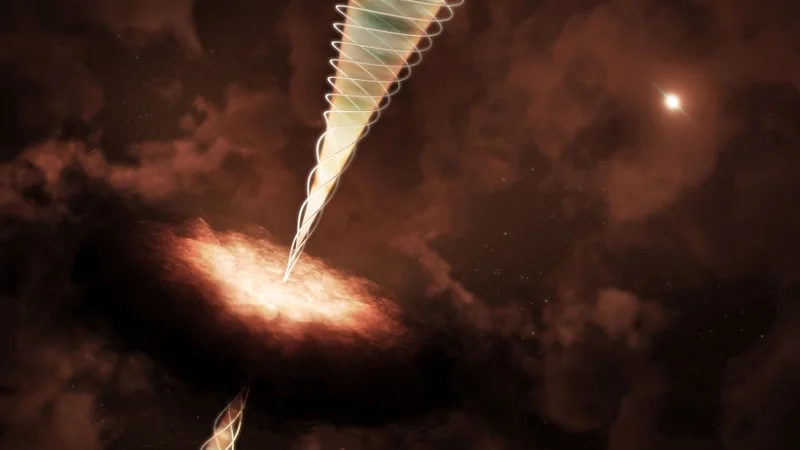
When a new star forms, a rotating disk of material forms around it called an accretion disk. The young star continues growing by attracting material from this disk. But as stars acccrete more material, they also funnel some away in powerful jets and outflows.
These jets are an important part of a star's growth. When material falls from the disk into the star, it carries a lot of angular momentum. Without a way to shed some of that energy, the material would simply rotate in the disk forever and the protostar wouldn't grow. The jets that launch from a young star's poles carry away excess energy, letting material accrete onto the star and allowing it to grow. The jets are also accompanied by wider, slower outflows.
For decades, astrophysicists have wondered how young stars create these jets. While they knew that a star's magnetic fields are responsible, they didn't know exactly how it all works.
Researchers used the Atacama Large Millimeter/submillimeter Array (ALMA) to examine a young double star system and captured a new look at the magnetic fields that shapes and launches its jets. The research is titled "Unveiling dominant toroidal magnetic fields in a protostellar outflow," and it's published in Nature Communications. The lead author is Tao-Chung Ching from the National Radio Astronomy Observatory and the Institute of Astronomy and Department of Physics at National Tsing Hua University in Taiwan.
"Magnetic fields play a fundamental role in the formation of protostellar winds," the authors write. "In the magneto-centrifugal models, poloidal magnetic fields launch winds from accretion disks, and fast-rotating gas twists the fields into toroidal geometry that collimates and accelerates winds through magnetic hoop stress."
"However, toroidal fields in protostellar winds remain observationally unresolved," the researchers write.
This is a widely-held understanding of how these magnetic fields and winds interact. But even if every astrophysicist in the world agreed with that prediction, only detection can confirm it. Now we have those detections.
âFor the first time, these ALMA observations have captured this invisible funnel of magnetic fields,â lead author Ching said in a press release. âThis is exciting because it proves a decades-old theory about how stars, like our own Sun, are born and fire off powerful cosmic jets.â
The star the researchers examined is NGC 1333 IRAS 4A. It's a young binary protostar about 960 light years away in the Perseus molecular cloud. The team used ALMA to observe NGC 1333 IRAS 4A.
"Here we report polarization observations of carbon monoxide emission toward the NGC1333 IRAS 4A protostellar outflow," write Ching and his co-authors.
ALMA can observe the very weak polarization of CO gas that radiates from the protostar's outflows. Ching and his colleagues used this polarization to trace the magnetic fields' strength and morphology as they envelope the outflows. The fields coil around the outflows, perpendicular to the the direction of gas flow, but matching the gas flow's rotation. This is a toroidal field, and it's exactly what researchers predicted.
The fields aren't very strong compared to a household magnet, only a few thousandths of a gauss. But in astronomical terms they're immensely powerful. Their strength is "... sufficient to collimate and accelerate the outflow at several hundred astronomical units from the protostar," according to the authors.
This figure from the research illustrates some of the findings. One of the protostar's jets is moving away from us and is redshifted, while the other is moving toward us and is blueshifted. The black lines show the polarization orientations of the CO redshifted emissions, while the white lines show the magnetic field orientations inferred from the polarization of the dust. The black and white combine to create the toroidal fields that drive the jets. Image Credit: Ching et al. 2026. NatComm.
When it comes to protostar jets, the ones coming from NGC1333 IRAS 4A are rather modest, extending for several hundred au. Astronomers have found many others that extend for several light years. The longest one that we know of in the Milky Way reaches a staggering 32.6 light years. But none of those have been studied in such detail.
"This study represents the first and most high-resolution observation of milligauss-strength toroidal magnetic fields at a scale of several hundred astronomical units from a protostar," said Ching.
NGC1333 IRAS 4A is the subject of lots of published research. Scientists have studied its infalling gas, its outflows, its rotation, and its turbulence. They've also found complex molecules in the star, including complex organic molecules in its outflows. In fact, researchers detected the polarized CO emissions from its outflows back in 1999 with the BIMA radio telescope array.
But this new research brings the binary protostar, its outflows, and its magnetic field lines into sharper focus.
"Overall, the perpendicular alignment between the magnetic fields and outflow axis, the parallel alignment between the magnetic field structure and the rotational structure of the outflow, and the wind-driven parabolic features are consistent with the theoretical picture of toroidal magnetic fields in an outflow driven by the protostellar wind," the authors write.
The results could extend to much larger astronomical objects, too. The same situation likely governs how the magnetic fields around supermassive black holes funnel material away and sheds energy.