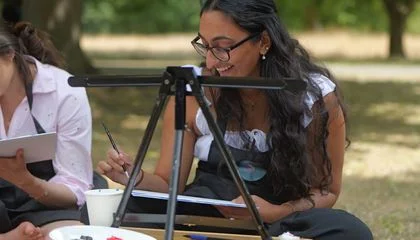
In London’s Hyde Park, young painters sit behind rows of wooden easels. Kicking off their sneakers on the picnic rugs and pulling down their baseball caps to keep the sun out of their eyes, they studiously start making their marks on the canvas. There is a carefree atmosphere as some sip prosecco from a pop-up bar cart.
Patrice-Rose McLean, founder of Ambient Art London, has seen an uptick in young adults joining the group’s mobile art events, where they can choose to recreate a suggested image or capture their own moment in time. “I think people are increasingly craving experiences that feel simpler, more meaningful and more connected to nature,” she says.
In the era of artificial intelligence, when a finished artwork can appear on your screen at the press of a button, Generation Z and millennials are seeking a more nostalgic pursuit. They are enjoying the 19th-century pastime of painting en plein air, setting up their art easels in the great outdoors to capture a moment in time with paint rather than pixels.
Last year, Gothamist reported that art schools in New York were seeing a surge in applications. Pratt Institute had a waitlist for its painting and drawing classes, and the Parsons School of Design saw applications increase 64 percent since 2016. Painting groups are popping up in parks, and people are choosing to take fine art classes in Italian art schools, instead of doomscrolling on the sofa.
A meditative medium
TikTok is filled with scenes of people embracing the technique. Burgeoning artists will post timelapses of their plein air paintings, while others share tips on how to craft your own easel from plywood, and more are showing that you don’t need a canvas when you have old mint tins or upcycled fabric.
Remington Robinson, 40, from Chagrin Falls, Ohio, has lit up TikTok with plein air paintings, including a street scene in Paris and even a Nissan truck in Mexico. The mural painter-turned-TikTok plein air artist uses upcycled Altoid tins as mini palettes. His online tutorials, which he first posted in 2021, now receive as many as 13 million likes apiece.
Robinson says plein air is like a mini meditation. “Every single plein air painting I make is a direct byproduct of a one- to two-hour waking-state meditation process in which I am practicing direct observation of my subject in real life and recording the careful study of the subject matter in paint,” he says.
The plein air artist says that being in nature helps him stay present. “The human eye also not only picks up color nuance better than a camera, but being there in person means you are picking up the subtle vibration frequencies, feelings and emotions that come from being immersed in the environment,” he adds.
Thanks to wild-card elements such as dealing with changing light conditions, bugs or people parking their car in front of him when he’s busy painting a scene, Robinson says the technique of plein air also teaches him patience.
Robinson, who wrote a how-to book on miniature painting on the go, thinks others should try painting al fresco. “It’s never a bad idea to go out and have real human experiences. Plein air painting is just one of many ways to do that,” he says.
History repeats itself
It’s not the first time that people have turned to a more traditional art practice when faced with uncertainty. During the 19th century, when industrialization was at its height, the Arts and Crafts movement formed as a protest against soulless mass-produced goods.
Clare Willsdon, an art historian at the University of Glasgow, says she can see a correlation between then and now. “The world that you can make on your screen via A.I. is so tightly organized, and at the same time you can’t quite see where it’s going to go in the future,” she says. Setting up an easel in the great outdoors, she adds, helps you embrace the seasons and “rhythms of nature.”
Quick fact: Origins of plein air
- The French term plein airmeans "open air" or "outdoors." The approach to painting, which refers to painting an entire piece outside, dates back to the 19th century. British painter John Constable was the first to create portable setups to paint natural landscapes from the landscapes themselves, as opposed to in a studio. The technique was instrumental to Impressionism.
Kim Tay, co-founder of the Artling gallery in Singapore, who has spoken about how art matters more during the times of automation, also sees the similarities. “The change that society is going through at the moment is similar to what was faced during the Industrial Revolution,” says Tay. “We are experiencing anxiety over the introduction of a new technology that the general public has no control over and cannot predict how it will shape their futures. It is only natural for people to gravitate toward activities that emphasize the human experience, and the unique qualities of creating something with your own hand.”
TikTokers and YouTubers have tried the art form to help regain some control in this ever-changing world. Gabi Sprout, 30, who is known as @myladysprout to her 12,000 Instagram followers, embraced the slow life and tried her hand at plein air art while on vacation in Miami. On her YouTube channel she said that with how uncertain the future is and “an A.I. takeover without any support structure to keep people living and thriving, I think we all just want to hold on to the past as long as we possibly can.”
The return to more traditional art forms during the rise of A.I. has also included figure drawing, which was popularized during the 15th century. People take pleasure in demonstrating the workings behind each piece and showing how a body moves rather than presenting a polished A.I. image.
Nucleus, an art gallery in Alhambra, California, hosts the Drawing Club. Each week up to 50 artists—both beginners and professionals—squeeze into the gallery for a figure drawing session. The models run the gamut, from former “RuPaul’s Drag Race” contestants to cosplayers.
Brenda Chi, 34, who took over the workshop in 2022, says she’s not surprised that more people are turning to traditional art practices. “A.I. cannot copy the creative decision making that an individual artist practices, so even if someone wants to use A.I. to create art, they are not going to have the same experience as if they drew from life,” she says.
Chi says as human beings we are designed to discover and be problem solvers: “Drawing from life brings experience that A.I. cannot replicate for you.”
Putting charcoal to paper also brings a sense of gratification, according to the illustrator. “I think in any creative practice, creating with tangible items is inherently more satisfactory than something on the screen,” she says. “We’re human and we’re always going to go back to creating with our hands.”
It’s not always people who are the subjects for this new generation of figure drawing artists. Dog Life Drawing classes are now held around the United Kingdom, and in July, the same team invited people to a farm in South Yorkshire where they could join a life drawing class featuring alpacas.
Scratching an itch
Art colleges may be seeing an increase in applications, and they are also welcoming new arrivals. People are feeling a need to learn skills once used by the old masters. YouTuber Cat Young, 28, from Seoul, left her accounting job to go to art school. Caitlin Cheadle, 40, from Vancouver, British Columbia, flew to Florence, Italy, to study art as part of a seven-month course. She runs her own communications company but had wanted to be an artist since she was a child. “This nagging desire to paint would not go away, so I finally pulled the trigger and sent my application to an art school in Florence,” she says.
Cheadle worked up to 11 hours in the studio each day mastering the Fibonacci sequence, which in art is used for balance and composition, and standing on the riverside in Florence, painting in the beating heat. “I would return home drenched in sweat, my legs aching,” she says. “You just have to be patient, trust the process and always remain open to learning more.”
Millennial Claire Yang from Singapore signed up for an alternative master’s degree in food and art from the Gramounce in Europe. She says, “Creating a body of work through the course is a way for me to keep my right brain from atrophy and my soul from withering.”
Psychologist Ritz Birah says, “[People] are consuming enormous amounts of content, but having fewer experiences in which they feel fully involved. Making art by hand reverses that. It moves someone from spectator to participant.”
Showing the work also adds a sense of agency. “You can point to the page and say, ‘I made decisions here. I adapted. I stayed,’” she says. “In an age when technology can give us a result without an experience, traditional art gives us the experience back.”
The budding artists who are putting paint to canvas in Hyde Park are experiencing what many people feel they are missing in the A.I. era. “The creative process gives people permission to be present in the moment,” says McLean, of Ambient Art London. “I think that’s especially valuable in busy cities, where people are often craving slower, more meaningful experiences that leave them feeling refreshed and connected.”