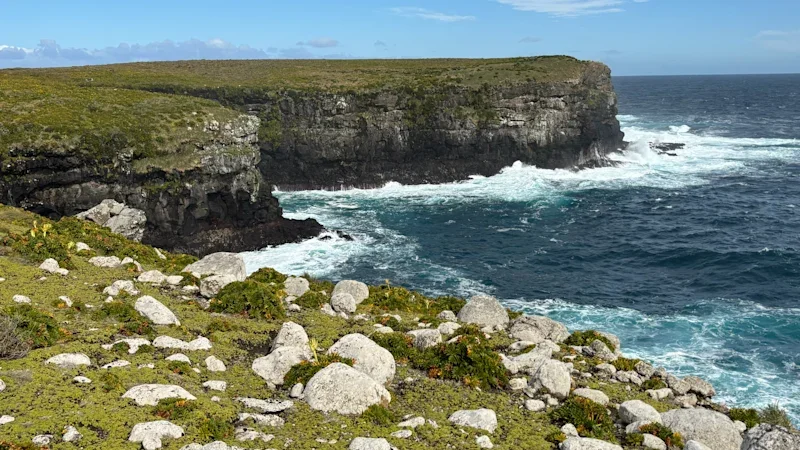
It’s near the end of my journey, standing on a boardwalk on remote Campbell Island, more than 600 kilometres south of New Zealand, when I experience a moment of clarity.
For the first time during the trip, I’m alone. Other passengers have headed back to our ship or are still up on the hill behind me, watching albatrosses.
There’s no one else in sight and no sound save for the strong wind. I look out on the landscape – treeless, but green, covered in thick shrubs and long grass, with rocky hills rising in the distance – and realise that I’ll probably never see this place again in my lifetime. And if I do, it’s likely it will never be the same.
Heritage Expeditions is one of the few companies that operate cruises to the sub-Antarctic islands of Australia and New Zealand, and I’ve boarded its expedition ship, the Heritage Adventurer, for its 12-day “Galapagos of the Southern Ocean” journey.
It’s an appropriate title, as the islands we visit are home to abundant endemic wildlife, much like Ecuador’s famous islands.
I arrive, along with the other passengers, in Queenstown on New Zealand’s South Island, where we spend the night before transferring to Bluff at the southern tip of the island to board our ship.
Get exclusive travel deals delivered straight to your inbox. Sign up now.
The Snares
Although we’re all on board in the afternoon, due to strong winds and swell the ship doesn’t depart until 1am. We awake to rough seas – something to be expected in this part of the world. Seasickness hits several passengers, including me. Fortunately I have strong and effective medication with me that relieves my nausea, if leaving me a little drowsy.
Despite our late departure, we arrive at our first destination, by lunchtime. Dramatic granite landscapes jut from the ocean in jagged cliff faces, some forming proper islands, others mere rocky outcrops like wizened fingers pointing skyward. These are the Snares, a collection of islands named for their hazardous nature, whose ruggedness means they remain virtually untouched by humans.
Although the waters are still choppy, our captain finds a calmer spot to board Zodiacs and cruise the coastline. We won’t make landings here, given the geography, but the steep terrain doesn’t deter the local Snares penguins, sporting stylish bright eyebrows, who have little trouble jumping up the rocks to higher ground when they return from the ocean.
Despite the swells and splashes – I quickly learn the difference between “waterproof” and “water-resistant” clothing (and regret wearing the latter) – we’re able to get within a few metres of penguin colonies, along with New Zealand sea lions and fur seals lazing on the rocks.
The Auckland Islands
By the next morning we’re already at our second stop, the Auckland Islands, formed by the remains of an ancient volcano. Despite the remoteness of the islands, of the nine days at sea, there are only three where we don’t get off the ship (particularly beneficial for those who are still struggling with seasickness).
We anchor at Port Ross and from here we visit Erebus Cove (named after the famous HMS Erebus, which disappeared in the mid-1800s searching for the Arctic’s Northwest Passage) on Auckland Island itself, the site of an ill-fated settlement.
It’s perhaps understandable that the Auckland Islands might have seemed appealing to early explorers, particularly if they chanced upon fine weather. The landscape is vastly different from the Snares – rolling hills covered in green forest and tussock. No doubt it reminded the English sailors of home.
The thick rata trees, which look like mere scrub from a distance, are tall and decidedly creepy, like something from Tolkien, with twisted boughs forming a dense canopy.
Despite the appealing greenery, I wonder, “What were they thinking?” The islands are so remote, so bleak and cold that it seems crazy anyone thought creating a settlement here was a good idea. But Charles Enderby, scion of a whaling and sealing magnate, established a township here in 1849. Named Hardwicke, Enderby envisioned the settlement as its own country, even creating its own currency. But the soil was too acidic for crops, the rata trees too hard and twisted to make viable timber, and the whalers too unruly. In the end, it lasted just three years.
Remnants remain, including old stoves, a cemetery, and carved messages for shipwrecked sailors (the islands were originally charted incorrectly, making shipwrecks common).
Enderby Island
The next day we land at Enderby Island, still within the Aucklands archipelago, and small enough to walk a full circuit of in a day. As we approach the shoreline in the Zodiacs, cranky bull sea lions mock charge us. A crew member plants a hiking pole firmly in the sand in front of them and this seems to be an adequate deterrent.
I’ve signed up for the full circuit. We’re soon off-piste, trekking across rough ground marked only by a series of poles. Despite bringing heavy winter gear, the sun is shining, making it surprisingly warm. I strip down to a thin jumper while others hike in T-shirts.
The passage quickly becomes slow going as we push through scrub, waist-high tussocks, and the spongy peat bogs. By the time we return seven hours later, my legs ache.
Nevertheless, it’s worth it to see the wild cliffs and the unique flora. We also spot the endemic yellow-eyed penguin, a shy bird we give a wide berth. In fact, our trek is extended by two kilometres near the end to avoid a cluster of penguins cautiously waiting to enter the water.
At sea
We spend the next day at sea, navigating the 600-kilometre or so distances between the islands. It’s an opportunity to get to know the other passengers.
For some, the sub-Antarctic islands are a long-awaited bucket-list item. Others didn’t even know the islands existed before booking the trip, while some avid bird-watchers are making the trip for the second or third time. Passengers range from an 18-year-old Bostonian on her gap year to a man celebrating his 90th birthday on board.
For me, it’s a region I’d been interested in since my brother-in-law worked on Macquarie Island for the Australian Bureau of Meteorology 15 years ago. The wildlife photos he returned with were incredible.
What everyone shares is an adventurous spirit. With a maximum of 120 passengers and 12 Zodiacs aboard, everyone can go ashore simultaneously. The team expertly assists those who struggle with mobility, ensuring even the 90-year-old passenger participates in almost every landing.
Our days at sea are also an opportunity to learn from our guides, who provide presentations in the ship’s lounge. Many of them have specialist knowledge of particular aspects of the region – wildlife, geology, history – which provides us with context to go with the spectacle.
Macquarie Island
The centrepiece of our voyage, as we leave New Zealand’s waters and enter Australian territory, is Macquarie Island. About 1500 kilometres south-east of Hobart, it’s officially part of Tasmania, staffed only by a handful of residents from the Bureau of Meteorology, the Tasmania Parks and Wildlife Service, and the Australian Antarctic Division.
The main residents, however, are 1.5 million penguins. They are kings (the second-largest species after emperors) and royals, the latter with wonderfully impressive yellow eyebrows sweeping back across their heads. There are also about 80,000 elephant seals. It’s just after calving season, and the beaches are littered with pups, already bigger than a human and on their way to reaching lengths of up to five metres.
Such is the remarkable nature of this island – at Lusitania Bay, the beach is so packed with thousands of penguins there’s no room for us to land—that we spend two days here. The weather is unusually fine, with little wind and bright sunshine, though it’s only 4 degrees.
The highlight is wandering Sandy Bay on foot, home to colonies of kings and royals including rookeries where we get to see fluffy chicks, already as large as adults but yet to develop their watertight feathers.
Campbell Island
Our final stop on the cruise is Campbell Island, the most remote of New Zealand’s islands. In the late 1800s, the government opened the island to a pastoral lease. Home to sheep farming until the 1930s, livestock and introduced pests (including cats and rats) devastated the native flora and fauna. These pests weren’t fully eradicated until the early 2000s in the largest eradication program in New Zealand’s history. Since then, the beautiful plant life and bird population have recovered.
With its steep, rocky hills and low-lying vegetation, Campbell Island looks like it could be part of the Scottish Highlands. Today we have weather to match. The wind howls and rain comes in at a sharp angle as I follow a boardwalk up into the island’s hills. This is a favourite nesting spot for the royal albatross. With bright white feathers, they’re easy to spot, though some have obligingly set up nests just metres from the boardwalk, allowing us to appreciate the enormous size of the birds (it is the second-largest albatross behind the wandering – the world’s largest flying bird).
Impressive as they are, I’m tired and cold after my hike up the hill, so I decide to head down. It’s here the rain stops, the wind drops, and I have my moment of solitude.
Across the trip, I’ve seen what humans have done to damage these incredible islands over the past two centuries, and what they’ve done recently to restore them. We follow strict biosecurity protocols after each landing, meticulously cleaning our boots and clothing to ensure nothing transfers between islands.
But the next threat doesn’t come from humans. Bird flu is spreading across Australia, posing a serious threat to birds and marine mammals, having already hit Antarctica. The remoteness of these islands may buy time, but the flu’s arrival seems inevitable – it has already reached Tasmania. The flu seemingly reached Australia via sea birds from the equally remote Heard and McDonald Islands, where estimates put elephant seal pup deaths this year at more than 75 per cent.
It’s depressing to think that after all the work to eradicate pests and protect these animals, they could soon face another terrible period of disease and death.
I reflect on this as we leave Campbell Island at sunset. We pass a cliff that’s covered in nesting seabirds. A large number of them take flight and follow the ship, darting around the stern. I bid farewell to the islands as they fade in the distance and go to bed, only to find the next morning the birds are still there, not willing to say goodbye to us just yet.
THE DETAILS
CRUISEHeritage Expeditions “Galapagos of the Southern Ocean” 12-day cruise through the sub-Antarctic islands has departures from New Zealand this year on November 22 and December 17, starting from $15,655 per person including all meals, expeditions, overnight accommodation in Queenstown and transfers to departure point Bluff. Various other Heritage Expeditions cruises also visit sub-Antarctic islands. See heritage-expeditions.com
MOREparks.tas.gov.au
The writer travelled as a guest of Heritage Expeditions.