Have you noticed that, as practised by our two main parties, politics has always been about the good news, never anything nasty?
Talk to the Liberals and they’ll promise to cut taxes. Talk to Labor and they promise more spending on this or that desirable cause.
The Libs never say how they’ll pay for the tax cut; Labor never says how it will cover the cost of higher government spending.
It’s the job of people like me to point out the not-so-nice things the pollies don’t want to mention in their sales pitch, but I’m embarrassed to admit I’ve been absent without leave on the simplest of points.
There was a time not so long ago when politicians and their audience were obsessed by worries about debt and deficit. We probably overdid it, but that was sooo yesterday. These days no one mentions the budget deficit.
If Treasury is worried it’s kept its concerns to itself. But on Monday a former Treasury secretary, Dr Martin Parkinson, expressed his worries to the Australian Financial Review. (Sometimes I wonder if part of the role of retired senior public servants is to say what those who haven’t retired aren’t allowed to say in public.)
“I’m quite concerned about the approach to fiscal sustainably by all sides of politics,” Parkinson said. “It’s almost like debt is not an issue for anybody any more because the concern dissipated during the COVID crisis and nobody’s ever refocused on it.
“The government is under no pressure to accelerate a return to fiscal sustainability in part because the Opposition is threatening to do things that are even more damaging to the economy.
“And what is, supposedly, our now new third party of government is on a pathway that is utterly irresponsible on both migration and spending.”
He said that where we are in the economic cycle meant we should be running big budget surpluses, and yet we’ve got a deficit.
The budget papers project a cumulative deficit of $264 billion over the five years to 2029-30, with no sign of surplus on the horizon. The deficit seems to slowly get a bit smaller, but this comes from an optimistic assumption that certain spending programs will be allowed to end rather than be renewed.
Now, Australia’s net government debt at present isn’t all that high relative to other countries, particularly the US debt. But it would be nice to keep it that way.
Nor am I implying that debt is a bad thing. Wisely used, it’s a good thing. So no one’s saying we should have a balanced budget.
Just as it makes sense to borrow to buy a house rather than rent while you save enough to buy one for cash, so it makes sense to borrow much of the cost of building roads and bridges and other infrastructure that will deliver a service for 30 or more years into the future.
As well, it’s OK to borrow heavily at times when the economy is weak and governments need to spend heavily to keep things going and limit the rise in unemployment.
This was the case in the unusual event of the COVID pandemic in 2020 which, as Parkinson implies, has proved to be a turning point in our thinking in many respects. When governments around the world were trying to halt the spread of the disease by requiring people to stay in their homes, they had to spend huge sums to hold the economy together until the crisis had passed.
But, as Parkinson also implies, the big spending during weak economies comes with a proviso: once the crisis has passed, you need to save to pay off the debt. That is, the government should turn the deficit into a surplus by spending less than it’s collecting in taxes.
Leaving aside its spending on infrastructure and other long-lasting assets, governments should stop their debt getting too high by offsetting deficits in bad times with surpluses in good times.
The times have been reasonably good since 2020, but we’ve gone on running annual budget deficits, with more to come for the foreseeable future.
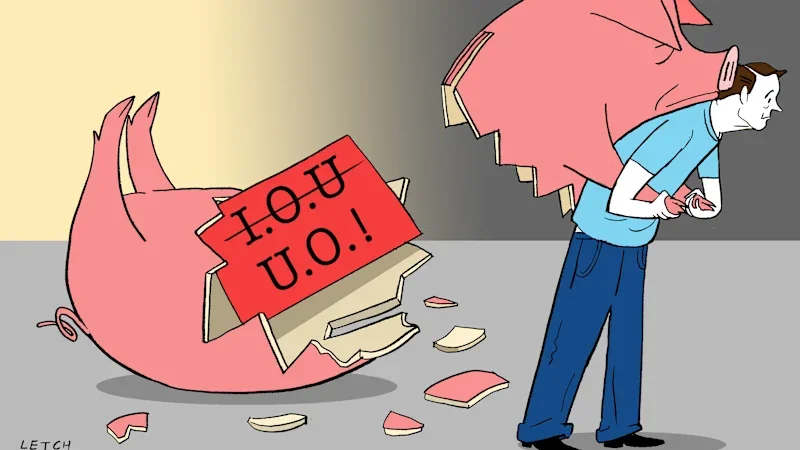
When, over time, we run deficits that aren’t matched by the infrastructure we leave behind, we’re spending money on our own comforts, then leaving part of the costs to be picked up by our children and grandkids. How is that a decent thing to do to your offspring?
What’s more, leaving debts for our kids to pay isn’t itself cost-free. Governments borrow to cover their budget deficits, and the lenders are paid interest. This means the debts we leave for our children to pay are a lot higher than the debts we left unpaid on the table.
Parkinson agrees with his predecessor, Dr Ken Henry, that our system of taxes and benefits is biased against the younger generation. Passing our debt and deficits on to our kids adds to the injustice.
Parkinson, who chaired the feds’ most recent inquiry into immigration, raises the question of what effect big cuts in annual net overseas migration would have on our government debt burden.
You could argue that a bigger population means more people to share the burden of the government’s debt. But it’s more complicated than that.
Some people, particularly those on low wages or with disabilities, may pay less in taxes over their lifetimes than they receive in government assistance. In which case, they add to the debt burden on the rest of us rather than reducing it.
It’s a different matter, however, when we bring in workers with skills that are in short supply.
But don’t forget this: what all these budget deficits mean is that we’re not being asked to pay as much tax as the cost of the services we’re getting requires. Nar, leave our bill for the kids.
Ross Gittins is economics editor.
Ross Gittins unpacks the economy in an exclusive subscriber-only newsletter. Sign up to receive it every Tuesday evening.