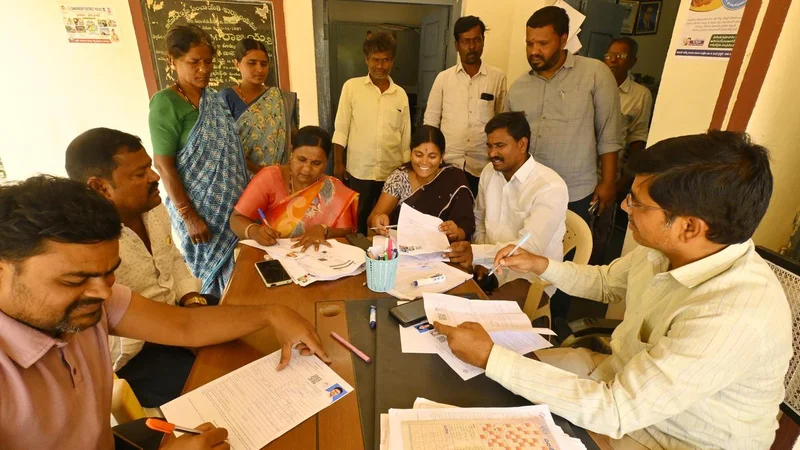
The ruling Congress party has sounded the alarm over Telangana’s ongoing Special Intensive Revision (SIR) of electoral rolls fearing a structural voter purge similar to, what it describes as, the “West Bengal and Assam model” where large-scale deletions allegedly altered electoral outcomes.
The concern was raised by Chief Minister A. Revanth Reddy during a recent Zoom meeting with senior party leaders, where the Chief Minister expressed strong displeasure over the manner in which the Congress had handled the ongoing SIR exercise. Mr. Reddy alerted his Cabinet colleagues and party cadre that a potential reduction of 21% in voter numbers could have serious consequences.
The Chief Minister criticised the party organisation for their “lackadaisical approach” during the field verification process. While Opposition parties were closely monitoring voter data and enrolment patterns, the Congress failed to deploy adequate Booth Level Agents to safeguard its voter base, he felt. This, he argued, allowed lapses in the electoral revision process to go unchecked.
According to the Telangana Chief Electoral Officer’s (CEO) office, of the total electorate of 3,38,26,448, a total of 2,64,86,214 enumeration forms have been digitised, representing a completion rate of 78.3%. The remaining 21.7% have been classified as “uncollectable”. In addition, nearly 20 lakh entries have reportedly been identified as technically inconsistent or unmapped. Together, these categories account for nearly 94 lakh electors who may face scrutiny during the revision process. The “uncollectable” category includes 9,22,230 deceased voters, 11,25,546 marked absent or untraceable, 45,18,961 listed as permanently shifted, 6,70,203 shown as enrolled elsewhere, and 1,02,294 classified under other categories.
Why Congress is worried
The Congress leadership’s anxiety stems largely from the possibility that a disproportionate number of deletions could affect the voting rights of the poorer sections of society. The party’s electoral support base includes minorities, low-income households, and socio-economically weaker groups. From the Chief Minister’s perspective, the high number of ‘uncollectable’ forms is not merely an administrative issue but a matter with wider demographic implications. Drawing parallels with voter-list controversies witnessed in other States, Mr. Reddy asserted that, “losing a vote does not merely disenfranchise a citizen; it can also affect access to welfare-linked identity systems and government benefits,” he asserted.
Several factors are being cited for the unusually large number of affected voters. One explanation was that overburdened Booth Level Officers allegedly skipped mandatory door-to-door verification in several areas and instead, operated from centralised collection points. As a result, persons who could not visit these centres were marked as unavailable.
A preliminary assessment within the ruling party suggests that the issue is concentrated in districts surrounding Hyderabad. The erstwhile districts of Hyderabad such as Ranga Reddy, Medak, Mahabubnagar and Nalgonda have witnessed substantial migration to the capital region over the years. This has led to a “dual voter” imbalance, according to party leaders. People from those districts chose to retain their votes in the native places. Across the 28 Assembly segments falling under the Hyderabad, Secunderabad, Chevella and Malkajgiri Lok Sabha constituencies, local enrolment rates are reported to be relatively low. A significant number of residents are believed to have retained voter registrations in their native districts rather than transferring them to Hyderabad. Similarly, migrant workers from Bihar, Chhattisgarh, and other States are also choosing to vote in their home States rather than registering locally.
Any elector whose form is missing, uncollected or found to contain discrepancies may face further scrutiny during the claims and objections process. The Congress party now hopes to identify such voters and assist them during the revision process. For the Congress, the upcoming claims and objections phase is no longer a routine electoral exercise. It has evolved into a high-stakes effort to protect what the party sees as its core voter base before the final rolls are published. To what extent the damage-control operation will succeed remains to be seen.
Published - August 19, 2026 12:32 am IST