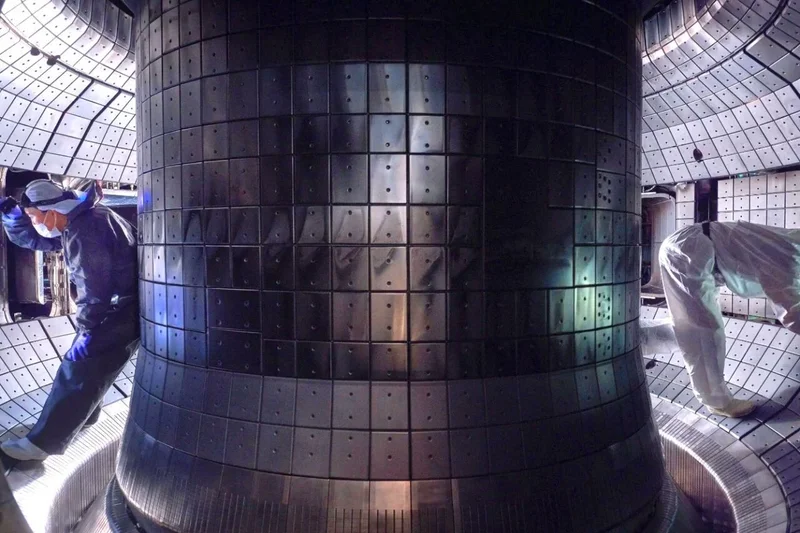
Nuclear fusion harnesses the immense energy released by the union of two lightweight particles. This requires extremely high temperatures and pressuresâliterally, this is how stars power themselvesâand, needless to say, thereâs not much that can come out unscathed from being exposed to fusion.
That unfortunately appears to include tungsten, a rare metal touted by researchers as a promising ingredient for fusion reactors. In a recent study published in Physical Review Letters, physicists ran large-scale simulations that revealed tungsten was far more vulnerable to deterioration inside fusion reactors than was previously believed. What made researchers excited about tungsten was its exceptional durability against extreme heat, but the new work suggests all that may be for naught considering the immense radiation produced in fusion reactors.
“Our recent paper focuses on the primary radiation damage, that is, the damage created by a single atomic recoil,” Jesper Byggmästar, the studyâs first author and a physicist at the University of Helsinki in Finland, told Phys.org. âUnderstanding this is an active field of research.â
Molecular meltdown
By principle, radiation damage occurs when powerful reactions produce extremely energetic particles that slam against another surface. In this case, fusion reactions release high-energy neutrons that smash into atoms comprising, say, a tungsten component of a reactor. That sheer force can knock an atom out of its original place, which then may trigger a chain reaction that messes with the overall formation of the component. This is referred to as primary radiation damage.
The study investigated how such processes could impact tungsten, which the paper noted is the âleading choice for the plasma-facing wall material of tokamak fusion reactors.â In other words, tungsten would be directly exposed to the fusion reaction inside the reactor and the resulting radiation in typical setups. However, as the team explained in the paper, the deterioration of metals exposed to radiation isnât always straightforward, as these âcollision cascadesâ can also recombine.
A billion atoms at once
As such, the team sought to reproduce the complex chaos of irradiation in its simulations. The simulations were based on well-understood information of molecular dynamics under stress and subjected tungsten to different levels of energy it could experience in fusion reactors, both before, during, and after a reaction. The researchers ended up simulating one billion atoms at a time, checking their work against models to ensure they were accurately reproducing real-life molecular dynamics.
âDuring reactor operation and in irradiation experiments, the material is subjected to much more irradiation over longer time and length scales,” Byggmästar said. Indeed, the simulations showed that such extended exposure to radiation resulted in tungsten deteriorating at greater rates than expected.
The latest results donât necessarily rule out tungsten from being a part of fusion reactors, though. For one, ITER, an international fusion research collaboration, is already planning to use tungsten as its plasma-facing material, so the lessons would more apply to how researchers could best design more robust and durable components in general, Byggmästar added.