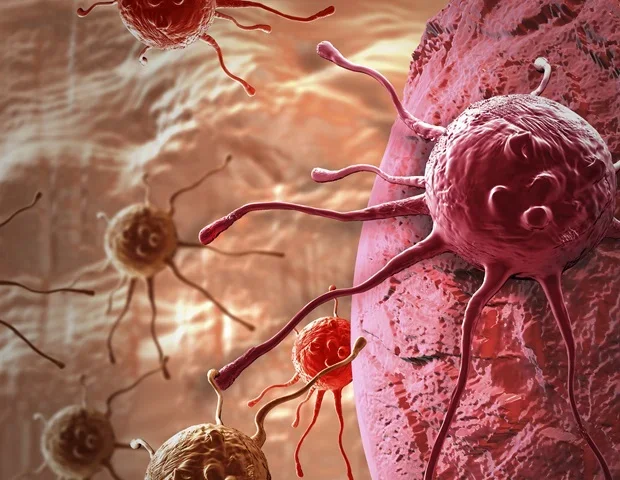
Off-the-shelf and mass-producible immune cells fight solid human tumors engrafted into mice. The Kobe University development is a significant contribution towards faster and cheaper cancer immunotherapy.
The body employs an army of immune cells for the fight against cancers, and one of the major forces are the T cells. They are also the target of modern cancer immunotherapies that try to increase the T cells' ability to find and attack cancer cells. When modifying T cells, current techniques require the extraction of a patient's own T cells from blood, modifying them in the lab and reintroducing them into the patient, which is not only very expensive but also costs valuable time.
Researchers have considered turning to a subclass of T cells, called "gamma-delta (γδ) T cells," that don't need to be tailored toward each individual patient but can be harvested from a donor and used in other people. However, these cells are much fewer, making the harvesting approach infeasible, and they also cannot be directly multiplied well in the lab.
Kobe University stem cell researcher AOI Takashi says, "Based on our experience with induced pluripotent stem cells, also called iPS cells, we thought that we could approach this issue by creating such easily storable and growable cells from these specific T cells, and then only turning them back into T cells when actually needed." Since during development T cells modify their DNA to target a specific threat, creating iPS cells from cancer-specific T cells also means that all their descendants will keep that specificity. Essentially, the process equates creating an army of clones from one good cancer fighter.
In their newest paper in the journal Stem Cell Reports, Aoi and his team show that they could create iPS cells from the subclass of T cells that can be used across patients and reproducibly turn them back into those T cells with an overall 80,000-fold multiplication. Importantly, they achieved this without relying on animal cells or extracts, which is a requirement for clinical applications. Their study was also the first to show, on a small preclinical scale, that the resulting T cells attack and shrink human patient-derived colorectal cancer tumors that were implanted into mice.
Cancers from cell culture lines don't have the same drug insensitivities as actual cancers and also don't emulate the physical barriers that actual tumors have. That's why patient-derived organoids are highly significant for evaluating new cancer treatment approaches."
Ryoko Futai, study's first author
When they designed the study, the Kobe University team imagined that their approach would be used fighting metastasizing cancers. Therefore, they also checked whether their T cells would find their targets not only when administered close to the tumor but even when administered intravenously a week after the tumor was implanted. And indeed, even in this setting tumor weights decreased between 43 and 92 percent in the three mice they tested this in. Futai says: "This suggests potential for future systemic therapy. We believe this achievement represents an important step toward the development of a new immunotherapy for solid tumors."
At the current stage, the study was conducted at a small scale, with only three or four mice in each experiment and tumors models derived from only two different patients. This is especially important because colorectal cancer tumors are known for their high variability.
"This study is a preclinical investigation demonstrating the potential using iPS cell-derived T cells and is not yet at a stage where it can be used on patients," cautions Futai.
But by conducting further studies using these easily multipliable and very standardized cells, the Kobe University development may also be used to elucidate where the variability comes from and what steps to take to counter it. Aoi closes, saying, "Furthermore, by combining this approach with cell modification techniques such as CAR therapy, we hope that this research will eventually lead to the development of new therapeutic possibilities for patients with solid tumors."
Source:
Journal reference:
Futai, R., et al. (2026) Allogeneic iPSC-derived γδT cells demonstrate antitumor efficacy against patient-derived tissues. Stem Cell Reports. DOI: 10.1016/j.stemcr.2026.103018. https://www.cell.com/stem-cell-reports/fulltext/S2213-6711(26)00229-8