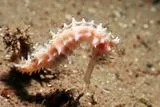
At Tuticorin harbor in southern India, marine biologist Amanda Vincent once examined fish hauled ashore by trawlers, fishing boats that drag large nets through the water or along the seafloor. Among the bycatch, or animals caught unintentionally, was a seahorse she did not realize belonged to a species science had never formally recognized.
Now, the overlooked seahorse has been named Hippocampus amandavincentae in her honor.
“This honor makes my heart glow,” Vincent, director and co-founder of UBC’s Project Seahorse, said in a press release. “It’s amazing that such a wonderful creature was hiding in plain sight.
According to a study published in Zootaxa, the animal had been misidentified as the thorny seahorse, Hippocampus histrix. Recognizing it as a separate species gives researchers a clearer picture of seahorse diversity across the Indian Ocean and where conservation efforts may be needed.
Read More: Pygmy Seahorses Lost Their Long Snout, And It’s Kept Them Alive For 18 Million Years
What Sets the New Seahorse Species Apart
At about 6.3 inches (16 centimeters) long, H. amandavincentae carries a coronet of five spines above its head. Its snout is shorter than that of H. histrix, while prominent spines line each major ridge of its trunk and tail.
The specimens used to describe the species came from southeastern India. Their mitochondrial COI gene, commonly used as a DNA barcode, placed them in a distinct lineage. That lineage matched previously published sequences from Madagascar, Mozambique, the Seychelles and the northern Red Sea, indicating that the species may inhabit much of the Indian Ocean.
One sequence from the northern Red Sea also places H. amandavincentae in the same area as Hippocampus jayakari, or Jayakar’s seahorse. The researchers said more fieldwork is needed to determine where the ranges of the two species meet or overlap.
One Seahorse Becomes Three
The taxonomic mix-up reaches back to 1856, when H. histrix was first described. Researchers later applied that name to spiny seahorses found from the Red Sea and western Indian Ocean to the western Pacific.
The new analysis limits H. histrix to Pacific waters, including those around Japan, Indonesia and the Philippines. It also confirms H. jayakari, first described from the Gulf of Oman in 1900, as a separate species of the northwestern Indian Ocean.
Together, the anatomical and genetic evidence redrew the map of where each species is believed to live. Many museum specimens and online biodiversity records identified as H. histrix may now need to be reexamined.
Updating those records could improve population assessments, trade monitoring, and decisions about which habitats require protection.
A Name Rooted in Seahorse Conservation
The species honors Vincent’s decades of research and advocacy for seahorses. She pioneered underwater field studies of the animals, documented their international trade, and co-founded Project Seahorse, which is marking its 30th anniversary.
Seahorses may be swept up in fishing nets or lose habitat when fishing disturbs the seafloor. They are also sold for medicinal products and aquariums. The entire genus Hippocampus is covered by Appendix II of the Convention on International Trade in Endangered Species, which regulates international trade to keep it from threatening wild populations.
For Vincent, the finding links a career spent protecting seahorses to a species she once overlooked. Its name now records both the honor and the conservation work still ahead.
Read More: Scientists Are Trying to Save This Seahorse Paradise in the Bahamas
Article Sources
Our writers at Discovermagazine.com use peer-reviewed studies and high-quality sources for our articles, and our editors review for scientific accuracy and editorial standards. Review the sources used below for this article:
- This article references information from a study published in Zootaxa:A new species of spiny seahorse, Hippocampus amandavincentae, with redescription of H. histrix and H. jayakari (Teleostei: Syngnathidae)