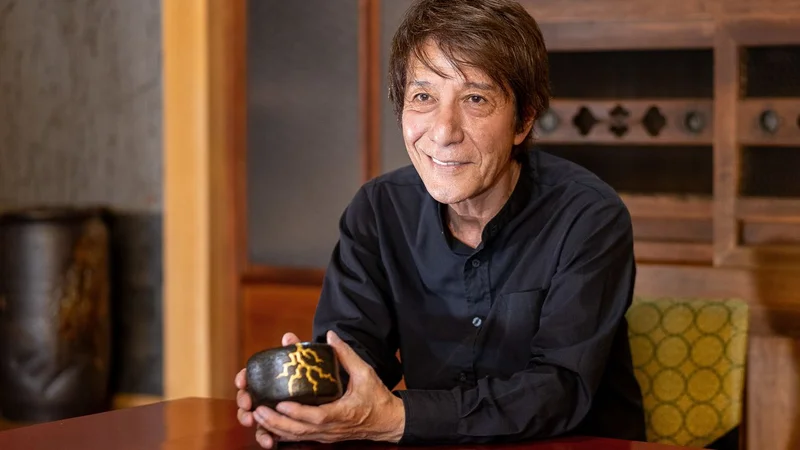
Kintsugi and the Art of Embracing Imperfection: Suezaki Hiroki’s Vision for Artisan Renewal
Culture Arts Guide to JapanKintsugiis the Japanese art of repairing broken ceramics with lacquer and gold. The technique highlights imperfection, rather than hiding it. Suezaki Hiroki stands at the forefront of this movement, capturing global attention by turning cracks into luminous seams and giving objects new depth and beauty.
A Tradition That Honors Broken Objects
“Everything with form is destined to break,” says lacquer restoration artist Suezaki Hiroki. “And kintsugi is a mindful restoration—a way of enhancing a damaged vessel’s beauty and value by mending it with gold.”
Kintsugi joins broken or chipped ceramics using lacquer-based adhesive, then decorates the seams with gold, silver, or platinum. Rather than concealing damage, it treats cracks as part of the object’s story and uses them to create a new “landscape.” Suezaki has been a key figure sustaining kintsugi’s growing global recognition.
During the COVID 19 pandemic—which left great scars in many people’s lives—the BBC visited his Kyoto studio and introduced kintsugi as reflecting a philosophy “that finds beauty in imperfection” and embraces any accident as helping us to be “reborn.” In March 2024, kintsugi was added to the Oxford English Dictionary, a sign of its growing international presence.
Passing Artisan Culture to Future Generations
For Suezaki, the rising public interest in kintsugi is no mere coincidence. It is a reflection of a clear sense of mission and a conscious effort to communicate the value of traditional crafts to a broader audience.
After graduating from high school, Suezaki entered the world of lacquer arts, specializing in restoration. At age 28, he established himself as an independent artisan, restoring statues and cultural properties at temples and shrines, as well as antique artifacts and furniture.
In 2014, he shifted his focus more fully to kintsugi—a decision rooted in his desire to keep artisan culture alive.
“I wanted to share the world of artisanship with the broader public,” he says, noting an affinity with the Mingei folk art movement of a century earlier. “Across Japan today, traditional materials are disappearing, tools are vanishing, and the population of craftspeople is dwindling—whether in weaving, carpentry, or countless other fields.
“Mass production is wonderful in its own way; it enables access to standardized goods at affordable prices. But we also need to preserve a culture that values one-of-a-kind, handmade items. A printed dress is fine, but you might run into someone on the street wearing the same thing—something you’ll never experience with a unique, embroidered dress. People have a natural desire to stand out from the crowd. That’s why we have to encourage people to rediscover the beauty of handwork before it disappears. For me, sustainability isn’t just about keeping objects around for a long time; it’s also about preserving artisan skills and culture so they’re still there for future generations to appreciate.”
Seeing firsthand how traditional skills were being lost, Suezaki felt a growing responsibility to help keep them alive for the next generation of artisans.
He soon realized, though, that restoring cultural properties was not conducive to conveying the value of handwork to the general public. Such treasures are not part of people’s daily lives, and restoration work is inherently meant to be unobtrusive—the better the technique, the harder it is to discern.
“No matter how hard the state works to protect traditional handicrafts, they’ll eventually disappear unless people find value in them and use them on a daily basis. That’s why I shifted my focus to kintsugi, which is easier for ordinary people to see.”
Exploring Nontraditional Expressions
Preserving artisan culture does not mean avoiding innovation. In fact, Suezaki’s work actively incorporates new forms of artistic expression.
For a blue-and-white porcelain vessel decorated with geometric and botanical motifs, for example, he used gold lines so they appear like ornaments hanging from a chandelier.
“The vessel is about 250 years old and quite venerable, so any kintsugi work should enhance the beauty of its design, not diminish it. What I tried to do, therefore, was to ‘collaborate’ with the object itself, making design decisions through dialogue with the original artist.”
Another of Suezaki’s works is an old wineglass whose rim had chipped. He reshaped the missing section into a droplet and applied soft-toned gold, capturing the moment a drop seems ready to fall.
“Just fixing cracks with neat lines or surfaces isn’t going to turn any heads. That’s why I’ve experimented with new forms of expression and shared them with a global audience.”
Now Part of the Vatican Museums Collection
As Suezaki’s work gained wider attention, his technical mastery and expressive power have opened new opportunities.
A major turning point came in 2022, when he gave a lecture in Vatican City as part of events marking 80 years of diplomatic relations between Japan and the Holy See. There, he demonstrated kintsugi and spoke about reviving tōtai shikki—works created using a nearly lost technique of applying lacquer, makie, and mother-of-pearl to a ceramic core. Such works had been major export items to Europe through the Meiji era (1868–1912) but declined with the spread of new materials.
He introduced a joint work with ceramic artist Mori Reiji called Bakōro, an incense burner in the shape of a horse, which was acquired by the Vatican Museums the following year. He was happy to feel that his message about preserving lost skills had come through.
Since then, Suezaki has been invited to lecture at museums and institutions in Rome, Faenza, Venice, Lugano, London, and Oxford. In 2024, he began teaching a special lacquer restoration course at a school in Venice, helping train overseas experts to preserve lacquer works.
Returning to Creation
Alongside his overseas activities, Suezaki continues to teach in Japan. Since 2015, he has offered classical kintsugi classes in Tokyo and Kyoto, welcoming around 250 students to date.
In addition to these classes, nearly 600 foreign visitors participated in kintsugi workshops in 2025, helping to spread kintsugi’s appeal worldwide.
As Suezaki’s message about kintsugi and artisan culture reaches more people, he hopes to begin a new phase of activity, devoting more time to creation and restoration itself, alongside his communication work.
“I’ve been able to meet so many people since launching my kintsugi career. If I had just kept restoring cultural property, my circle of acquaintances would have been much smaller. But there are now pieces waiting for kintsugi and restoration, and I need time to face them properly, while my hands and eyes are still relatively sharp.”
Kintsugi teaches that breaks are not the end of a story but the beginning of a new chapter—one that can be richer, deeper, and more meaningful than what came before. Suezaki carries this philosophy forward so that it, and the artisan culture that embodies it, will shine for generations to come.
(Originally published in Japanese. Reporting and text by Sugihara Yuka with editing by Power News. Banner photo: Suezaki Hiroki holding a matcha bowl with a lightning-like kintsugi design. © Matsumura Shina.)