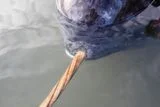
Narwhals, with their long, twisted tusks, are not mythical creatures, though they certainly have inspired folklore in the past. Even with modern scientific methods and technology, there is still much mystery surrounding this spiral horn — which is actually a tooth. Researchers still aren’t even sure what narwhals use it for.
However, recent advances in scientific methods and technology have revealed how this tusk achieves its notable spiral structure.
A new study in Nature Communications used 3D X-ray technology to determine that the tusk actually contains two spirals rather than one, challenging what researchers have long thought they knew about this mythical animal and its unique feature.
Read More: Curious Narwhals Keep Bumping Into Underwater Listening Devices — Here's Why
The Structure of the Narwhal’s Tusk
According to the WWF, a narwhal’s tusk can grow between about 5 to10 feet, depending on the size of the animal. It’s full of nerve endings and can be very sensitive, as reported by the Ocean Conservancy. Although the tusk is a tooth, it differs from a human tooth, which has enamel. Instead, the tusk has cementum on the outside and dentin on the inside.
The tusks form a notable spiral, similar to that of the mythical unicorn. Thanks to advanced 3D X-ray techniques, the team determined that the tusk's outer structure twists to the left while the inner structure twists to the right. The team refers to this as a sort of biological counterbalance — two opposing forces that meet at the boundary between the exterior and interior parts.
Prior to the study, the team knew that the left spiral was likely a specific organization of the mineralized collagen fibrils, the microscopic elements that help strengthen the tusk. But they had never before been able to capture this in 3D.
But thanks to several imaging techniques, including tensor tomography — a technique that sent powerful X-rays through a narwhal tusk to see how the rays would scatter from the mineralized collagen fibrils — the team could map this full structure for the first time.
Where Narwhal Tusks Get Their Stability
After completing their analysis, the team was amazed by the unique pattern that made up a narwhal tusk.
The scan showed that most mineralized collagen fibrils ran along the tusk’s longitudinal axis, although some deviated at small angles. It appears that the mineralized collagen fibrils on the outside of the tusk twist to the left, while they twist to the right on the inside. As the opposing spirals rise, they eventually meet at the point where the dentin transitions into cementum. This, according to the study, is a highly intricate biological boundary that is far more complex than previously thought.
This complex structure likely provides the tusk with stability and enables it to withstand excessive forces.
“No one has previously carried out such an advanced experiment of this type,” Adrian Rodriguez-Palomo, the study’s lead author, said in a press release.
“We have only been able to do it by collaborating across several disciplines — namely chemistry, physics, materials science and biology. Without collaboration with the biologists at the Greenland Institute of Natural Resources, we would not have been able to interpret the results,” he added.
Using These Patterns for the Future
As a narwhal ages, its tusk develops growth layers similar to rings of a tree. Another interesting element the study revealed is that as the tusk continues to grow, so too does the double-spiral structure.
The research team thinks that the left-handed growth pattern may be genetically programmed to remain stable as the narwhal ages. From the findings, it’s possible that humans could one day adopt the idea of these complex structures into our own construction or even medical materials.
Either way, there’s still more to learn about narwhals and their incredible tusks.
“Since whales can live for up to 80 years, their teeth form a kind of historical record of changing environmental conditions throughout the animal’s lifetime,” Henrik Birkedal, from the Department of Chemistry at Aarhus University and the study’s lead researcher, said in the press release.
“And because the North Atlantic is currently undergoing very rapid changes, it is obvious to investigate whether we can trace these changes in the hard tissue of the narwhal tusk. That is what we are now working on.”
Read More: Rare Arctic Seafloor Footage Captures Narwhals, Backward-Swimming Fish, and Panicked Copepods
Article Sources
Our writers at Discovermagazine.com use peer-reviewed studies and high-quality sources for our articles, and our editors review for scientific accuracy and editorial standards. Review the sources used below for this article:
- This article references information from a study published in Nature Communications: The narwhal tusk assembles its macroscopic helix from building blocks with opposing twists
- This article references information from the Ocean Conservancy: Narwhal
- This article references information from the WWF: Unicorn of the sea: narwhal facts