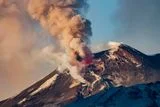
Mount Etna had been sending lava down its slopes and ash into the sky when a 29-year-old American tourist hiked across the volcano on Aug. 16, 2026. But the danger that killed him came from the storm overhead. During a thunderstorm, lightning struck the Kansas man on a treeless stretch of the mountain.
The man was found in the Rocca Capra area at about 4,600 feet (1,400 meters) above sea level, according to the Associated Press (AP). Firefighters airlifted him from the mountain, but he was later pronounced dead.
His death adds to a counterintuitive pattern on Etna. On a mountain known for fire, lightning has claimed more lives in recent decades than the volcano itself. A historical compilation identified six lightning deaths in Etna’s modern record before the latest case, bringing the count to seven. By comparison, Etna’s eruptions have killed two people since 1980.
Mount Etna Has a History of Fatal Lightning Strikes
Those earlier deaths stretch back at least to August 1999, when an Israeli tourist was struck and killed on the mountain. Two years later, lightning killed Sabrina Pilara and Horst Karl Martin at an elevation of about 9,800 feet (3,000 meters), according to a compilation by Santo Scalia for the local publication Il Vulcanico.
In August 2004, an unidentified man was struck and killed inside the Valle del Bove. The following month, 49-year-old French tourist Étienne Nicoladze Arnaud died near Montagnola.
The compilation also records the death of a forestry worker near Monti Rossi, although it does not provide the year of that incident. Together, those cases account for the six lightning deaths recorded before the latest tragedy.
Read More: Fuego Volcano's 50-Hour Eruption in Guatemala Sends Lava Fountains Almost 1,000 Feet High
Etna’s Last Fatal Eruption Was Nearly 40 Years Ago
Etna’s eruptions have been lethal, particularly for people close to its summit craters. Its most recent eruption-related deaths occurred on April 17, 1987, when a sudden phreatic explosion threw fragments of older volcanic material from the Southeast Crater, according to the Smithsonian Institution’s Global Volcanism Program. Two tourists were killed, and seven others were injured about 1,600 feet (500 meters) from the crater.
A similar explosion at the Bocca Nuova crater killed nine tourists and injured 23 in September 1979, according to the Smithsonian. No eruption-related deaths have been recorded on Etna since 1987.
The contrast is partly about where each danger travels. Access restrictions can keep visitors away from an active crater. Lightning can threaten people across the mountain, including hikers far below the summit. A storm may also develop while they are already crossing exposed ground.
Etna’s Open Slopes Offer Little Cover
On Etna’s higher slopes, trees give way to expanses of volcanic rock and ash. A lone hiker can become one of the most prominent objects in the landscape, increasing the chance of a strike, according to Italy’s Civil Protection Department.
The department says thunderclouds can produce lightning without rain directly overhead. Lightning may also strike more than a mile — or several kilometers — from the centre of a storm, allowing the danger to reach hikers before the rain does.
People who hear thunder in the mountains should leave summits and ridgelines for lower ground, according to the department. A building or vehicle offers the safest available shelter. Hikers should also avoid large metal structures, which can carry an electrical current if struck.
Visitors climbing Etna may keep their eyes on its craters, but the mountain’s recent history gives them another instruction: listen for thunder.
Read More: Kīlauea Volcano's Record-Breaking Lava Fountains Lasted for 9 Hours and Shot 650 Feet in the Air
Article Sources
Our writers at Discovermagazine.com use peer-reviewed studies and high-quality sources for our articles, and our editors review for scientific accuracy and editorial standards. Review the sources used below for this article:
- This article references information from the Associated Press: US tourist dies after being struck by lightning while hiking Sicily’s Mount Etna
- This article references information from Il Vulcanico: There are more than 100 victims, direct or indirect, of Etna
- This article references information from the Smithsonian Institution’s Global Volcanism Program: Etna
- This article references information from Italy’s Civil Protection Department: In case of thunderstorms and lightning