- READ MORE: IVF scandal as UK children 'conceived with WRONG sperm or egg
- See more Daily Mail on Google - save us as a Preferred Source
Thousands of men with suspected prostate cancer could be spared invasive procedures by instead being offered a simple, painless scan, a study suggests.
British researchers found MRI scans alone can, in some cases, accurately diagnose the disease.
Currently, men being investigated for prostate cancer typically undergo a biopsy, a procedure where a needle is inserted into the prostate to take a tissue sample.
Under NHS best–practice guidelines, men should first receive an MRI to determine whether this is actually necessary, as there is a small risk of serious infection and bleeding.
In practice, however, limited scanner capacity and workforce shortages mean many men are still sent straight for biopsy.
'We already treat patients on the strength of imaging alone for a number of cancers, such as kidney and liver cancer, without putting them through an invasive biopsy first,' said Dr Alex Kirkham, a consultant radiologist at University College London Hospital.
'This study suggests prostate cancer could, in some cases, join that list.'
Dr Kirkham added that, if further research confirms the findings, thousands of men could avoid a 'risky and uncomfortable' procedure.
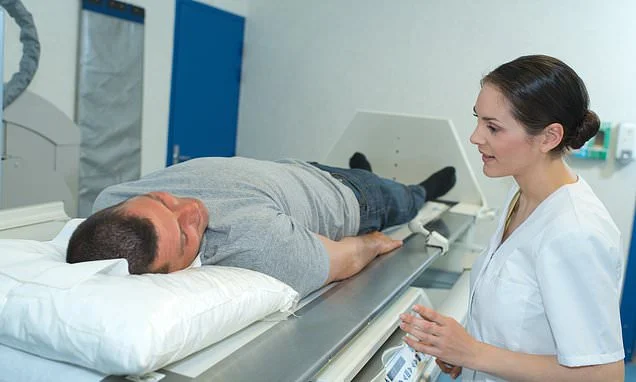
Thousands of men with suspected prostate cancer could benefit from an MRI scan, researchers say
Prostate cancer is the most common cancer in men, with nearly 58,000 diagnosed each year in the UK.
The findings come after the Government's decision in July to again reject proposals for a nationwide prostate cancer screening programme, which would have offered regular PSA testing and MRI follow–up to men at higher risk.
Advocates, including champion cyclist Sir Chris Hoy, warned the move could condemn thousands of men to an avoidable death – with estimates suggesting that up 9,000 deaths could be prevented every decade if screening were introduced.
Now researchers say MRI could help diagnose thousands of men sooner, when their cancer is at its most treatable.
In the new study – published in the European Journal of Radiology – researchers looked at the scans of 880 men who attended the hospital's one-stop clinic for suspected prostate cancer.
All of the men underwent a prostate MRI alongside a blood test for PSA, a potential marker of cancer.
Radiologists then examined the scans and rated how certain they were that a tumour was present.
Crucially, when doctors were 99 per cent certain from the MRI that a man had prostate cancer, the diagnosis was confirmed by biopsy in every case.
Prostate cancer is now the most common cancer in the UK, according to Prostate Cancer UK
The Daily Mail is campaigning to end needless prostate deaths and backing prostate cancer screening for men at high risk of the disease
Even at slightly lower levels of confidence, scans proved highly accurate at identifying significant cancers.
The team concluded: 'There is a group of patients in whom prostate cancer is close to certain based on MRI findings.
'In future this may enable treatment without the need for biopsy.'
They added that reducing reliance on biopsy for a carefully selected group of patients could mean faster access to treatment and less discomfort.
'What surprised us was how confidently we could call some of these scans, even when the tumours were small or PSA levels looked unremarkable,' Dr Kirkham said.
'It tells us that a proportion of prostate cancers have a genuinely distinctive appearance on MRI, one that experienced readers can recognise with a very high degree of certainty.'
In the NHS, the wait for a biopsy – and its results – is the most commonly breached target across all cancer pathways, UCLH doctors say.
For suspected prostate cancer, NHS best–practice guidelines state referral to MRI and biopsy should happen within seven days of an urgent GP referral. But capacity constraints often make this far longer.
'This matters because prostate cancer incidence is only set to rise: a Lancet Commission paper projects that global cases will double by 2040, driven largely by ageing populations,' Dr Mark Emberton, a consultant urologist at UCLH said.
'Together, these pressures make faster, more reliable ways of diagnosing prostate cancer an urgent priority.'
Earlier this year, the National Screening Committee rejected proposals for a national PSA screening programme.
Instead, only men who request a test or are flagged as high‑risk are currently offered screening.
The committee justified its decision on the basis that expanding screening could lead to over‑diagnosis and over‑treatment, exposing some men to a risk of impotence and incontinence when their tumour was unlikely to cause issues in their lifetime.