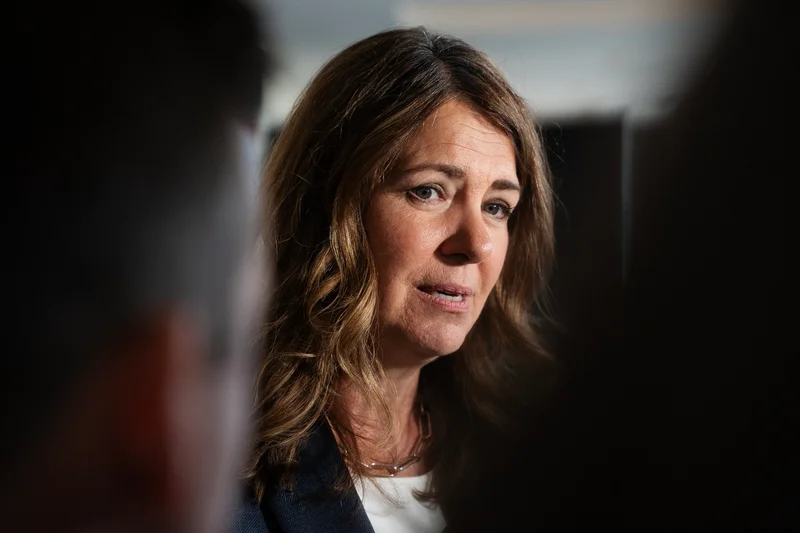
Alberta Premier Danielle Smith has acknowledged the province’s referendum on separation is being targeted by foreign influence campaigns, after Canadian researchers released new data this week indicating Russian cyberoperations in particular are focused on the contentious debate.
The research, published Monday in The Globe and Mail, linked a surge in online activity this summer – including social-media posts, memes, headlines, false news items and other content designed to be unwittingly circulated among Canadians online – to a Russian-based, pro-Kremlin content farm.
The operation, known as Pravda Network, has been known by Western governments to target political debates, looking to foment division, stoke discord by spreading false or misleading content, said Brian McQuinn, co-director of the University of Regina’s Centre for Artificial Intelligence, Data, and Conflict and one of the contributors to the research.
Dr. McQuinn, in partnership with researchers at the University of Alberta, developed technology to track influence campaigns from foreign countries, including content designed to masquerade as grassroots debate by Canadians that is aimed at shifting the discourse as it gets passed around online. The technology, called Cipher AI, has been providing analysis to the federal and provincial governments.
Referencing the data from Cipher AI, Ms. Smith said late Monday that she had also been briefed by CSIS and the RCMP, and that the apparent attempts to influence the Oct. 19 separation referendum were a concern.
“What we’re seeing right now is that there’s nothing out there that has elevated to a level of criminal involvement in our process, but we are seeing influence campaigns,” the Premier said during an interview on OMNI Television in Alberta.
“There [are] various shares of information online that appear to be amplified by different bot farms that may have a link to Russia, which is something that does leave us concerned.”
The research tracks suspected influence campaigns from Russia and the United States involving Alberta. Future reports will also aim to catalogue activity from China, Dr. McQuinn said.
The Russian activity, which comprises about 80 per cent of the online material the software flagged over one month this summer and that researchers later determined was suspect, is more covert in nature, while the American content – with influencers, podcasters and politicians openly promoting Alberta separation – is overt.
Though it is difficult to measure the impact such material is having, Dr. McQuinn said the Russian activity has pushed narratives that tell Albertans not to trust how the referendum votes are counted, and that the province is being economically punished within Canada, leaning into grievances the separatists have long held. Among the narratives emanating from U.S. MAGA influencers is that Canada is a failed state, leaving the province no choice but to leave.
From mid-July to mid-August, the researchers found 296 different examples of what they believe to be clear-cut attempts to shape or twist the Alberta debate, with the bulk of the activity originating in Russia, or through Russian-linked proxies.
The Alberta government previously tried to play down concerns that the referendum was being targeted. When the researchers first raised concerns in a May report – citing evidence of a website claiming to be a homegrown Alberta separatist site that was instead traced back to a Russian state-sanctioned cyberoperation in St. Petersburg – the province denied there were problems.
Asked about it in the legislature May 6, Alberta’s Minister of Minister of Public Safety and Emergency Services Mike Ellis said the province had been told by the RCMP there was no evidence of foreign interference in Alberta.
However, Mr. Ellis did not address suspected foreign influence.
Dr. McQuinn has noted the difference between foreign interference and foreign influence are significant.
Foreign interference, under Canadian law, is any covert or deceptive action that poses a threat to citizens, including espionage, hacking and attacks on individuals by a foreign entity. Meanwhile, foreign influence is much more nebulous; often involving propaganda or disinformation spread online, or content that is designed to shift beliefs, stoke discord or change minds.
Though political debate and disagreement are the foundation of any democracy, outside influence is a threat to what Dr. McQuinn calls “Canada’s cognitive sovereignty.”
“Really good disinformation starts with something you nod your head to, that’s how you get people passing something on without even looking at what’s actually in it,” he said in an interview in May, adding that such campaigns are difficult to detect.
What can be done about such tactics after they are detected is even less clear. Ms. Smith called on Albertans to be vigilant about the online content they are amplifying or spreading on their social-media feeds, particularly if the provenance is unknown.
“People just need to, before they believe everything they read on social media, they need to check the source and verify to make sure that they’re not sharing things and inadvertently amplifying a message that is being used to try to interfere in our contest,” Ms. Smith said.
“I trust that Albertans are able to do that research. I trust that they can identify sources that are credible and sources that are not.”