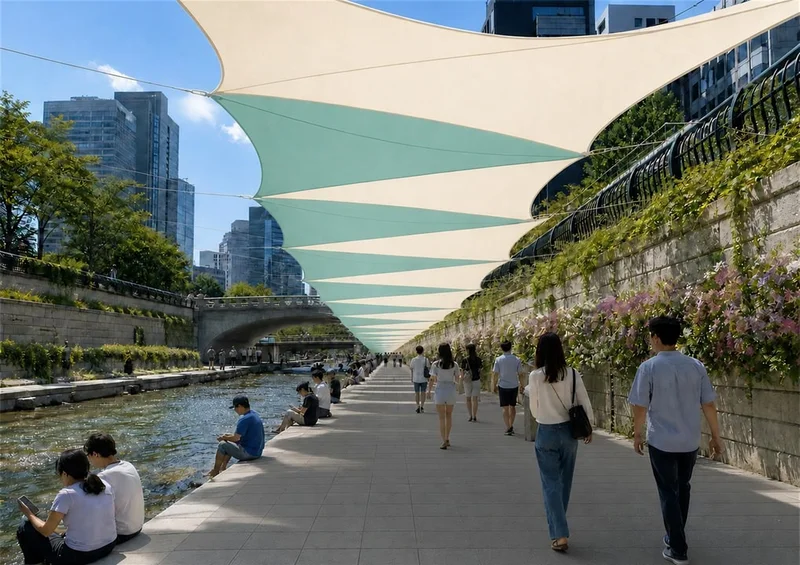
The Seoul Metropolitan Government pledged Wednesday to make "the right to shade" an urban policy principle throughout the capital, guaranteeing shielded pedestrian routes amid record heat waves. The concept treats access to cooling as a public service for all, not a privilege determined by geography in an era of extreme heat.
After running a pilot program in 10 areas next year, Seoul plans to expand the initiative citywide starting in 2028.
"Heat waves are no longer a temporary inconvenience that people can endure for a few days. As they grow more intense and last longer, they are becoming a routine disaster that threatens people’s lives and safety," Seoul Mayor Oh Se-hoon said during a press conference Wednesday.
“While the city has expanded green spaces through its Garden City Seoul initiative, the right to shade is the next step in connecting those spaces from residents’ homes to their destinations ... I will make shade not simply facilities available in only some places, but a basic urban service that protects residents’ health and daily lives.”
The city government said the policy will involve planning and management of urban spaces so citizens can enjoy continuous shade along their daily walking routes, connecting street trees, gardens, building shadows, canopies, awnings, open public spaces and pedestrian pathways into a single system — linking individual "dots" of shaded spots into "lines" of shade.
The city said it will prioritize planting trees with broad canopies on wide sidewalks while installing retractable awnings and seasonal shade structures, and will incorporate these features into its urban master plan and neighborhood plans. Ultimately, the goal is to extend these shaded routes to key living spaces such as residential areas, subway stations, schools, markets, hospitals and parks, forming what the city calls "neighborhood shade paths."
The moves came in response to rising deaths from high summer temperatures. As of Monday, 31 people had died from heat-related illnesses this year, while 3,439 others had suffered heat-related illnesses, according to the Ministry of the Interior and Safety. The number of deaths this year has already exceeded last year’s total of 23.
Seoul City had analyzed areas shaded by buildings and urban trees across 67,029 sidewalks spanning a combined 4,031 kilometers on July 28, 2025. The analysis found that pedestrian routes in Seoul were exposed to sunlight for an average of four hours and 21 minutes. Some 27.6 percent of the routes were exposed to direct sunlight for six hours or more.
The average shade on Seoul pedestrian routes was 44.4 percent, with building shade accounting for 29.2 percentage points and street-tree shade for 15.2 percentage points. The analysis found that around noon, when building shadows grow shorter, street trees help compensate for the lack of shade.
Roadsides accounted for the largest share of heat-related illnesses in Seoul, according to the Korea Disease Control and Prevention Agency, which found that 31.4 percent of the 815 cases reported in the city from 2023 to 2025 occurred there.