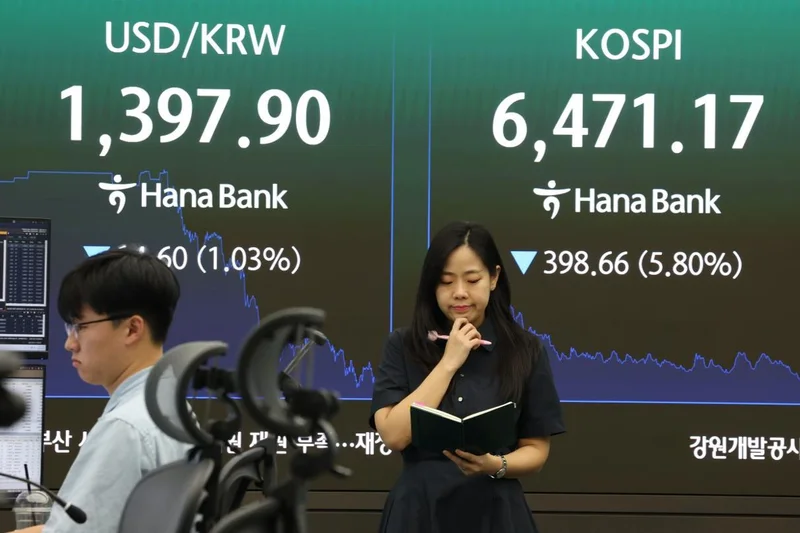
The Korean won strengthened to below the 1,400-won mark against the U.S. dollar for the first time in nearly 11 months, while the KOSPI plunged 5.8 percent on Wednesday.
The won-dollar exchange rate closed at 1,397.7 won per dollar, down 14.1 won from the previous session. It was the first time that the rate fell below 1,400 won since Oct. 2 last year, when it stood at 1,399.5 won.
Companies, including Samsung Electronics and SK hynix, are believed to have sold large amounts of dollars ahead of this month's interim corporate tax payments. Recent U.S. consumer and producer price data also came in below expectations, strengthening views that the Federal Reserve will refrain from raising rates next month.
In contrast, the stock market was hit by a sharp sell-off amid growing concerns over rising global bond yields.
The benchmark KOSPI closed at 6,471.17, down 5.8 percent. The index opened 4.96 percent lower and extended its losses, triggering a sell-side sidecar at 9:06 a.m. It was the 48th sidecar activation on KOSPI this year.
Foreign and institutional investors sold a net 3.49 trillion won and 1.32 trillion won in shares, respectively. Retail investors, meanwhile, bought a net 4.64 trillion won.
SK hynix plunged 9.75 percent to close at 1,500,000 won, while Samsung Electronics lost 7.82 percent to finish at 247,500 won. The two chip stocks moved in tandem with global chipmakers, with Micron down 7 percent and SanDisk down 9 percent in the U.S. market overnight. Japan's Kioxia also fell 12 percent.
The sharp drop was attributed to ongoing geopolitical tensions and their market impact.
Both Iran and the U.S. refused to extend a memorandum of understanding following the expiration of a 60-day negotiation period stipulated under the agreement.
The yield on the 30-year U.S. Treasury climbed to around 5.33 percent during the session, its highest level since 2007, while the 10-year Treasury yield hovered around 4.71 percent, its highest level since January 2005.
The secondary Kosdaq also slid, falling 1.17 percent to close at 824.46.
Meanwhile, the combined operating profit of companies listed on KOSPI reached a record 388 trillion won on a consolidated basis, up 254.15 percent from a year earlier, according to the Korea Exchange.
Samsung Electronics and SK hynix, riding the semiconductor supercycle, drove the surge in earnings. Excluding the two chip giants, however, the improvement was far less pronounced, highlighting a widening earnings divide.
Kosdaq-listed companies also posted earnings growth in the first half of this year. The combined operating profit of 1,264 companies on a consolidated basis reached 9.43 trillion won, up 61.54 percent from a year earlier.