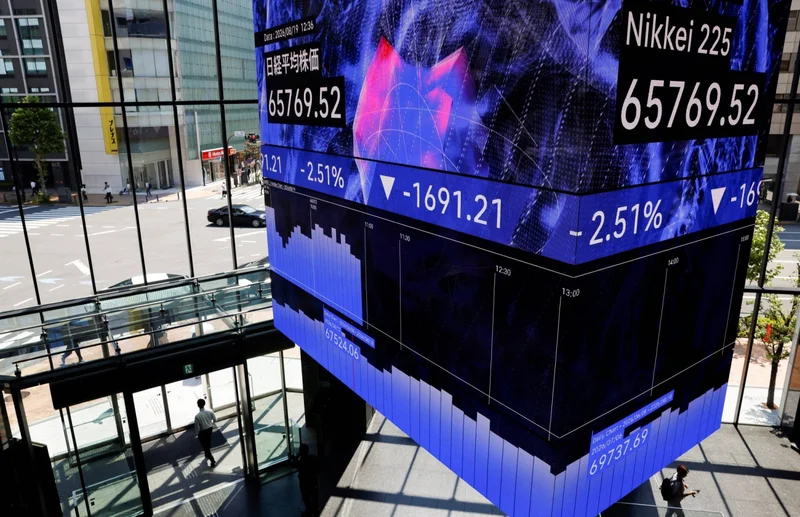
Stocks, bonds and the currency remain weak in Japan, with government spending at the top of the list of concerns weighing on the country’s financial assets.
A global tech rout and a sudden realization just about everywhere that the world has too much debt also contributed to the weakness.
The yen hit ¥159.76 to the dollar Tuesday evening before regaining ground on Wednesday, trading at around ¥159.15 to the dollar in the afternoon, while Japanese government bonds were near 30-year lows.
The yield on the benchmark 10-year government bond briefly climbed to 2.945% on Tuesday, its highest level since September 1996. Bond prices move inversely to yields.
Japan’s 10-year government bond recovered slightly to about 2.9% on Wednesday.
The Nikkei 225 stock average fell 3.16% on Wednesday after falling 2.54% on Tuesday.
“Concerns over fiscal deterioration are weighing on the yen,” Takahide Kiuchi, executive economist at Nomura Research Institute, wrote in a report on Monday.
Masahiro Ichikawa, chief market strategist at Sumitomo Mitsui DS Asset Management, wrote in a report on Wednesday that Prime Minister Sanae Takaichi’s fiscal policy appears to be a key driver pushing up bond yields.
Takaichi is considered by many analysts to be pro-stimulus. She has made comments in the past that suggest she is in favor of spending and subsidies, and has taken action recently that indicates that she is willing to follow through.
The administration is planning a cut in the consumption tax on groceries. It has also placed no cap on funding requests for a new growth initiative, while it has not lined up funding for the program.
“To ease fiscal concerns, I believe it’s important that the government clearly lays out specific funding sources, debt issuance amounts and spending curbs to offset expansionary outlays for crisis management and growth investment,” Ichikawa wrote.
In September last year, before Takaichi took office, the yen was trading under ¥150 per dollar. The 10-year Japanese government bond yield was about 1.6%.
In late July, the United States and Japan stepped in to support the yen in a massive coordinated intervention that has so far proven relatively ineffective, with the yen giving back much of the gains.
The support, which has been confirmed by both governments, pushed the yen from around ¥162.80 to the dollar to around ¥155 per dollar.
Finance Minister Satsuki Katayama and U.S. Treasury Secretary Scott Bessent have both said that they won’t hesitate to intervene again.
Bessent said that interventions send signals, and that Japan needs follow-up policies. One possibility is a rate increase by the Bank of Japan. The overnight index swap market indicates that the market is pricing in a 79% chance of a rate increase in September.
Tech stocks are being hit globally. The Nasdaq composite fell 1.3% on Tuesday, while South Korea’s KOSPI fell 5.8% on Wednesday. Samsung Electronics fell more than 7%, while SK Hynix fell more than 9%.
In Japan on Wednesday, SoftBank Group’s stock was down more than 10% on Wednesday, and Kioxia Holdings fell more than 12%.