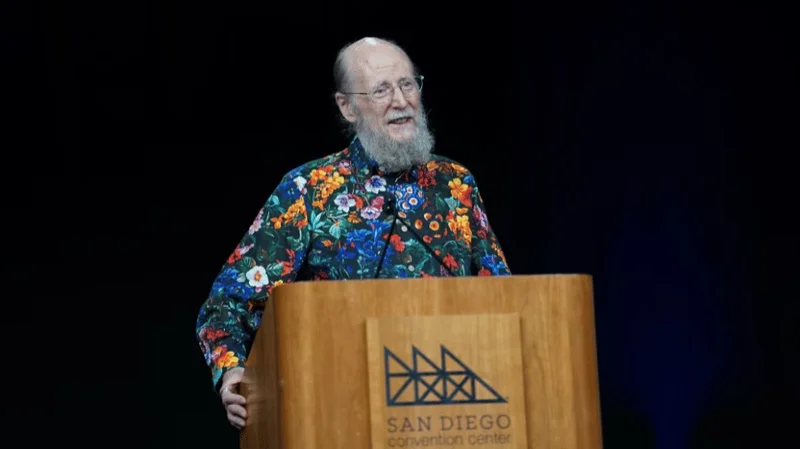
Richard Sutton thinks the AI industry’s answer to running out of training data is a mistake, and he has picked a blunt word for it. “
That’s just a big mistake,” he said of the turn to synthetic data on Sequoia Capital’s Training Data podcast, published on Tuesday and hosted by Sonya Huang and Pat Grady.
The remark carries more weight than most podcast soundbites. Sutton shared the 2024 Turing Award with Andrew Barto for founding reinforcement learning, wrote the 2019 essay The Bitter Lesson that half the field now quotes at the other half, and left John Carmack’s Keen Technologies in July to start his own lab.
His objection has two specific edges rather than a blanket verdict. “There’s no way we can have synthetic data for other people’s minds,” he said, and on simulating the physical world: “The world is infinitely complex, and any simulation of it is like, microscopic.”
Underneath sits what he calls the big world hypothesis, the idea that reality is always larger than an agent’s model of it, which makes any simulator a lossy compression by construction.
A second objection is subtler, because somebody has to decide what synthetic data to generate, and that smuggles human judgement back into exactly the process The Bitter Lesson warned against.
What he wants instead is experiential data, gathered by an agent acting in its environment rather than assembled in advance by anyone. The thesis is not new, having been set out with David Silver in Welcome to the Era of Experience in April 2025, but he has not previously aimed it this squarely at synthetic data.
The industry’s reason for reaching for it is not really in dispute. Epoch AI projects that the stock of public human text, somewhere around 300 trillion tokens, will be fully used between 2026 and 2032, and labs have been improvising ever since.
Some of that improvising is physical. AI companies have been buying and cutting up second-hand books for pre-2022 text, on the reasoning that anything published since is contaminated with machine-generated slop.
Nor is the shortage only an English-language problem. Chinese labs are hitting the same wall in their own language, and rather sooner.
There is peer-reviewed support for the anxiety Sutton is voicing. A 2024 Nature paper by Ilia Shumailov and colleagues found that models trained recursively on their own output degrade, an effect the literature now calls model collapse.
The rebuttal is just as published, though, and it matters here. Work by Matthias Gerstgrasser, Rylan Schaeffer, and co-authors found that collapse depends on synthetic data replacing human data; where the two accumulate alongside each other, it does not show up.
In practice the labs are long past the argument. Microsoft’s Phi-4 trained on roughly 400 billion synthetic tokens across 50 dataset types, and Nvidia has released a synthetic pre-training corpus of about 10 trillion tokens for its Nemotron models.
Those also happen to be the domains where Sutton’s objection bites least, since maths and code have checkable answers in a way that other people’s minds do not. His limits are about modelling humans and physical systems, not about generating training examples as such.
Andrej Karpathy has made the best-known counter-case, arguing that language models are less like animals grown through experience than ghosts distilled from human writing, and that tuning them is a legitimate path rather than a wrong turn. Sutton, for his part, told the podcast that language accounts for perhaps a quarter of intelligence.
He is calling this the next big lesson, and Sequoia is happy to bill it as a second bitter one, which is tidy framing for a venture firm that also backs David Silver’s new lab. Sutton’s own, co-founded with his former student Khurram Javed, is aiming at a trillion-parameter mind that never stops learning and runs on 20 watts, within five to ten years.
Get the TNW newsletter
Get the most important tech news in your inbox each week.