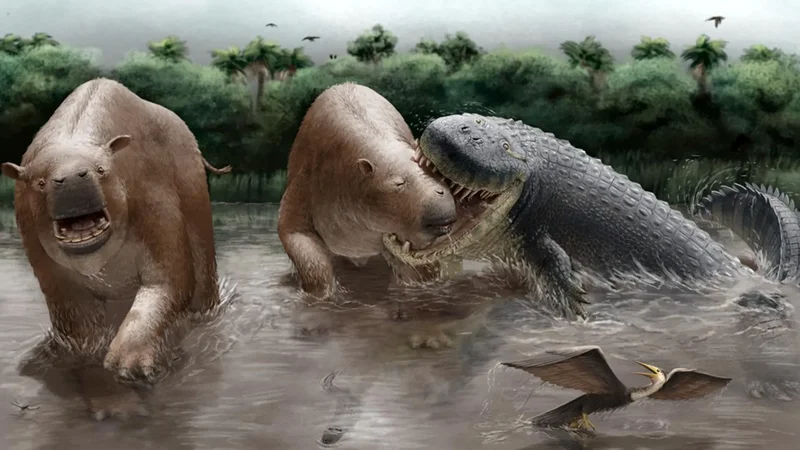
This 23-foot crocodylian may have ruled South Americaâs food chain
- Date:
- August 19, 2026
- Source:
- University of Helsinki
- Summary:
- Miocene South America was packed with giant preyâand the predators hunting them were just as spectacular. Fossil bite marks suggest crocodylians, especially the enormous Purussaurus neivensis, were more important predators than mammals in this ancient tropical ecosystem. At around seven meters long, Purussaurus may even have helped control populations of giant herbivores.
- Share:
More than 10 million years ago, South America was home to an ecosystem filled with enormous animals and formidable predators. During the Miocene, a geological period that lasted for millions of years, a vast lake covered a large portion of the continent. Its waters supported giant turtles and crocodylians, while an extraordinary collection of hunters prowled the surrounding shores.
Those predators included anacondas, saber toothed mammals, flightless "terror birds" and sebecids, a group of land dwelling relatives of crocodylians. Despite this intense competition, new research indicates that crocodylians occupied an especially important place in the ecosystem and were the most significant group of predators in the region.
"There was so much prey available that mammalian predators couldn't have eaten it all," says Oscar Wilson, postdoctoral researcher at the University of Helsinki.
"Our new study shows that crocodylians in particular were the region's most important predators, especially when it came to hunting large prey."
A Lost Ecosystem Packed With Giant Prey
The lake shores supported a remarkable variety of herbivores. Giant ground sloths lived alongside glyptodonts, heavily built relatives of armadillos, as well as several groups of ungulates. Ungulates are hoofed mammals, although many extinct South American forms looked very different from familiar animals such as horses and deer.
Among them were astrapotheres ("lightning beasts") and toxodontids. Some of these ancient ungulates reached enormous sizes and could weigh well over a metric ton.
That abundance of large prey helped support predators that were equally impressive in scale.
The Giant Crocodylian at the Top
The largest known predator in this ecosystem was Purussaurus neivensis, a massive crocodylian related to modern caimans. It grew to about seven meters in length and weighed roughly 1,800 kilograms.
Its immense size placed it near the top of the food chain, where it may have done more than simply hunt individual animals. The new study suggests that Purussaurus could have been influential enough as a predator to affect the size of herbivore populations across the ecosystem.
That possibility gives researchers a glimpse of how powerful giant crocodylians may have been in shaping ancient tropical communities, rather than simply living alongside other large predators.
Fossil Bite Marks Reveal Ancient Predation
To determine which animals were actually attacking prey, researchers examined fossils preserved in museum collections. The evidence comes from bite and tooth marks left on the fossilized remains of herbivores.
These traces are especially valuable because they provide the only direct evidence of interactions between predators and their prey. Rather than relying only on the size, anatomy or presumed hunting abilities of extinct animals, researchers can use the marks left on bones to identify signs of actual feeding or attacks.
The fossils analyzed in the study ranged from 10.5 million to 16 million years old.
"The frequency of marks likely made by Purussaurus suggests that it was an important predator in these tropical ecosystems," Wilson comments.
The study was published in Journal of Vertebrate Paleontology.
Story Source:
Materials provided by University of Helsinki. Note: Content may be edited for style and length.
Journal Reference:
- Oscar E. Wilson, Jorge W. Moreno-Bernal, Catalina Suarez, Frank Cardozo Tovar, Andrés Vanegas, Rubén Vanegas, Ethan A. Shirley, Patricia A. Holroyd, John-Paul Zonneveld. Physical evidence of crocodylian predation on ungulates in the Middle Miocene of Colombia.Journal of Vertebrate Paleontology, 2026; DOI: 10.1080/02724634.2026.2701154
Cite This Page:
ScienceDaily. Retrieved August 19, 2026 from www.sciencedaily.com