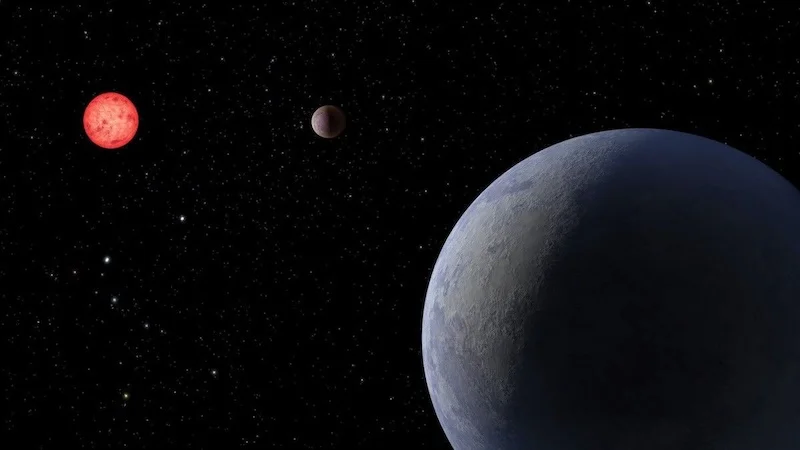
- Super-Earths are rocky exoplanets, larger and more massive than Earth but smaller than Neptune. What are they like on the inside?
- Researchers at Princeton University say in a new studythat, surprisingly, super-Earths might be solid deep down in their mantles.
- The study suggests the minerals inside these worlds would take on unusual formsdue to the extreme heat and pressure deep down, meaning they would remain solid instead of melting.
Super-Earths might be solid inside
Super-Earths are rocky exoplanets that are larger and more massive than Earth, but smaller than Neptune. Powerful telescopes have provided clues about what their atmospheres are like. But what are they like on the inside?
Some astronomers have suggested these worlds could contain oceans of magma. Now, a new study from researchers at Princeton University in New Jersey suggests something surprising; super-Earths might actually be solid deep inside their mantles. That’s because under the intense pressure and heat deep below the surface, some minerals could take unusual forms.
The researchers found these minerals could likely withstand the extremely high temperatures and pressures deep inside super-Earths – much hotter than inside Earth – and remain solid.
Nathaniel Scharping wrote about the new findings for Eos on August 6, 2026.
The researchers published their peer-reviewed paper in AGU Advances on July 18, 2026.
Minerals take unusual forms
Scientists expect that some common minerals found inside Earth should be present within super-Earths as well. This includes substances like magnesium orthosilicate (Mg2SiO4). But the interiors of super-Earths have much more intense pressures and temperatures than inside Earth.
As noted in Eos, the atoms in the mineral would rearrange into different crystal structures. As explained in the article:
One of these high-pressure forms is called the spinel phase [spinel group], which is found in Earth’s mantle. At even higher pressures, this phase breaks down into two different minerals: bridgmanite, the most abundant mineral phase in Earth, and ferropericlase, a magnesium-rich oxide. However, under the far more extreme pressures expected inside massive rocky planets known as super-Earths, Mg2SiO4 becomes stable again in an entirely new crystal structure called post-post-spinel. Scientists predict that this ultrahigh-pressure phase of Mg2SiO4 is one of the dominant minerals in the deep mantles of super-Earths, making its melting behavior important for understanding how these planets form and evolve.
Recreating conditions inside super-Earths
It is difficult to recreate these kinds of conditions in a lab. So the researchers did a computer model recreation instead. They used a technique called thermodynamic integration to study the melting curve of this mineral – the bizarrely named post-post-spinel Mg2SiO4 – at up to 1,300 gigapascals of pressure.
The post-post-spinel Mg2SiO4 is a refractory mineral. That means it can withstand extremely high temperatures before it begins to melt. Pressure plays a role, too. Depending on the pressure, it melts between 9,780 K (17,144 degrees Fahrenheit or 9,507 degrees Celsius) and 14,897 K (26,350 degrees Fahrenheit or 14,620 degrees Celsius). That is much hotter than temperatures at which related minerals melt, including bridgmanite and postperovskite (MgSiO3). Postperovskite is the high-pressure form of bridgmanite, which is stable near Earth’s core-mantle boundary.
In most exoplanets, iron would end up mixing with the post-post-spinel Mg2SiO4. The researchers found that even then, the melting point for post-post-spinel Mg2SiO4 remained above the temperatures estimated for the deep mantles of most rocky planets.
Effects on super-Earths inside and out
In short, this means that many super-Earths likely have solid deep mantles. This can affect both convection inside the planet and magnetic fields outside the planet. Interestingly, another study from earlier this year found that super-Earths with powerful magnetic fields might be more likely to be able to support life.
Bottom line: Super-Earths might be solid in their deep insides, a new study says. Minerals might take unusual forms and remain solid despite the intense heat and pressure.