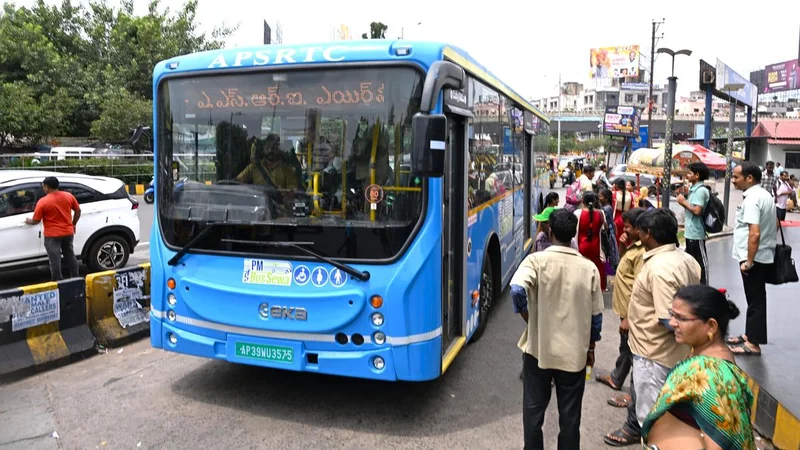
With the Alluri Sitarama Raju International Airport at Bhogapuram having taken over full commercial operations on August 17, replacing the civil enclave at INS Dega, the Andhra Pradesh State Road Transport Corporation (APSRTC) has rolled out a dedicated “Aero Express” electric bus service to give air travellers a cheaper and more predictable alternative to private cabs, fares for which currently range between ₹1,000 and ₹2,000 for the roughly 50-km run from the city.
The corporation began operating the service on August 16, a day ahead of the start of commercial flights at the airport, and formally inaugurated it on August 15, Independence Day. B.A. Naidu, District Public Transport Officer (Regional Manager), APSRTC, Visakhapatnam, said the early rollout was deliberate, so that passengers would not be left without transport on the airport’s opening day.
A fleet of 20 buses, comprising 16 electric buses and four regular air-conditioned buses, has been deployed, together completing 40 departures a day from either side of the route. The buses run on two alignments, both originating at Old Gajuwaka. The ASR-1 route runs via NAD, Gurudwara, Zoo Park, Anandapuram and Tagarapuvalasa Junction to the airport, while ASR-2 travels via Scindia, the Railway Station, the Bus Station, VUDA Park, Siripuram, the ISKCON Temple, IT Hills and Marikavalasa before joining the same alignment onward to the airport. Services operate from 4.30 a.m. to 10.30 p.m., with buses on both routes at half-hour intervals.
The one-way fare from Old Gajuwaka to the airport is ₹400 on both routes. On ASR-1, intermediate fares are ₹350 from NAD, ₹300 from Gurudwara, ₹250 from Zoo Park, ₹200 from Marikavalasa, ₹150 from Anandapuram, ₹100 from Tagarapuvalasa and ₹50 from the Airport Junction stop. On ASR-2, fares are ₹400 from Scindia and Kancharapalem, ₹350 from Siripuram, ₹300 from the ISKCON Temple, ₹250 from IT Hills, and the same descending scale as ASR-1 from Marikavalasa onward.
| Stop | ASR-1 Fare | Stop | ASR-2 Fare |
| Old Gajuwaka | ₹400 | Old Gajuwaka | ₹400 |
| NAD | ₹350 | Scindia | ₹400 |
| Gurudwara | ₹300 | Kancharapalem | ₹400 |
| Zoo Park | ₹250 | Siripuram | ₹350 |
| Marikavalasa | ₹200 | ISKCON Temple | ₹300 |
| Anandapuram | ₹150 | IT Hills | ₹250 |
| Tagarapuvalasa | ₹100 | Marikavalasa | ₹200 |
| Airport Junction | ₹50 | Anandapuram | ₹150 |
| Tagarapuvalasa | ₹100 | ||
| Airport Junction | ₹50 |
Passengers unsure of where to wait need not look for separate stops, Mr. Naidu said. The Aero Express halts alongside the existing APSRTC bus stops at each of the named points. “NAD means the NAD RTC bus stop. Old Gajuwaka means the present Old Gajuwaka bus stop,” he said, adding that timing boards had been installed at each stage so that passengers could check schedules where they wait.
For a service built around fixed flight schedules, timing is the question passengers ask first, and Mr. Naidu addressed it directly. The journey takes close to two hours under normal conditions, he said, stretching to about two hours and 15 minutes during peak hours, largely because of traffic near the Anandapuram bridge. “You have to run one hour before, practically we have jams there,” he said, urging passengers against building in an excessive buffer either. “Two hours is the running time, don’t keep three hours and get anxious for no reason. If you start one hour before, your journey will be comfortable.” Delays of 15 to 20 minutes were common at certain stretches, he added, but an alternative bus was usually available within the hour if one ran late. “Airport passengers have their precious time. Even five minutes is precious to them,” he said, explaining why the corporation was asking commuters to leave with some margin rather than cut it close.
The electric buses come with several safety features built in, Mr. Naidu said, including air suspension, automatic doors that close before the vehicle moves off, a hammer fitted at every window for emergency glass-breaking, an emergency stop switch and an automatic fuse cut-off in the event of a short circuit. Front, rear and interior cameras have also been installed, feeding into a monitoring cell at Gajuwaka that tracks every bus on the road. Buses on the airport route additionally carry drinking water and a first-aid box.
To help travellers locate the service without confusion on arrival, RTC staff in white uniforms are stationed at the airport terminal to guide passengers to the buses as soon as they land. Tickets are currently issued only on board, Mr. Naidu said, with both cash and UPI payments accepted; online advance booking is expected once the service settles in. Passengers can also use the official APSRTC mobile application to track a specific bus number in real time, check how many buses are near a given stop and estimate arrival at their destination.
Mr. Naidu said the Greater Visakhapatnam Municipal Corporation (GVMC) was looking into setting up an information kiosk to assist passengers, while GMR, the airport operator, was working on passenger lounges at select points along the route. Eight lounge locations have been identified. Four stops, namely Auto Nagar, Gurudwara, VUDA Park Junction and Venkojipalem, are to be taken up in the first phase, with the remaining four to follow. Occupancy on the service touched 50% in its first days of operation, he said, and the corporation expected ridership to rise further as commuters grew familiar with the timings and routes.
Published - August 19, 2026 05:04 pm IST