After three years apart, a Gaza father returns to his wife - and six death certificates
Ahmed al-Siqali had been dreading his return to the Gaza Strip for almost three years.
The father of seven left the Palestinian enclave to work in Israel a week before the genocide began in October 2023.
With the crossing closed, he remained trapped in the occupied West Bank, unable to return to his family for more than two years.
In December 2023, an Israeli strike hit the home where his family was sheltering in Gaza City’s al-Sahaba neighbourhood, killing six of his children.
Since then, the prospect of returning had been a source of anguish.
Last month, Israeli forces raided a compound in Qalqilya in the West Bank where he was staying with other Gaza labourers.
He was detained for two weeks before being finally sent back to Gaza.
“Returning to Gaza and embracing my family had been my dream, especially during my time in prison and after everything I was subjected to,” al-Siqali told Middle East Eye.
“The torture and humiliation were so unbearable that every moment, I wished for death,” he said.
“But I wanted to run away from that moment. I was terrified of seeing my wife and my daughter without my six children.”
A final goodbye
Before 7 October, Palestinians regularly travelled to Israel and the occupied West Bank for work under permits issued by the Israeli authorities, taking jobs in construction, agriculture and services.
“I never imagined that the moment I said goodbye to my children before leaving to work in another part of our homeland would be the last moment I would ever spend with them,” al-Siqali recalled.
“I never imagined the journey meant to build their future would separate our fates, leaving me unable to protect them or even say goodbye.”
As the war began, he struggled to contact his family as communications repeatedly went down across Gaza.
On the rare occasions he reached them, his children pleaded with him to come back.
“We want you beside us. We don’t want work or money. We just want you to be with us,” they would say.
On 8 December 2023, after numerous failed attempts, al-Siqali managed to contact his family using an eSIM.
“In those few minutes, they were terrified, and my words couldn’t protect them from their reality,” he said.
“I had a terrible feeling. I asked my wife to write their names on their hands in case something happened to them. Then the call was cut off.”
Dream house
Minutes later, one of al-Siqali’s relatives called.
“He said the house where my family had been sheltering had been bombed. My wife and children had been caught in the strike.”
Al-Siqali could not believe the news.
“There are no words that can describe what I felt at that moment. It was something no human being should have to endure.”
'What did my children do to have their dreams taken away and be killed like this?'
- Ahmed al-Siqali, Palestinian father
Six of his seven children had been killed. Rosan was the only child to survive.
“What kept me going was learning my wounded wife and daughter Rosan were pulled alive from the rubble.”
Separated from his family, al-Siqali spent his days looking at photographs and videos of his children.
“I thought of them constantly, endlessly rewatching photos and videos of our family trip to al-Nour resort just days before I left,” he said.
“They were so happy. They told me how grateful they were to me.”
He had bought a house near the sea in al-Sudaniya, north of Gaza City, hoping to fulfil his children’s dream of living close to the beach.
The house was later destroyed.
“I worked to fulfil their dreams. I still remember their joy walking through the house, picking rooms and wall colours.”
Mohammed and Muhannad had dreamed of a large room. The twins, Kinan and Rayan, and Basant dreamed of going on outings with their father.
Eileen was only two months old when the attack happened. Her father had seen her just once.
Al-Siqali spent the years of war waiting to return to his wife and Rosan, but the closure of the crossings made that impossible, until last month.
‘Incomplete reunion’
On 21 July, while speaking to his wife on WhatsApp, al-Siqali heard unusual movement outside and the sound of dogs.
He warned her to take care of herself and Rosan, believing the army was about to arrest him.
Israeli forces raided the building and arrested all the workers inside, including al-Siqali.
Two weeks later, he was released from Ofer prison and transferred back to Gaza alongside 23 other workers.
Handcuffed and blindfolded during the four-hour journey to Kerem Shalom, they were handed over to the Red Cross and taken to Nasser Hospital.
“As I walked towards the crossing, my legs could barely carry me. I felt as though I was about to lose consciousness,” al-Siqali said.
“All I could think about was my incomplete reunion, the reunion I had waited so long for. It had finally come, but my family was no longer whole.
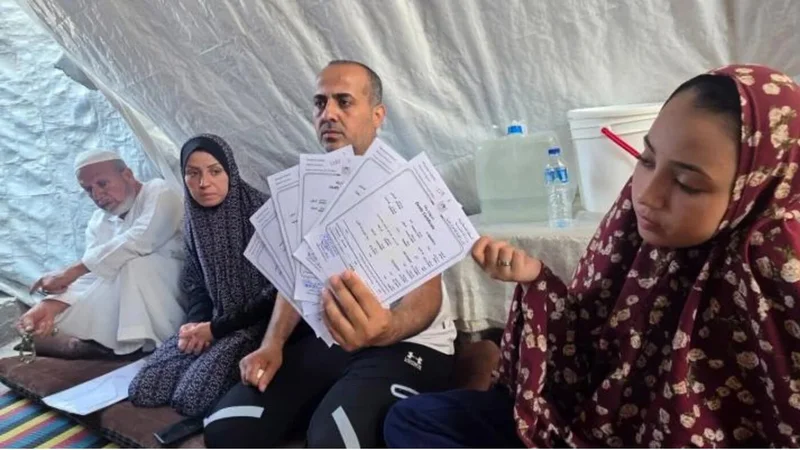
'Instead of my children being there to welcome me, I was welcomed by their six death certificates'
- Ahmed al-Siqali
“What did my children do to have their dreams taken away and be killed like this?”
Since the beginning of the war, Israel has killed more than 21,000 children in Gaza and the West Bank, according to the United Nations. Thousands more are missing and presumed dead.
“Instead of my children being there to welcome me, I was welcomed by their six death certificates,” al-Siqali said.
At Nasser Hospital, al-Siqali’s wife, Hayat, 36, was waiting for him.
“I received the news of his release at 2pm, after two weeks without knowing anything about him,” Hayat told MEE.
“My heart pounded, and I wanted to fly to him, yet I didn’t know how to face him without our six children.”
When the Red Cross bus arrived, relatives and friends ran towards al-Siqali and embraced him.
Hayat remained frozen.
“I couldn’t run. I couldn’t even walk. I felt completely unable to move.”
When al-Siqali approached her, their reunion after nearly three years apart was silent and filled with tears.
Then Hayat told him: “Forgive me. I couldn’t protect what you entrusted to me.”
Hayat had endured the family’s loss while recovering from her wounds and being repeatedly displaced.
“After the strike that killed our children, I was in terrible psychological pain because of losing them. I was also physically injured,” she said.
A new reality
The family now lives in a tent in al-Mawasi, Khan Younis.
For al-Siqali, adjusting to life there has been another ordeal.
“It is extremely difficult for him to adjust to life in a tent, especially during the summer, when the heat burns our bodies,” Hayat said.
More than 90 percent of Gaza’s buildings have been damaged or destroyed, forcing nearly 1.9 million people into displacement, including 800,000 living in makeshift tents, according to the United Nations.
The tents offer little protection from the elements and leave people exposed to insects, rodents and disease.
“When we returned from the hospital to our tent, I cannot describe the expression on my husband’s face,” Hayat said.
“He was shocked by the scale of the destruction and the broken roads. Now, inside the tent, he is facing another shock: the primitive conditions in which we are living.”
For Hayat, her husband must now find a way to rebuild a life that has been shattered.
“Beyond losing our children, he now has to support us, yet as a construction worker, he faces a completely collapsed sector in Gaza.”
Back in the tent, al-Siqali spends much of his time lying on a thin mattress, scrolling through photographs of his children saved on his phone.
Their six death certificates lie beside him.
He looks at them, holds them close and repeats: “This is all I have left of them.”