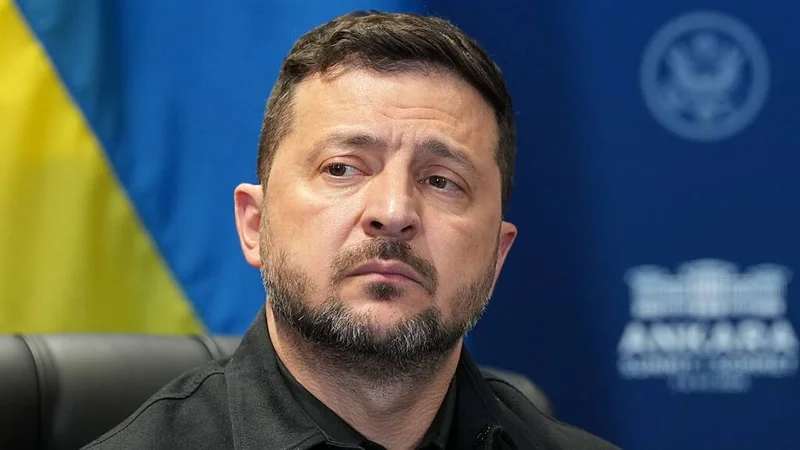
Ukrainian anti-corruption agencies have announced they are investigating senior officials in President Volodymyr Zelensky’s office, a day after the country’s recently sacked defence minister called for national elections despite the ongoing fight against Russia’s invasion.
The revelation brought another test of Mr Zelensky’s political resilience as Ukraine’s war with its bigger neighbour stretches into its fifth year.
Investigators are conducting an operation to expose a criminal organisation allegedly led by a sitting and a former legislator, involving senior officials from the presidential office and other individuals, according to a joint statement from Ukraine’s National Anti-Corruption Bureau and the Specialised Anti-Corruption Prosecutor’s Office.
Further details would be released later, the agencies said in a joint statement.
Mr Zelensky made no public comment on the investigation but issued a decree dismissing Iryna Mudra from the position of deputy head of the Office of the President.
Mr Zelensky remains dogged by high-level graft investigations.
Last year, his chief of staff Andriy Yermak resigned and was later named as a suspect in a major graft probe involving a luxury construction project in the biggest threat to Mr Zelensky’s government since Russia’s invasion in February 2022.
Also last year, a major embezzlement and kickbacks scandal involving the state-owned nuclear power company brought the resignations of Ukraine’s justice and energy ministers.
The European Union has identified deep-seated corruption as one of the major hurdles to Ukraine’s desired membership in the bloc.
Mr Zelensky is already under pressure over his sacking last month of defence minister Mykhailo Fedorov, one of the longest-standing members of his team and a close ally since he helped Mr Zelensky win the 2019 presidential election.
Mr Zelensky, seeking to reconcile tensions between the Defence Ministry’s young and tech-savvy innovators and Ukraine’s seasoned, Soviet-trained battlefield leaders, risked angering both sides by reshuffling his wartime leadership.
He ousted both Mr Fedorov, whose changes to military procurement aimed to stamp out corruption, and commander-in-chief General Oleksandr Syrskyi.
That sparked days of street protests in support of Mr Fedorov.
For Mr Zelensky, it was the second time in a year that a wartime decision triggered a strong public backlash, after he moved in mid-2025 to curb the powers of anti-corruption agencies.
Mr Fedorov, in a video address posted to YouTube late on Tuesday, called for elections to be held in Ukraine in a bombshell statement that appeared to directly confront Mr Zelensky, who says a ballot cannot be held under the martial law in place due to the war.
“We must find a legal, safe and realistic mechanism that will allow Ukraine to restore a full democratic process even amid a prolonged war,” Mr Fedorov said.
He said Ukraine is facing a systemic crisis in how it is governed, arguing that the current system is oriented towards protecting itself and resisting change.
He also condemned corruption among officials without naming anyone, saying it had weakened Ukraine’s ability to fight the war.
Mr Zelensky’s office did not immediately comment on Mr Fedorov’s address.
It was not immediately clear whether Mr Fedorov’s appeal for a ballot would resonate with Ukrainians.
Russian President Vladimir Putin, who has baulked at negotiating a peace deal directly with Mr Zelensky, asserts that the Ukrainian president is an illegitimate leader because his term expired in 2024.
Ukraine’s parliament approved Mr Zelensky’s candidate, Yevhenii Khmara, as the new defence minister in a vote on Wednesday, a move that effectively closes the door to Mr Fedorov’s return to the post, which he has sought, any time soon.
Legislators also gave their consent for Andrii Sybiha to stay on as foreign minister after holding the post in an interim role.
The political disarray comes after recent successes in the war for Ukraine.
Using its innovative drone technology, it has repeatedly hit Russian oil facilities, causing fuel shortages.
It has also shocked the Russian public by striking warehouses of Wildberries, Russia’s biggest online retailer, and stalled frontline advances by Russia’s bigger army.
But Mr Zelensky has been unable to get traction in US-led peace efforts, and Ukraine is at the mercy of Russia’s ballistic missiles because more US-made Patriot interceptors are not available due to low international stockpiles.
In its latest strike on oil facilities, a drone hit an oil refinery in Ufa in Russia’s Bashkortostan, its governor Radiy Khabirov was quoted as saying by Russian state news agency RIA Novosti.
The city of Ufa is located roughly 1,300 kilometres (800 miles) east of the border with Ukraine.
There are three oil refineries in Ufa, and all three have been attacked before.
Russian air defences overnight intercepted 453 Ukrainian drones over multiple Russian regions, as well as occupied Crimea and the Black Sea, the Defence Ministry in Moscow said on Wednesday.
The Defence Ministry said Russian forces on Tuesday evening hit a bulk carrier in the Black Sea, south east of Odesa, that was carrying military equipment.
On Wednesday, the Russian military struck what it said were fuel and lubricant storage tanks for the Ukrainian armed forces in the southern port of Chornomorsk.
In Ukraine, a Russian drone attacked a minibus in the southern Kherson region on Wednesday morning, killing four people, said Oleksandr Prokudin, head of the Kherson regional military administration.
Four women were wounded in the strike and were taken to hospital, he said.
A Russian drone struck a civilian car in Kherson city, the region’s capital, on Wednesday, killing a woman, Mr Prokudin said.
Amid the fighting, Russia and Ukraine each sent home 103 prisoners of war on Wednesday, according to Mr Zelensky and the Russian Defence Ministry.