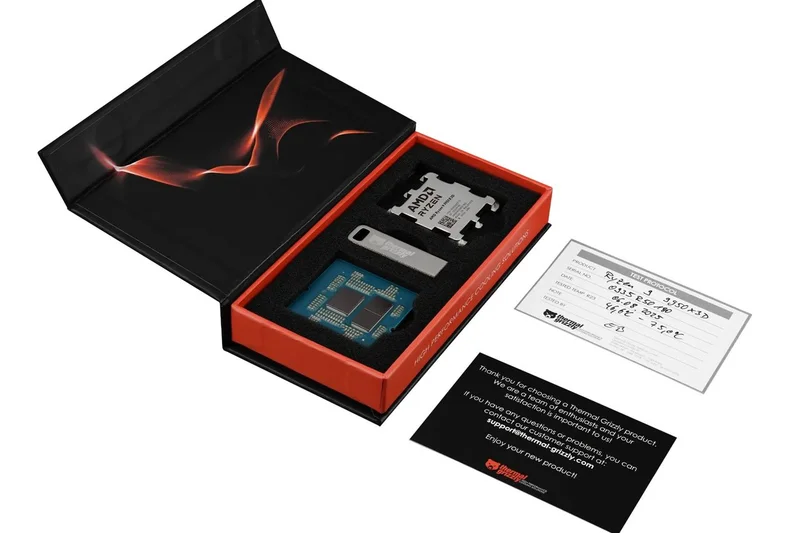
Thermal Grizzly has started selling its delidded version of AMD's already-excessive Ryzen 9 9950X3D2 Dual Edition, and here's the hard part up front: it will set you back a cool $1,402.83. That price is, obviously, rather difficult to justify on the face of it, but Thermal Grizzly does at least provide considerably more than a CPU with the heatspreader yanked off.
- Intel VP Robert Hallock sets Nova Lake expectations, teases return to Raptor Lake for DDR4 platforms
- CPU scaling with DLSS
- Intel's one-two punch plan in desktop CPUs is taking shape
- Benchmarking AMD's BC-250, offering Steam Machine-like performance at half the price
- AMD splits Zen 7 into three EPYC families for 2028 and starts selling server CPUs by the agent
The company thoroughly cleans and tests each processor after delidding, records its measured operating temperature, and includes a USB stick containing the test results and a microscope image of the exposed processor. More importantly, Thermal Grizzly provides a 24-month worldwide warranty; that's welcome in light of the fact that delidding the processor naturally voids AMD's own warranty.
The firm even goes a step further than you might expect on the warranty front. Under German law, the burden of proof normally shifts after the first 12 months of a purchase, but the company's warranty explicitly states that this reversal does not apply to its TG Delid CPUs. In other words, Thermal Grizzly continues to take responsibility for the product throughout the full 24-month warranty period rather than automatically putting the burden on the customer after the first year. That's a meaningful bit of insurance when you've just spent more than $1,400 on a processor that AMD won't touch with a ten-foot pole.
Paying more than $500 over MSRP could never really make any sense on a lower-end processor, and indeed we've reported on the high price of Thermal Grizzly's delidded CPUs before. But the Ryzen 9 9950X3D2 Dual Edition is AMD's halo desktop processor, with 16 Zen 5 cores, 32 threads, and a whopping 192MB of L3 cache thanks to its unusual dual-CCD 3D V-Cache configuration. It also carries a 200W TDP and can consume considerably more power under heavy workloads; AMD itself recommends liquid cooling for optimal performance.
For someone who insists on having the biggest, baddest AM5 processor possible, a factory-tested direct-die version with a warranty is certainly a more attractive proposition than buying a retail chip and breaking out the delidding tools yourself. Delidding a CPU and cooling the silicon directly can reduce the thermal resistance between the processor and cooler, which is all but guaranteed to help the CPU sustain its normal boost behavior with less aggressive fan speeds, making an extremely powerful system somewhat quieter. What it won't help with (at least, not much) is performance.
That's because Thermal Grizzly's warranty is surprisingly restrictive about what you're actually allowed to do with all that newfound thermal headroom. The warranty covers normal operation as well as "overclocking according to manufacturer specifications," but excludes operation outside AMD's specified values. Thermal Grizzly specifically warns that CPU and memory clock speeds beyond those specifications aren't covered. So, in practical terms, you're probably looking at AMD-sanctioned tuning such as PBO and EXPO rather than taking your naked Ryzen 9 9950X3D2 and seeing how far you can push it before the magic blue smoke comes out.
Which is a little ironic given that overclocking is one of the main reasons an enthusiast might be interested in going to the trouble of delidding a processor in the first place. What Thermal Grizzly is essentially selling you is a much better thermal envelope while telling you that the warranty doesn't cover you if you use that envelope to operate the CPU outside AMD's specifications. As we've just explained, it's not completely pointless, but if you're looking to do some serious overclocking, DIY might be a more attractive route (warranty details notwithstanding).
Get Tom's Hardware's best news and in-depth reviews, straight to your inbox.
Of course, before you decide if the extra $500 over MSRP for a delidded Dual Edition is worth it, you need to figure out why you'd want a Ryzen 9 9950X3D2 in the first place. Our own coverage of AMD's dual-CCD X3D processor found that it is by and large a halo product. The extra 3D V-Cache can provide meaningful benefits in certain workloads that can take advantage of the enormous amount of cache across both CCDs, but the gains aren't remotely proportional to the price premium over a Ryzen 9 9950X3D. Gaming performance, in particular, is generally exactly in line with the cheaper chip, and both typically run behind the Ryzen 9 9850X3D.
That's not to say the 9950X3D2 is a bad processor. Quite the opposite; rather, it's an extremely impressive stack of silicon, and AMD's decision to put 3D V-Cache on both CCDs makes it arguably the most exotic desktop processor the company has ever produced. It's just also very much a "because we can" product for people who want the best and don't particularly care what it costs. If you're one of the relatively small number of people whose workload genuinely benefits from having that much cache across 16 cores, there's a good chance you're doing that work on a workstation or EPYC system rather than spending your days trying to justify a $1,400 delidded AM5 CPU.
Still, if you've got the money to build a machine around the Ryzen 9 9950X3D2 Dual Edition, the extra $500 might not be a deal-breaker. For the price, you get a cooler-running, quieter system, and as long as you don't go ham on the overclocking, Thermal Grizzly has your back for 2 years. Just make sure you also buy your cooling equipment from Thermal Grizzly, because regular Socket AM5 cooling hardware may not mount up correctly to a delidded CPU.
Zak is a freelance contributor to Tom's Hardware with decades of PC benchmarking experience who has also written for HotHardware and The Tech Report. A modern-day Renaissance man, he may not be an expert on anything, but he knows just a little about nearly everything.