Political parties are being urged to go back to hate crime and hate speech recommendations laid out by the inquiry into the Christchurch terrorist attacks.
The Law Commission released the final report from its review on hate crime laws this week, calling for a strengthening of the system rather than new offences.
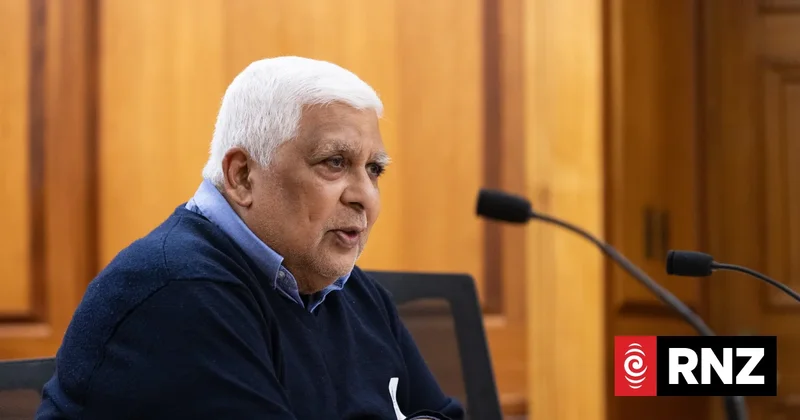
But Federation of Islamic Associations (FIANZ) spokesperson Abdur Razzaq told RNZ that although the Law Commission had done a thorough job, it was far too constrained by its terms of reference, which kept hate speech as well as anything not already considered an offence out of scope.
"The Law Commission had an excellent engagement process, I mean, A+. But their hands were tied," Razzaq said.
FIANZ has for years been pushing for the work of the Royal Commission of Inquiry to be continued, with Razzaq saying that would be "the baseline" for safety for all New Zealanders.
"We know there's a direct connection between hate speech and hate crime. Even the Royal Commission emphatically said so, and then also the Human Rights Commission, in their report, said an extraordinary link.
"The latest police data is there's one hate crime against a Muslim ... every 54 hours."
The data he referred to points to a 7 percent increase in recorded hate crimes against Muslims in New Zealand - the most targeted religious group - from 2024 to 2025 (September to August).
Razzaq said he met recently with some of the victims of the Christchurch terror attack who survived.
"They still have the bullets in their body, and it's oozing pain ... the thing is, every single case of terror in the last eight years, every single one, bar none, there was hate rhetoric before."
Successive governments had failed to implement the hate speech changes the Royal Commission of Inquiry recommended, with Labour having botched two attempts, first having "absolutely made a hodge" of explaining hate speech then "just went in a totally different tangent".
"Then National came in: too-hard basket," Razzaq said. "Not just 'too hard' basket, it's a 'never-never' basket".
"It's a political hot potato. They said, 'oh, we have to have the the balance between ... free speech'. We totally agree, but we've had hate speech legislation since 1993. It just does not cover faith, it covers all the others.
"Look, other countries have done it ... even in the United States where they have freedom of information, the First Amendment. States also have limits."
The Free Speech Union on Wednesday backed the Law Commission's report which "landed where we and thousands of submitters urged it to".
"This is a win for every New Zealander who took the time to speak up," said Free Speech Union chief executive Jill Heather said in a statement.
"What we opposed was building new, vaguely defined crimes on top of a concept as slippery as hate, and that is exactly what the Commission has declined to do."
Heather pointed to more than 4000 New Zealanders responding "through our submission tool, adding to the thousands who have consistently rejected attempts to turn subjective judgements about 'hate' into new criminal offences."
Razzaq however rejected the suggestion the original efforts to introduce hate speech laws had faced pushback other than from the Free Speech Union.
"They came up with a report that 'we had 10,000 people who were against the legislation', now who were the 10,000, it was click and send.
"I asked the Free Speech Union, were there 10,000 different people? They said, 'look, we don't know, it's just one site'. So somebody could have sat there and just click, click, click, click, click ... that is not public opinion."
He urged action, saying the risk of failing to make changes would allow hate speech - particularly against religious groups - to continue.
"The risk is we'll have a lot more Brian Tamakis. The risk is we're going to have a fractured society. The risk is people will be able to incite violence against faith communities, and they'll get away with it."
Destiny Church leader Brian Tamaki last month called on followers to "purge" Muslims, Sikhs and Hindus from New Zealand.
Police are investigating, and Prime Minister Christopher Luxon dismissed Tamaki's comments, saying he did not listen to him, while Labour leader Chris Hipkins called him a "thug".
Political parties had mixed stances on hate speech reform, with the Greens and Te Pāti Māori saying they supported legislating against hate speech, National saying it did not, ACT calling for more enforcement of current laws, and Labour promising to share a detailed policy in due course.
RNZ sought comment from Justice Minister Paul Goldsmith, but he said he had nothing to add at this stage to his statements about the Law Commission's findings.
RNZ has also sought comment from Labour.
FIANZ in 2024 published a report outlining definitions of hate speech, including:
- Racial or Ethnic Hate Speech: Expressions that denigrate or demean individuals or groups based on their race or ethnicity
- Religious Hate Speech: Speech that vilifies or promotes hostility towards individuals or communities based on their religious beliefs or practices
- Disability-Based Hate Speech: Expressions that mock, belittle, or demean individuals with disabilities.
- Xenophobic Hate Speech: Speech that fosters animosity, prejudice, or discrimination against individuals or groups based on their nationality or immigration status.
The report gives a further "litmus test" used by some other countries:
- Describing group members as animals, subhuman or genetically inferior
- Suggesting group members are behind a conspiracy to gain control by plotting to destroy western civilisation
- Denying, minimising or celebrating past persecution or tragedies that happened to group members
- Labelling group members as child abusers, paedophiles or criminals who prey on children
- Blaming group members for problems like crime and disease
- Calling group members liars, cheats, criminals or any other term meant to provoke a strong reaction