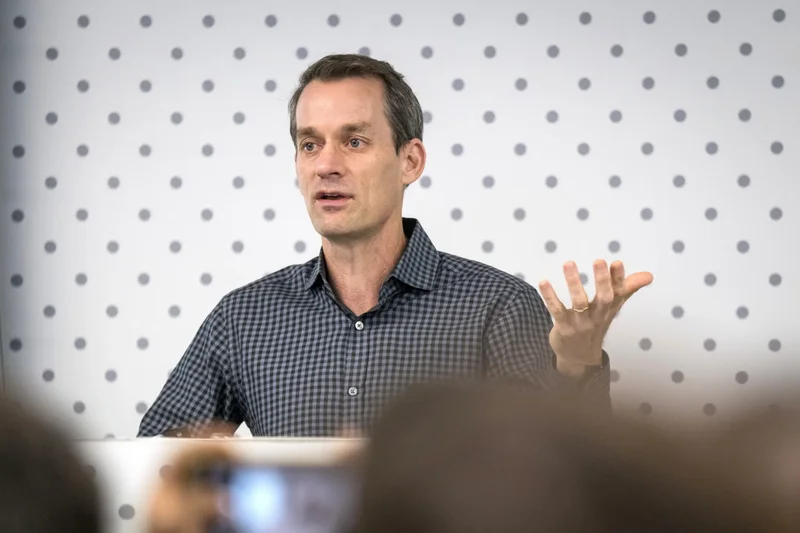
Trying to keep up with AI developments can feel like a losing game, and Jeff Dean, who has spent the last three decades working on the new technology at Google, says Gen Z shouldn’t even try to master it all. Instead, his advice is simple: Skim widely and look for connections others might miss.
“I often tell students it’s better to skim 10 papers than to read one in detail because you then get 10 points in your cloud of what might be possible,” Dean said yesterday at the Asian American Scholar Forum’s 2026 Frontier & Pioneer Symposium in his first public talk since leaving Google.
“Or, even skim 100 abstracts because what you want to be able to do is connect important ideas that have not yet been connected.”
For young people entering the tech field, Dean’s advice is less about cutting corners than learning how to use time wisely and think broadly. That approach, he said, can identify solutions to problems that previously seemed unsolvable—and help narrow an appropriate timeline.
A problem that could take 20 years to solve is probably too ambitious if you don’t have a clear idea of how to attack it, he added. But a problem that can be solved in two years may be too obvious to produce a major breakthrough.
“The perfect shape of a problem that you want to work on in a reasonably long-term manner [is] like five years or something,” Dean said. “Try lots of things that might not work. Some of them will.”
AI can put Ph.D.-level expertise in everyone’s hands, according to Dean
Dean stepped away from Google earlier this month after working at the company for 27 years, notably serving as the head of Google AI from 2018 to 2023 and Google’s chief scientist from 2023 to 2026. The 58-year-old is now the cofounder and CEO of DiscoveryLoop, an AI company focused on accelerating scientific and engineering discovery.
Despite predictions that the technology could lead to massive unemployment and widening wealth inequality, Dean remains bullish on AI’s potential to improve lives.
“The vast majority of the uses of these models is incredibly positive for the world. Like advancing AI in healthcare and AI in education…being able to make people able to solve problems they couldn’t solve on their own will make people able to do more,” Dean said. “And I think that’s super exciting.”
And while Dean acknowledged that even he doesn’t have a “magic answer” and frequently encounters failure, part of his optimism comes from AI’s potential to give people access to expertise that once would have required years of specialized training.
“By building models that are really good at understanding many many different domains of science and engineering you can get Ph.D.-level expertise in a model across many different domains,” said Dean, who graduated with a Ph.D. in computer science from the University of Washington in 1996.
AI leaders are promising a ‘new golden era’—but the hype faces a reality check
Dean isn’t unique in his optimism. Some of the biggest names in tech have made even bolder predictions about what AI could mean for humanity.
Demis Hassabis, Nobel laureate and chairman of Google Deepmind has predicted that AI could radically transform industries like healthcare, energy, and space.
“In 10, 15 years’ time, we’ll be in a kind of new golden era of discovery that [is] a kind of new renaissance,” Hassabis previously told Fortune. In addition to curing diseases, he said he foresees AI unlocking new materials to solve the energy crisis through fusion or solar breakthroughs, eventually allowing humanity to “travel the stars and … explore the galaxy.”
Elon Musk has been even more bullish about AI’s impact. The Tesla and SpaceX CEO believes the advancement will be so great that goods will be abundant and money will not be a major factor.
“Don’t worry about squirreling money away for retirement in 10 or 20 years,” said the world’s richest man on the Moonshots with Peter Diamandis podcast earlier this year. “It won’t matter.”
Challenges, however, persist—especially when it comes to public skepticism. Anthropic CEO Dario Amodei recently acknowledged on X that promises of AI have begun to sound hollow to the public.
“At this point, saying that AI will cure cancer is more a cliche than it is inspiring, and most people think it is deceptive. The thing that will work is actually curing cancer,” Amodei said. “I think by far the most accurate criticism of AI companies including Anthropic is that we haven’t yet delivered on our big promises to benefit the world. That is totally on us.”
breaks the traditional barrier between audience and newsroom. The show transforms
Fortune DailyFortune’s trusted reporting into actionable, conversational, and entertaining insights for an emerging class of business leaders.
Watch here.