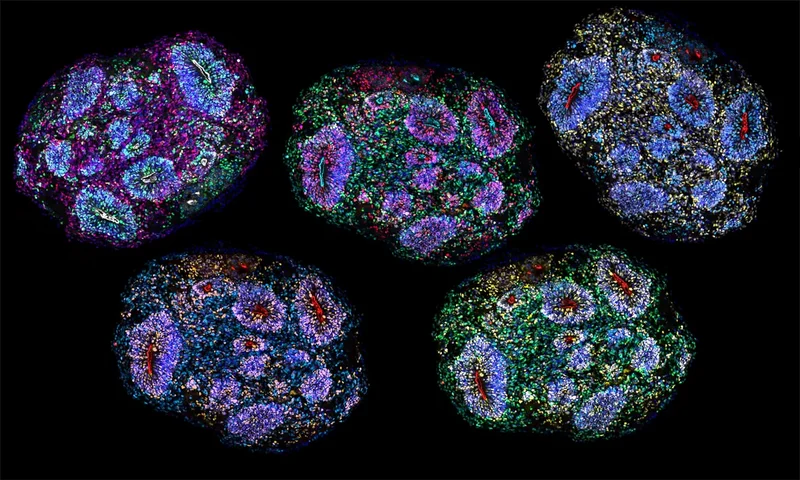
Lab-grown “mini brains,” called brain organoids, kind of look like navy beans—and have very little in common with a functional human brain. These tiny clumps of neural tissue are grown from stem cells and mimic the earliest stages of brain development. Scientists typically culture organoids for just a few months, allowing them to study how the cells begin to grow and organize into more complex tissues.
But what happens if they let the tissues develop for longer? In a new study published today in Nature, researchers sustained brain organoids in the lab for years, dramatically extending the organoids’ longevity and opening new opportunities to investigate neural development and disease.
“There are parts of development and maturation of the human brain ... that we really don't know very much about,” says Harvard University stem cell researcher Paola Arlotta, senior author of the new study. Hoping to replicate some of those little-understood developmental stages, she says, “we decided to push this and say, ‘Okay, let’s go way farther.’”
On supporting science journalism
If you're enjoying this article, consider supporting our award-winning journalism by subscribing. By purchasing a subscription you are helping to ensure the future of impactful stories about the discoveries and ideas shaping our world today.
Arlotta and her team documented the organoids’ progress over five years before submitting their research. And then the team continued culturing some for two more years before ending the experiment. In a growing medium designed to support neuronal activity, the organoids maintained a diverse collection of brain cells while they underwent changes in gene activity, cell types and other features that mirrored those seen during normal human brain development. They also appeared to mark the passage of time, with their DNA accumulating chemical tags called methyl groups, which scientists often use to estimate a person’s biological age.
The organoids showed signs of “maturation and even aging like you see in an actual brain,” says Madeline Lancaster, a developmental biologist at the University of Cambridge, who was not involved in the new research. This suggests that some of the instructions governing brain development are built into cells, allowing them to grow and arrange themselves independently into neural circuits. “It’s a very exciting study and really showcases the power of self-organization,” Lancaster says.
She adds that more mature organoids could be useful for studying neurological disorders that tend to emerge in adulthood, such as schizophrenia, Alzheimer’s and Parkinson’s disease. Still, Arlotta thinks there’s a limit to how far these organoids can mature. They lack blood vessels and large-scale neural architecture, not to mention the sensory input that comes from having a body—all key drivers of development in standard brains. “At some point, you need much more,” Arlotta says.
Brain organoids pose significant bioethical concerns, including the prospect that they may be able to feel pain. Scientists, philosophers, lawyers and religious scholars regularly gather to discuss such questions, but given the vast differences between organoids and the brain, Arlotta says that it’s considered “highly, highly, highly unlikely” that they are even faintly conscious. Though scientists don't know what gives rise to conscious experience, it’s widely believed to emerge from the interplay between complex, diversified brain networks that process sensory input and direct our interactions with the outside world—structures and functions that are absent in organoids.
Still, the closer these tissues come to resembling actual brains, the more cautious researchers must be. “We need to reexamine as we go along,” Arlotta says, “because there is the potential to generate a system that is more and more complex.”