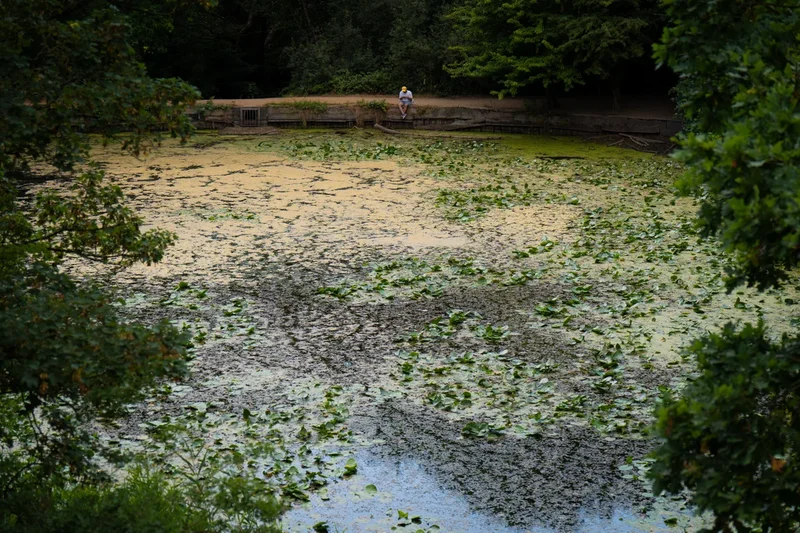
London’s first official bathing spot has been hit by a toxic algal bloom, as swimmers have been warned to avoid the river.
The Ham and Kingston site on the Thames became a bathing spot as recently as May this year.
However, the Environment Agency (EA) issued a formal notice on Tuesday cautioning against swimming, warning: “Bathing is not advised, due to pollution from harmful algae.”
Staff from the regulator have taken samples of the water since May, checking for harmful bacteria and to establish the water quality.
Marlene Lawrence, who founded local swimming group Teddington Bluetits said swam in the river before the warning notice was issued.
“Instantly on Sunday night I came out in a really bad rash, itchy spots, and that’s not like me. I can only attribute it to the algae in the river,” she told The Times.
The semi-retired swimmer, who helped secure the site as a bathing spot, first noticed signs of algae last week.
She believes the consecutive record-breaking heatwaves are behind the water pollution.
According to the EA, during an algal bloom, the water becomes less clear and may become blue-green or greenish-brown.
Scums can form during calm weather when several bloom forming species rise to the surface. This can look like paint, mousse or small clumps.
Cyanobacteria or ‘blue-green algae’, a type of blooming algae, can produce toxins. These toxins can kill wild animals, livestock and pets. They can also harm people, producing rashes after skin contact and illnesses if swallowed.
An Environment Agency spokesperson said: “We have identified blue-green algae on the lower River Thames including the Ham and Kingston designated bathing water.
“We are working with the Royal Borough of Kingston upon Thames, who have put signage in this location to warn people that it is not safe to swim.
“An advice against bathing notice has been activated on the Swiminfo website.”
The spokesperson also warned that it was likely the section of the River Thames between Hampton and Kingston had also been affected.
“It is important that members of public do not enter the Thames along this stretch. It is also vitally important to keep dogs out of the water,” they urged.
It comes as a sobering new assessment has revealed that a mere 14 per cent of England’s rivers, lakes, and coastal waters are currently in good ecological health.
The findings come from the Environment Agency’s first update in six years, conducted under retained EU legislation governing water quality.
This comprehensive evaluation scrutinised 4,658 of the country’s rivers, lakes, estuaries, canals, and coastal waters, measuring their health against a range of standards including wildlife populations, overall water quality, and the condition of physical habitats.
The report indicates that just 14.3 per cent of surface water bodies achieved an overall good ecological status in 2025, with widespread issues attributed to sewage spills, agricultural nutrient runoff, and pollutants emanating from urban areas and roads, such as litter, petrol, and garden pesticides.