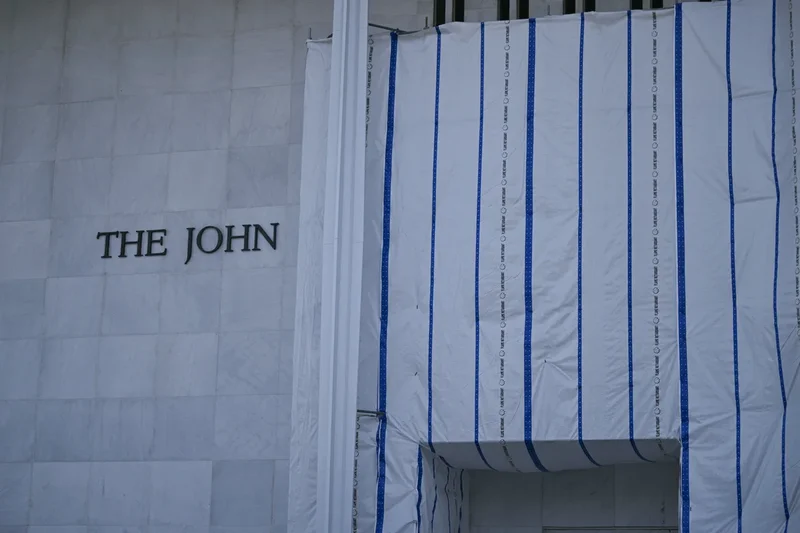
In June, construction workers erected tall scaffolding at the Kennedy Center’s entrance and covered their work with a massive white tarp as they chipped Donald Trump’s heavy metal name plates from the building’s marble facade.
But the scaffolding and tarp were kept in place even after the work was done. They have now been there for more than two months, fueling speculation that the construction crew never actually removed the president’s name from the performing arts venue — or have been told to keep the scaffolding in place while the venue’s Trump-dominated board fights to put his name back.
Lawyers for the Department of Justice told a federal judge on Tuesday night that the scaffolding needs to stay there while workers perform “water testing and structural repairs to the roof.”
“The protective barrier around the scaffolding was and is a necessary element of the ongoing construction activities at the Center — during the removal of the name, it served as a safety barrier for ongoing construction activities and helped safeguard the marble facade of the building in light of reported panel damage,” they wrote.
That “reported panel damage” appears to have come from construction crews stripping Trump’s name off the building, according to plaintiffs who are suing to stop the Trump-led changes.
Trump’s name was removed from the building after a federal judge ruled that Congress made it “crystal clear” that the memorial to President John F. Kennedy is only to be named after the assassinated former president, “and it cannot bear any other formal name or public memorial” based on a “unilateral say-so.”
Last week, the institution’s Trump-controlled board of trustees voted to close the venue for two years as part of a renovation plan that is still tied up in litigation. That initial plan included renaming the venue “The Donald J. Trump and John F. Kennedy Memorial Center for the Performing Arts.”
But under the resolution approved by the board, Trump’s name will re-appear on the building to thank him for the multi-million dollar renovations.
An inscription will read “Restored and Renovated by President Donald J. Trump” — directly below Kennedy’s name.
The board also voted to name the area where the building is located “President Donald J. Trump Plaza.”
With those changes in mind, the Kennedy Center “will utilize the existing scaffolding to access, investigate, and engineer structural repairs to the overhead soffit, which will enable further repairs to be made while minimizing delay, public disruption, and cost redundancies,” lawyers for the venue said Tuesday.
But that “overhead soffit” is roughly 20 feet above the scaffolding, according to lawyers for Democratic Rep. Joyce Beatty, who filed a lawsuit last year to stop the Trump-led changes.
Keeping the scaffolding in place is “a strong indication that this structure has nothing to do with the roof and is, instead, meant to defy a return to the status quo,” they wrote.
The Justice Department also has not offered up any details on what construction projects are left, why they require a tarp, and when they will be completed, according to Beatty’s legal team.
“Final removal of the scaffolding and its barrier is contingent upon the scope of any repairs required at present to the marble facade, as well as any other necessary repairs,” lawyers for the Kennedy Center said.
That explanation “is impossible to square with their assertions that they need the tarp and scaffolding to examine the roof,” Beatty’s lawyers replied.
The congresswoman’s legal team has argued that the board’s latest attempts to close the Kennedy Center and add Trump’s name to the building are a legally dubious workaround to defy the court’s orders against changing the name.
The Kennedy Center is trying “to frustrate the intent of the court’s order that the Center be returned to a memorial exclusively honoring President Kennedy,” lawyers wrote.
The latest renaming resolution “is a breathtaking act of defiance,” they said.
Before last week’s board meeting, the board was presented with a 163-page proposal for renovations, which could exceed $560 million — more than double the $257 million Congress had already eyed for the project.
The resolution that was ultimately approved by Trump’s hand-picked board will approve a renovation plan from real estate firm JLL that is expected to cost roughly $250 million.
Renovations are expected to be completed by summer 2028.
According to the resolution, the board will remain “fully committed” to continue supporting arts programming during the two-year closure to maintain the “historic and architecturally significant nature of the center’s main building.”