Christopher Nolan’s rendition of The Odyssey is arguably the movie of the summer. The cinematic masterpiece was filmed in IMAX and included a soaring score from an award-winning composer, but the original presentation of the epic poem in the ancient world would have been a much humble affair.
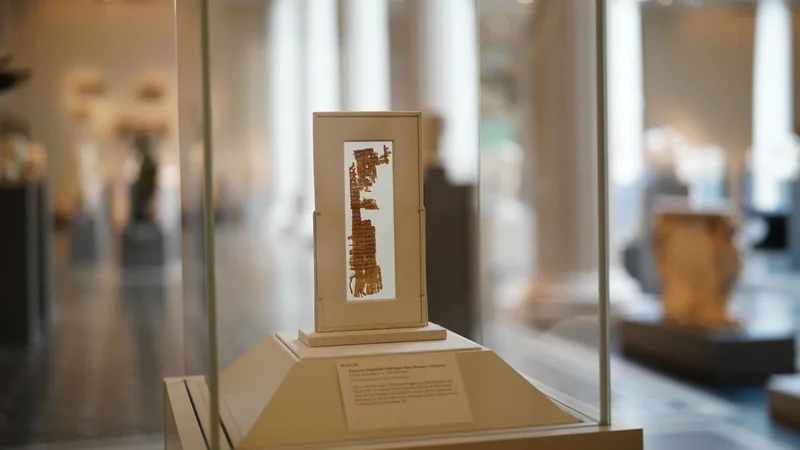
Before it was written down, bards recited the adventures of Odysseus and the Greeks orally. Most scholars assume that the Iliad and the Odyssey were composed sometime between the eighth century and the mid-seventh century BCE, and finally copied down by the mid-sixth century BCE. The earliest known fragment from the Odyssey is from the third century BCE—and New York City’s Metropolitan Museum of Art (MET) has put it back on view.
“This fragment is so interesting because three lines are different than the lines that we have today in Homer’s Odyssey. And we know that there were many versions of Homer’s Odyssey and Iliad because they were epic poems,” Séan Hemingway, Greek and Roman art curator at the art museum said in a recent video. “They were oral poems that were recited by bards across the land, and they would occasionally embellish and have different versions of these stories.”
In the third century BCE, Egypt was ruled by the Ptolemies. The Macedonian dynasty built the city of Alexandria and founded its famous library in the early third century BCE. The library was the Hellenistic world’s greatest collection of Homeric texts.
The Odyssey fragment was discovered in 1902 in Hibeh, Egypt and purchased by the MET in 1909. The fragment is also the first known early Ptolemaic fragment of the epic poem. It was written down on papyrus—a sheet made of papyrus stalks—which was the ancient Greek’s material of choice for permanent texts.
“It’s incredibly rare to have a fragment like this of such an early book,” said Hemingway. “You can actually look at both sides of this fragment and you can see how the papyrus is put together in a kind of a weave pattern and you can see that beautifully on the back. This fragment of Homer’s odyssey has been off view for many years, and we’re pleased to put it back on view in the Greek and Roman galleries.”