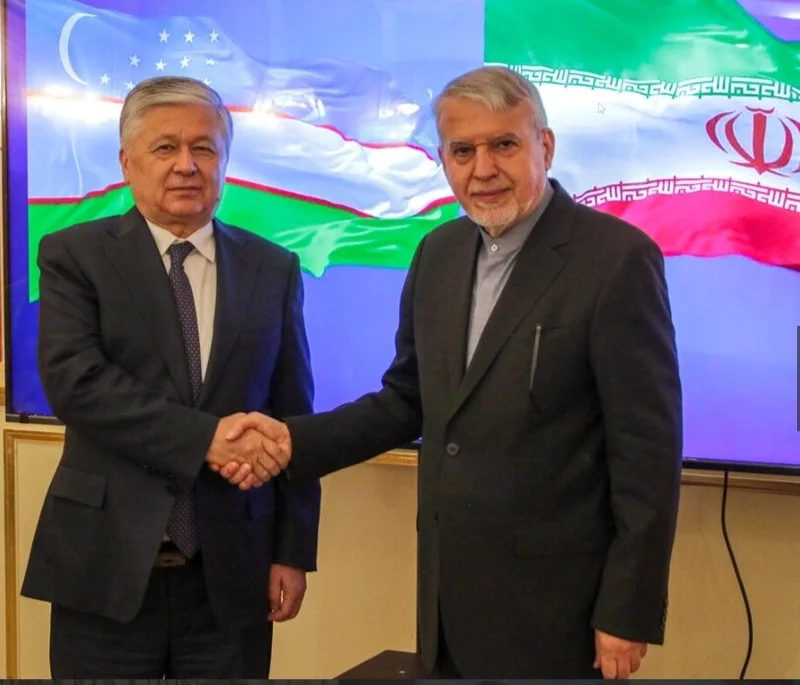
Tehran, Tashkent explore stronger tourism ties
TEHRAN – Iran and Uzbekistan should turn their shared cultural and civilizational heritage into practical tourism programs and joint projects, Iran’s Minister of Cultural Heritage, Tourism and Handicrafts Seyyed Reza Salehi-Amiri said on Tuesday.
Speaking at a meeting with Bahram Jan Aliyev, Uzbekistan’s deputy foreign minister, at Tehran’s Sa’dabad Historical and Cultural Complex, Salehi-Amiri highlighted the two countries’ extensive common capacities in cultural, historical, tourism and economic fields.
He said recent talks between Aliyev and Iranian deputy foreign ministers had been productive and could open a new chapter in bilateral relations.
Recalling his previous visit to Uzbekistan during his tenure as head of Iran’s National Olympic Committee, Salehi-Amiri said he had felt as though he were visiting Iran’s central city of Isfahan when he toured Samarkand and Bukhara.
“Seeing the handicrafts, tiles and beautiful artworks there, I realized that we have these works in our own country as well and share them with Uzbekistan,” he said.
The minister emphasized the deep ties between the two nations, saying Iran and Uzbekistan shared cultural, social, economic and even political commonalities.
Salehi-Amiri proposed the establishment of a joint tourism working group and called for stronger people-to-people ties, saying Iranians were interested in learning about Uzbekistan’s history, civilization and traditions, while Uzbeks were similarly interested in Iran.
He said the two countries’ presidents were determined to expand bilateral relations and stressed the importance of strengthening ties between their peoples.
“Tourism is an area in which there are no restrictions between us and Uzbekistan,” Salehi-Amiri said, adding that current tourist flows between the two countries did not reflect their potential and should be increased.
He proposed the development of joint and multi-destination tours as a key way to achieve this goal, with shared travel packages centered on the historical, cultural and civilizational attractions of Iran and Uzbekistan.
The minister also identified medical tourism as an important area for bilateral cooperation, citing Iran’s medical specialists, well-equipped hospitals, relatively low costs and existing capacities as potential advantages.
He further called for stronger air links between the two countries, saying the expansion of Iranian and Uzbek airlines could help boost bilateral tourism.
Salehi-Amiri also stressed the role of public and media diplomacy in promoting Iran’s tourism potential. He said Iran would invite Uzbek celebrities, influential figures and media professionals to visit the country to help introduce its historical, cultural and civilizational attractions.
He added that the national broadcasters of the two countries could also help showcase Iran and Uzbekistan’s tourism capacities to their respective audiences.
The minister called for a joint meeting between Iranian and Uzbek private-sector economic and tourism operators, describing the private sector as the two countries’ “greatest capacity” for developing tourism ties.
He said Iran had targeted 8.5 million tourist arrivals in the previous year but received six million due to wartime conditions. Given the country’s tourism potential, he added, Iran is seeking to achieve its target during the second half of the current year.