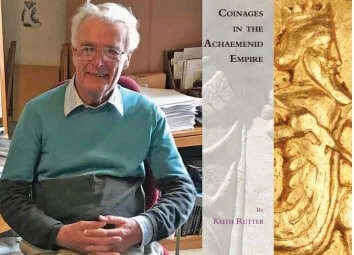
Persian Empire: New scholarly work sheds light on Achaemenid monetary systems
TEHRAN - A major new scholarly work on the monetary systems of the Achaemenid Empire was published earlier in July, offering the first comprehensive account of the diverse coinages that circulated across one of the ancient world's most expansive and administratively complex territories.
Titled Coinages in the Achaemenid Empire, the book is the final contribution of the late Emeritus Professor Keith Rutter of the University of Edinburgh, a world-renowned specialist in ancient numismatics who passed away in October 2024 after a short illness.
Published by Edinburgh University Press, the volume forms part of the Edinburgh Studies in Ancient Persia series and runs to 376 richly illustrated pages.
The study addresses the challenge posed by the Achaemenid Empire's vast scale, which has long left scholars grappling with disparate and fragmentary evidence. Professor Rutter's work demonstrates that the coinages struck within the empire offer distinctive and vital perspectives on how the realm was organized and administered. This numismatic evidence holds particular value for its firsthand, contemporary nature, speaking directly to modern researchers without the filtering lens of later Greek or Roman historiography.
Drawing together evidence for coin production and use across the whole of the Achaemenid Empire, the book reveals that actual minting was largely confined to the western satrapies, from Asia Minor to Egypt, while also looking eastward to communities and kingdoms where Greek cultural influence was often absent a significant departure from most previous studies, which have concentrated on coinage's spread westward into Hellenic lands.
Professor Rutter offers an exhaustive examination of the wide variety of coinages issued under Achaemenid rule, encompassing not only the familiar royal coinage of the Persian kings but also the numerous local and regional issues struck by satrapal administrations, city-states, and vassal kingdoms. The iconography found on these pieces, he argues, raises fresh questions about artistic cross-currents, the minutiae of provincial governance, and the religious beliefs that permeated imperial society. The book moves logically from an overview of the empire's administrative framework and the nature of its royal coinage to detailed regional surveys of Thrace and Asia Minor, the Cypriot kingdoms, the Levant including Phoenicia and Philistia and Egypt, before concluding with a dedicated chapter on coinage produced directly by the royal administration.
Beyond its numismatic focus, the work treats coins as integral components of the broader systems of exchange and resource allocation that sustained the Achaemenid state. The famous coin deposits unearthed in the Apadana at Persepolis receive thorough analysis, with the longstanding puzzle over the selection of those specific issues carefully reconsidered.
Alongside the publication, Catherine Rutter, daughter of the late Professor Rutter, has contributed a personal reflection on her father's final work. In her remarks, she recalls a significant journey to Iran undertaken with her father in 2017, as his research was nearing completion. Travelling together in the favorable autumn climate, they visited Persepolis, Pasargadae, and Naqsh-e Rostam an experience she describes as offering invaluable insight into the physical and cultural landscape of the Achaemenid heartland, and one that reinforced her father's longstanding admiration for Persian history and its people.
Intended as the definitive point of departure for anyone seeking to understand this complex subject scholar, student, or general reader alike Coinages in the Achaemenid Empire stands, with its comprehensive scope and clarity of exposition, as a fitting final testament to a distinguished academic career that spanned decades and inspired countless students and colleagues.
AM