In the vast majority of fantasy video games, the world is populated by more than just humans. Mankind is typically accompanied by a range of different species or races, and The Blood of Dawnwalker has no intention of bucking that trend. Vampires are not the only creatures you’ll be bumping into on your journey through Vale Sangora, but that doesn’t mean you’ll find your typical elves and dwarves at the local tavern – this is a place that doesn’t play to the normal rules.
Developer Rebel Wolves has taken a very particular approach to its fantasy worldbuilding. Its sentient races lean far more into ideas established in folklore than they do Tolkien or Dungeons & Dragons. One of the best examples of that is the impish, tooth-thieving sanzhana.
“They play on a lot of tropes around pixies from folklore, but of course with our own twist,” says creative director Mateusz Tomaszkiewicz. “There are a number of quests that utilize them and I'm very excited to see how people will react to them.”
Sanzhana are strange creatures, somewhat akin to moths spliced with small humans, complete with blue skin, white markings, and fuzzy abdomens. And, as our recent gameplay footage demonstrates, they have a curious interest in teeth, so much so they’ll forage from corpses and barter with bandits to obtain their victims’ gnashers.
But why would Coen, our young and noble protagonist, ever indulge a pixie’s request for molars and incisors? Well, the reward could well be much more valuable than a few gold coins. “They allow you to play with the time limit,” Tomaszkiewicz reveals, “because there are a lot of myths around pixies where they get to do some time-bending stuff. And for us, since our game is so heavily revolving around the time system, this was something cool to play around with.”
“I think it's very cool when you do systemic stuff to have exceptions from it and some ways that impact it in ways you didn't anticipate,” he adds. “It creates this feeling that something unexpected might happen at every turn and there are still secrets to be found.”
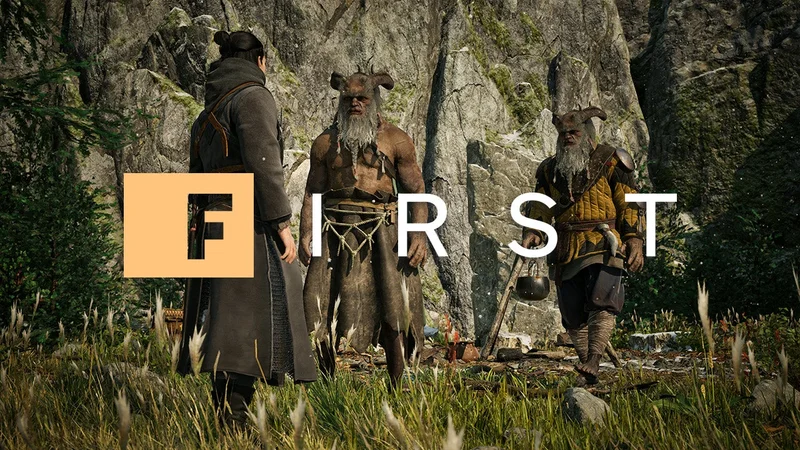
Sanzhana are powerful, but they’re also rare – you won’t pass by dozens of them as you wander through the world’s villages. Fulfilling a role more similar to that of traditional fantasy game races is the uriashi, a species of towering, beast-like humanoids.
You’ll frequently spot them working alongside humans, providing significant extra muscle for garrisons. But their role in society is relatively new – after being hunted to near-extinction in a previous age, the uriashi only recently re-revealed themselves to humanity.
“They live high up in the mountains in places that were inaccessible to humans,” explains Jakub Szamalek, The Blood of Dawnwalker’s narrative director. “They actually ensure that they are inaccessible, they'd cause a tiny little avalanche to make sure that their secrets are kept safe.” All that considered, actually finding the uriashi’s village on Dawnwalker’s map will be “a whole adventure of its own.”
While the humans of Vale Sangora were largely clueless to the existence of the uriashi, the vampire lord Brencis had already discovered them. “So he showed up at their village and he said, ‘Well, I call the shots now and I'm enlisting you guys’,” reveals Szamalek.
Szamalek and the Rebel Wolves team have gone to great lengths to create a distinct, believable culture for these mountain giants. Their village is made of rocks, moss, and twigs, with houses built to blend in with the mountainside to help maintain their secrecy. As people who spend their winters holed up in caves, they’ve developed incredible patience. And they have their own political structures, which naturally causes some division among their society.
“They're quite conservative,” Szamalek explains. “So the overall feel of the culture is to keep things the way they are and not experiment and that also becomes a bit of a tension in one of the stories.”
But creating a new race is not just about identity and culture – it also requires some thought about how the uriashi interact with their neighbours. That forced Rebel Wolves to consider the uriashi vocabulary and how they sound in conversation.
“They're really intelligent creatures, but they don't know the human language very well,” Szamalek says. “Their vocal situation isn't necessarily conducive to speaking a human language. They struggle to talk and their grasp of grammar is not necessarily very strong.
“I think the first reaction is to take them for dumb brutes,” he adds. “But the more time you spend with them, you realize that they're more sophisticated than that.”
While the uriashi may struggle with human words, they have no such issue with magic – something Coen can take advantage of when interacting with their peoples. Coen can, of course, learn spells, curses, and hexes – they’re one of the three branches of his skill tree. And, if you’ve seen any of those abilities in action, you’ll already know that Rebel Wolves has crafted a very particular approach to the supernatural arts.
“There are no fireballs, there are no lightning bolts, there's no elemental magic in the D&D sense of the word,” explains Szamalek. “It's more like dark voodoo arts. A lot of it revolves around giving your own blood in order to draw from some cosmic power. The visual element of it is subdued.
“You're basically opening a channel of communication with some course that you don't truly comprehend and certainly cannot control,” he adds.
Magic has multiple purposes in Vale Sangora, far beyond Coen’s abilities to increase his running speed and summon spectral birds. One of the monsters we’ve seen, for instance, is the gargoyle, a sort of jury-rigged automaton that Szamalek suggests is the product of magic and a dark imagination.
While there are no doubt more races and creatures to discover in the valley, the last one Rebel Wolves highlighted for me during my IGN First visit to the studio was kobolds, Dawnwalker’s take on a fantasy classic. Among the most famous kobolds in games are World of Warcraft’s candle-capped rat men and the strange reptilians that plague the Nashkel Mines in Baldur’s Gate. Rebel Wolves’ interpretation shares some common ground, but they’re a new twist on the idea, turning them into something akin to dark, chittering goblins.
“They're the nasty little creeps that live in caves and mines,” Szamalek says. “They are sentient, but they're difficult to talk with. They are very impulsive and greedy and vicious, but they have sort of a high mentality. They're unable to think quietly, so whatever they're considering they will say out loud. When dealing with them, this can be used to your advantage because you can sort of see what they're up to, but it also makes coming to some sort of agreement with them difficult because you don't know if they're just thinking about something or if they're actually planning to do it.”
No doubt there are more species to meet than just pixies, uriashi, and kobolds – my conversations with Rebel Wolves have made it clear that our journey will see us meet far more than just humans and dead humans with fangs. And with the sanzhana set to twist time and the uriashi primed to teach us magic, I can’t wait to see what other opportunities each new culture and group can offer.
*Matt Purslow is IGN's Executive Editor of Features. *