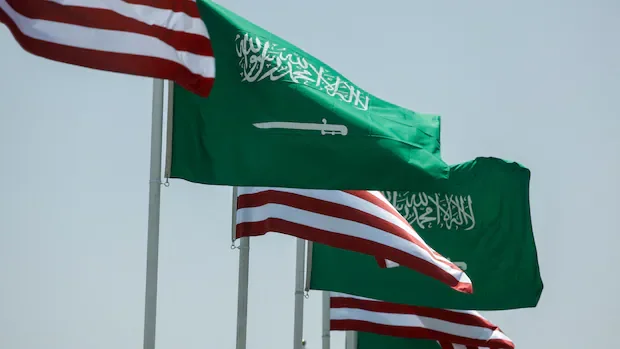
Trump says Saudi nuclear deal hinges on normalizing relations with Israel. Here's what we know
Lawmakers have 90 session days to prevent new deal from going into force
U.S. President Donald Trump said Thursday a new agreement reached with Saudi Arabia for a civilian nuclear program will require the kingdom to normalize relations with Israel through the Abraham Accords, a move Saudi Arabia has long rejected.
Trump's comments come after U.S. and Saudi Arabia announced the agreement Wednesday, letting Riyadh enrich uranium and build nuclear reactors using U.S. technology, without requiring the snap United Nations inspections that Washington has demanded from Iran.
The move has alarmed some U.S. lawmakers and regional states concerned about weapons proliferation. Washington's top regional ally Israel, which has also repeatedly voiced opposition to the idea of a Saudi civil nuclear program, welcomed the prospect of Saudi Arabia joining the Abraham Accords — a series of diplomatic agreements first signed in 2020 that normalized relations between Israel and some Arab states.
Here's what we know about the deal, the concerns raised and what it could mean for the region.
What does the deal include?
The White House and Saudi Arabia have not made public the text of the nuclear co-operation agreement, known as a "123 agreement," alongside what the Trump administration described as a "bilateral safeguards agreement."
Under Section 123 of the U.S. Atomic Energy Act of 1954, the U.S. may negotiate agreements to engage in significant civil nuclear co-operation with other nations.
It specifies nine non-proliferation criteria those states must meet to keep them from using the technology to develop nuclear arms or transfer sensitive materials to others.
The announced deal was signed Wednesday by U.S. Energy Secretary Chris Wright and Saudi Minister of Energy Abdulaziz bin Salman.
The pact is expected to last 30 years and involve U.S. firms in the program's development — if passed by Congress.
Saudi's Energy Ministry on Wednesday said the agreement bolsters "efforts to diversify energy sources, advance cutting-edge technologies, and expand opportunities for co-operation and investment in ways that serve the mutual interests of the two friendly countries."
Why is uranium enrichment a key concern?
A key issue is whether Washington might agree to build a uranium enrichment facility on Saudi territory, when it might do so, and whether Saudi personnel might have access to it or it would be run solely by U.S. staff in a "black box" arrangement.
In a post on social media, Trump said the deal does not allow for enrichment of uranium.
Non-proliferation experts have raised concerns that the deal fails to include guardrails to prevent enrichment of uranium to weapons-grade levels.
WATCH | Why this nuclear deal is so significant:Without rigorous safeguards built into an agreement, Saudi Arabia, which has uranium ore reserves on its territory, could theoretically use an enrichment facility to produce highly enriched uranium, which, if purified enough, can yield fissile material for bombs.
The agreement does not include the International Atomic Energy Agency's "additional protocol," which would allow for more monitoring, inspections and verification, according to a second person familiar with the decision who spoke with The Associated Press.
Deal hinges on Saudi acceptance of Abraham Accords
Trump said the agreement "will be approved, but is totally subject to Saudi Arabia joining the very respected and successful Abraham Accords."
White House press secretary Karoline Leavitt said later Thursday that the U.S. will continue conversations with Saudi Arabia.
The Saudis have made clear that normalizing relations with Israel would first require the establishment of a clear path for Palestinian statehood. Israeli Prime Minister Benjamin Netanyahu has rejected the idea of Palestinian statehood as being untenable for his country's security.
The Saudi Embassy in Washington declined to comment Thursday on Trump's assertion the deal will require the kingdom to join the accords.
WATCH | From 2020, signing of the Abraham Accords::Netanyahu's office in a statement applauded the prospect of Saudi Arabia joining the Abraham Accords as a "historic leap forward for peace in the Middle East." The statement made no mention of the deal to bolster Saudi's civil nuclear program.
Trump has sought to build on the 2020 agreements, which expanded the number of Arab and Muslim-majority nations with diplomatic ties with Israel. Saudi Arabia is the most important Arab power in the Middle East, and Trump believes the kingdom joining the accords is critical to establishing long-term stability in the region.
The aftermath of Israel's war in Gaza and the nearly five-month-old U.S. and Israel war against Iran have complicated Trump's push to expand the accords.
The agreements have proved unpopular among the public in certain signatory countries such as Morocco and Bahrain, sparking widespread protests.
Still, the Trump administration has made clear it remains optimistic an agreement with Saudi Arabia on joining the accords can be sealed by the end of Trump's second term.
Other countries pursued nuclear deal
Washington and Riyadh have for years been discussing a nuclear co-operation deal that would give Saudi Arabia access to U.S. technology and American companies a chance to win big contracts for Saudi atomic energy facilities.
Should the U.S.-Saudi pact fail, even at this late stage, several countries with established nuclear industries have expressed interest or are seen as potential partners for Saudi Arabia's nuclear program.
State-owned China National Nuclear Corp. reportedly submitted a bid in 2023 to construct a nuclear plant.
WATCH | Trump announces landmark deal with Saudi Arabia Wednesday:Russia's state nuclear firm Rosatom, which built a nuclear plant in Egypt, has also signed preliminary co-operation agreements with Riyadh. Other potential contenders include South Korea, which built reactors in the neighbouring United Arab Emirates and France.
The choice of partner will likely depend on technological offerings, financing and geopolitical alignment, including conditions related to nuclear fuel handling.
Secretary of State Marco Rubio told reporters Thursday in Manila that the agreement would make certain that Saudi Arabia works with American companies instead of "competitors" to build its civil nuclear program.
What happens next?
The Trump administration said on Wednesday the deal has been submitted to Congress.
Lawmakers have 90 session days to prevent it from going into force, but only if they get the two-thirds majority to overcome any presidential veto.
United Nations nuclear watchdog, the International Atomic Energy Agency, said it is aware of a U.S.-Saudi plan to ask it to carry out verification work in relation to the nuclear co-operation deal they are discussing, but has yet to receive a request from them.
With files from Reuters