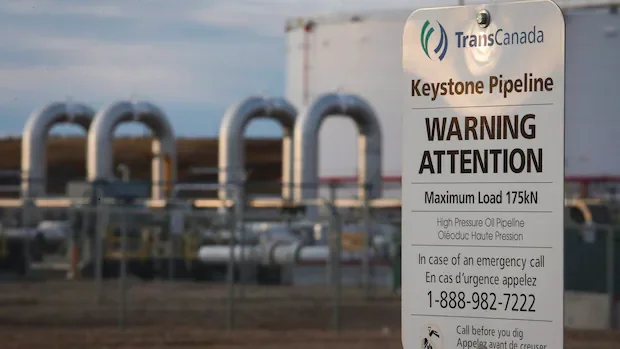
Key dates in Keystone XL pipeline as Trump claims contentious project being revived
Canada hasn't commented on Trump's claim expansion 'may be awoken from the grave'
U.S. President Donald Trump has claimed a contentious oil pipeline project is being revived as Canada and the United States continue negotiations aimed at staving off a new batch of U.S. tariffs on Canadian goods.
Trump wrote on his Truth Social website late on Tuesday that, "The great Keystone XL Pipeline, long ago killed by Sleepy Joe Biden, may be awoken from the grave!"
The U.S. president also shared an AI-generated image showing him lifting a massive pipeline tagged "KEYSTONE" out of a grave, with two American flags waving in the background and a headstone that reads, "Buried by Biden."
Canada has not commented publicly on Trump's claim that the project is being revived as part of ongoing trade talks. Washington said late on Tuesday that it was pausing planned 50 per cent tariffs on a range of Canadian goods for three days to allow for more negotiations.
Here's a look at some key dates in the history of the Keystone XL expansion.
WATCH | Trump seeks to revive parts of Keystone XL project:Initial proposal, and opposition grows
July 2008: Keystone XL was first proposed back when Stephen Harper was prime minister and U.S. President George W. Bush was finishing his second term. TransCanada — now called TC Energy — and ConocoPhillips, joint owners of the Keystone pipeline, pitched a major extension to the network. The expansion, dubbed Keystone XL, would carry hundreds of thousands of barrels of oilsands bitumen from Alberta to Texas.
March 2010: The National Energy Board approves TransCanada's application for Keystone XL, though the OK comes with 22 conditions regarding safety, environmental protection and landowner rights.
Aug. 26, 2011: After an extended review, the State Department releases its final environmental assessment, which echoes an earlier draft statement in saying the pipeline would have a limited environmental impact.
August—September 2011: Protesters stage a two-week campaign of civil disobedience at the White House as wider opposition to Keystone XL grows, particularly among environmental and Indigenous groups.
Obama rejects pipeline route
November 2011: The U.S. State Department says TransCanada must reroute Keystone XL to avoid an ecologically sensitive region of Nebraska. Days later, TransCanada agrees to reroute the line.
January 2012: U.S. President Barack Obama rejects Keystone, saying a timeline imposed by U.S. legislators did not leave enough time to review the new route. Obama says TransCanada is free to submit another application.
April-May 2012: TransCanada submits a new route to officials in Nebraska for approval. The company also files a new application with the State Department for the northern part of Keystone XL.
January 2013: Nebraska Gov. Dave Heineman approves TransCanada's proposed new route, sending the project back to the State Department for review. Pipeline opponents file a lawsuit against the Nebraska government claiming the state law used to review the new route is unconstitutional.
April 18, 2014: The State Department suspends the regulatory process indefinitely, citing uncertainty about the court case in Nebraska.
Jan. 9, 2015: The Nebraska Supreme Court throws out the legal challenge against the project.
January-February 2015: The U.S. Senate approves a bill to build Keystone XL. Less than a month later, Obama vetoes the measure.
Nov. 6, 2015: The Obama administration rejects TransCanada's application to build Keystone XL.
Trump promises Keystone XL
Nov. 8, 2016: Donald Trump wins the U.S. presidential election after promising several times on the campaign trail that he would approve Keystone XL if elected.
Jan. 24, 2017: Trump signs an executive order that he says approves Keystone XL, but suggests the U.S. intends to renegotiate the terms of the project.
Nov. 9, 2018: A U.S. federal judge blocks the pipeline's construction to allow more time to study the potential environmental impact.
March 29, 2019: Trump issues a new presidential permit in an effort to speed up development.
May 3, 2019: TransCanada changes its name to TC Energy.
March 31, 2020: Alberta agrees to invest $1.5 billion in Keystone XL, followed by a $6 billion loan guarantee in 2021.
April 7, 2020: Construction begins, despite calls from Indigenous groups and environmentalists to pause their efforts.
Nov. 3, 2020: Joe Biden defeats Trump in the U.S. presidential election.
Biden revokes permit
Jan. 20, 2021: Biden signs an executive order on his first day in office revoking the 2019 permit Trump issued for Keystone XL, which he says is not in the U.S. national interest. Prime Minister Justin Trudeau says his government is "disappointed" by the decision.
June 9, 2021: TC Energy says it has terminated the Keystone XL project "after a comprehensive review of its options, and in consultation with its partner, the Government of Alberta."
July 2021: TC Energy announces plans to file a claim under the Canada-U.S.-Mexico Agreement (CUSMA) to recoup $15 billion US in damages it says were caused by the cancellation of the project. The company argues Washington breached its obligations under CUSMA's predecessor, NAFTA.
Feb. 9, 2022: The Alberta government files a notice of intent to initiate its own "legacy NAFTA claim" under CUSMA over the U.S. permit's revocation. Alberta says it wants to recover its investment in the project.
December 2022: Nearly 130,000 barrels of oil leaks from a ruptured stretch of the existing Keystone pipeline in Kansas. The U.S. Environmental Protection Agency (EPA) says it's "one of the largest inland oil spills in recent history."
October 2024: South Bow spins off from TC Energy to take over its oil pipeline business.
July 2024: The International Centre for Settlement of Investment Disputes, an international tribunal, throws out TC Energy's claim for $15 billion US in damages against the U.S. government, citing a jurisdictional issue.
Trump 2.0
February 2025: Trump, who took office for a second term in January 2025, says the company behind Keystone XL should "get it built – NOW!" in a post on his Truth Social platform. A spokesperson for South Bow says the company has "moved on from the Keystone XL project" but will "continue to engage with customers to develop options to increase Canadian oil supplies to meet growing demand."
October 2025: Prime Minister Mark Carney tells Trump during a meeting at the White House that there's renewed national interest from Canada in the Keystone XL pipeline, a source with knowledge of the discussions tells CBC.
April 30, 2026: Trump signs an order authorizing a proposed project to transport Canadian oil across the border as part of an effort to revive parts of the Keystone XL pipeline. South Bow is partnering with U.S. company Bridger Pipeline on the proposal.
WATCH | Trump approves partial revival of Keystone XL:May 2026: South Bow says it will decide by mid-2027 whether to proceed with the proposed project. The 550,000-barrel-per-day Alberta-to-Wyoming pipeline, dubbed Prairie Connector, would not follow the same U.S. route as the project cancelled in 2021 but it would use some of the already-assembled Keystone XL pipe on the Canadian side of the border.
July 2026: The U.S. government says it reached a settlement with South Bow over the 2022 oil spill in Kansas, with the company agreeing to pay more than $26 million US in civil penalties. South Bow will also pay approximately $40 million US to prevent future spills and $3 million US to help Kansas conduct natural resource restoration projects, the government says.
Aug. 18, 2026: Trump says the Keystone XL project "may be awoken from the grave!" as he agrees to postpone new 50 per cent tariffs on a range of Canadian goods by three days. In his own statement about the postponed U.S. tariffs, Carney does not mention Keystone XL.
With files from Paula Duhatschek, Kyle Bakx, Rosemary Barton, Reuters and The Canadian Press