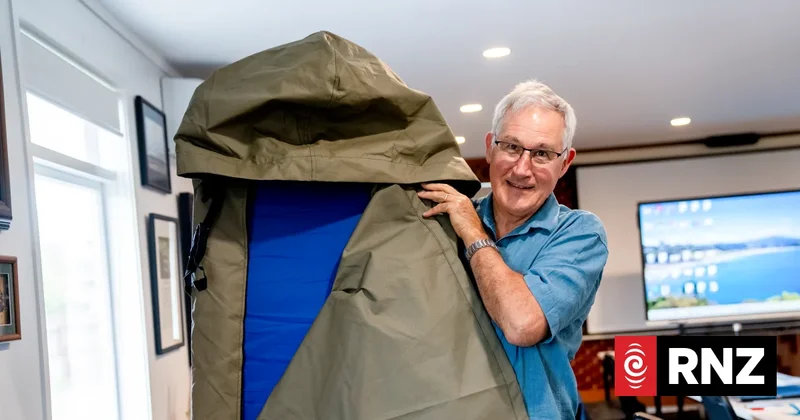
An Auckland man who has been sleeping rough for months says the gift of a shelter bag was a game-changer this winter, helping him stay warm while waiting for housing.
Rotary Clubs across the country have responded to increasing homelessness with a special fundraiser - they've imported a container of 1000 shelter bags for city missions and other charities to give out.
Lifewise has given 50 shelter bags to rough sleepers from its hub, at Merge Cafe on Auckland's K'Rd.
One grateful recipient is a man who was deported from Australia early last year and spent seven months homeless.
He wishes to remain anonymous.
"I wasn't sleeping. I was staying awake, crashing on the couch every 10 days or so. If you don't go to bed, you're not homeless which stems into obviously depression and drug addiction and stuff so it's all a cycle."
He said he hit rock bottom feeling isolated and cold, when he received a shelter bag.
The canvas bags have a mattress layer, are bigger than a sleeping bag, and roll up easily.
"Getting that shelter bag actually helped me on one of them [sic] times because it gives you a little something."
He said it provided him with warmth, security and comfort.
"Them bags, whoever funded them, they were a great idea. Just having that, especially in the winter months [when] it's unbearable each day is a question of, do I really want to be around?," he said.
"I don't want to go dark or anything, but for me personally, I'm hanging on by a thread some nights and that warmth may have kept me in the fight another day."
That link to Lifewise prompted him to ask for help and he is now living in housing.
"It's fantastic, the starting block, the stepping stone you need to become independent again, that's the difference between Australia and New Zealand. Australia has a lot more things that can help you and they do it for you, they really do."
First time homeless
A recent Salvation Army report suggests a growing number of people are finding themselves homeless for the first time.
The Homelessness Briefing, the fourth six-monthly report, also found 18 of 19 frontline homelessness services surveyed reported an increase in homelessness in the first half of the year.
"The profile of homelessness appears to be changing with more people becoming homeless for the first time alongside an entrenched pattern of repeat homelessness," the report said.
"Our respondents noted systemic pressures including insufficient housing supply, fragmented pathways into housing and support, and unmet demand for appropriate housing options."
It found there were not enough houses for those in need.
"Providers we had conversations with described pressure points across the housing continuum. They noted shortage of emergency, transitional, community, and permanent housing. Particular emphasis was placed on the lack of both one-to two-bedroom homes for older adults, as well as larger homes for families."
Link to government policy
That mirrors a community housing leader's warning on Wednesday that there is a direct link between growing homelessness and the government's decision to tighten emergency housing eligibility.
Central Auckland Rotary community leader Malcolm Stapleton said there has been a noticeable rise in rough sleepers across the country and they wanted to do something to help.
He said Rotary members in New Plymouth decided to fundraise for shelter bags last year and after its success they extended it around the country.
The fundraiser struck a chord, raising $150,000 to import 1000 shelter bags from a social enterprise in South Africa to distribute to those in need.
"We have an increasing number of people who are sleeping rough in our metropolitan centres," Stapleton said.
"These are your sons, sisters, brothers, fathers, daughters, nieces, uncles, aunts who for whatever reason need help," he said.
"We have found what we believe to be a light durable waterproof windproof piece of kit that can be carried around and will provide them with a little bit of comfort."
Auckland Council also bought 130 shelter bags through Rotary, for its outreach partners and community wardens to give out.
Its head of community impact, Dickie Humphries, said council had had feedback that the bags were providing much-needed physical relief from the weather and keeping bedding and belongings dry, reducing the number of items left on the streets when they became wet.
"While Auckland Council's position is that homelessness should be rare, brief and non-recurring, Rotary's partnership proposal to purchase shelterbags for people rough sleeping has provided an immediate relief opportunity."
Council's team leader for community safety Karen Smith said the wardens were often the first point of contact for people experiencing homelessness.
"Through their daily engagement and relationship-building across the city, wardens have been able to ensure the shelter bags reach individuals who will benefit from them the most."
She said a key focus has been to support a core group of permanent street whānau living in Auckland's CBD.
"These individuals remain on the streets throughout the year and often face complex challenges that can make it difficult to access accommodation and support services," Smith said.
"As some of the city's most vulnerable residents, they were among some of the first to receive the shelter bags."
The bag has an internal pouch and handle to sling over a shoulder, which Smith said reduced the need for shopping trolleys and other makeshift storage methods.
Permanent solution still ultimate goal
Lifewise's service manager for Merge Cafe, Paula Bold-Wilson, said the 50 shelter bags they gave out were very well received.
"They're excited and super grateful, often they're using multiple blankets if they're lucky and so to have something like a shelter bag it takes that urgency away."
She said the shelter bags were needed, but the ultimate goal was to find people housing.
"It's always urgent to house our street whānau but if we can't house them that night, that week, we still have these shelter bags."
Bold-Wilson said there needed to be more affordable social housing and funding for social services to address the underlying drivers of homelessness.
Looking ahead, the man with no more need for a shelter bag was grateful to be able to plan his future.
"Now that I'm slightly out of the city, I've got four walls and a roof and somewhere to put food, I can start planning," he said.
"My goals are going to take a long time, because I want my own proper place where if the day comes up, my kids are 18 and they need to come across or can come across, I can automatically say yeah, there's a room here for you."
Rotary clubs are already planning to fundraise for another container of shelter bags, for next winter.