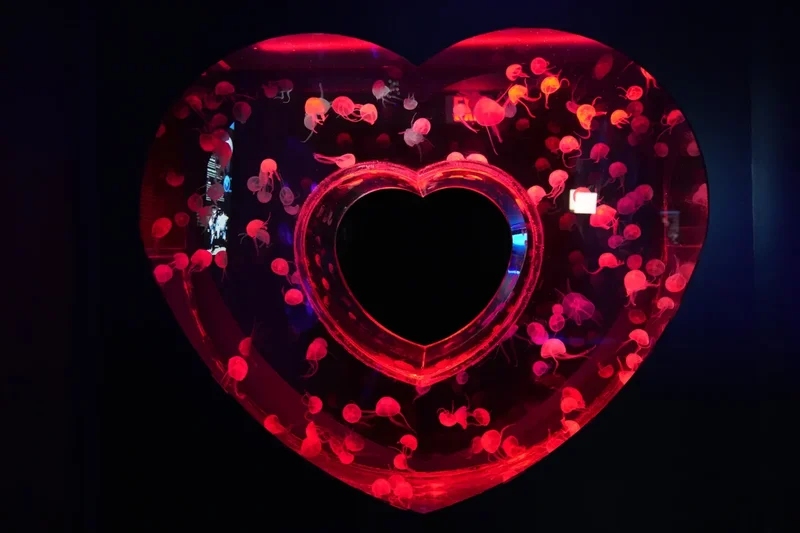
Inside a darkened venue in South Florida, glowing saltwater tanks and wall projections cast light upon tentacled predators as they swirl and pulse in hypnotic rhythms.
Located in Pompano Beach, just north of Fort Lauderdale, the private Jellyfish Museum is believed to be the first museum in the United States focused exclusively on the translucent invertebrates, and among a rare few globally, according to founders and local officials.
The space was established by Alex and Yana Yanovsky, who previously ran thriving aquariums in Ukraine, including a dedicated jellyfish museum in Kyiv. The founders were forced to abandon those venues when they fled the country following the 2022 Russian invasion, according to operations manager Jessica Eisenbarth.
Having launched this past spring, the site is the couple's first aquatic attraction since moving to the U.S., though they intend to expand further.
"When they left Ukraine, they moved to Florida, and then they immediately wanted to share their passion here," Eisenbarth said.
Jellyfish have inhabited the oceans for more than 500 million years, making them older than both trees and dinosaurs. Their ancient lineage adds to their appeal, alongside their rhythmic, pulsing motions. Composed mostly of water and lacking both a heart and a brain, the creatures possess a translucent appearance.
Yana Yanovsky came up with the idea for a specialized museum after noticing how popular jellyfish displays were across their other aquarium facilities.
"Jellyfish are some of the most resilient creatures on Earth. While they lack a brain, they maintain a simple nerve net that allows them to respond to their environment," Yana said in a statement provided by the city. "Their movement is mesmerizing, almost meditative, and they play an important role in marine ecosystems."
Monty Graham, director of the Smithsonian Environmental Research Center, said he is not surprised someone launched an aquarium dedicated entirely to jellyfish. He credits California's Monterey Bay Aquarium with starting the global trend of jellyfish exhibits. The Monterey facility introduced temporary jellyfish displays in 1985 before opening a permanent gallery in 1996.
"Jellyfish are cool, they’re things that people don’t get to see up close unless they’re scuba diving," Graham said. "So here was this opportunity, in a controlled environment, very beautiful settings. It clicked all the buttons and checked all the boxes, and it was a very good, positive thing."
The facility, spanning nearly 10,000 square feet (900 square meters), houses roughly 20 distinct species found in Florida waters and internationally. The museum can rotate different species across its 21 tanks. Current inhabitants include Japanese sea nettles, moon jellyfish, spotted jellies and upside-down jellyfish, which inhabit Florida's mangrove swamps.
The animals are obtained through licensed aquaculture partners, according to the city.
The space was converted from a former Wells Fargo bank branch using about $100,000 in community redevelopment grants from the city of Pompano Beach, and is designed to convey tranquility, general manager Iryna Pelypkanych said. Tour guides educate visitors on the ecological role of jellyfish and why protecting them matters.
"The biggest idea here is to leave people with the feeling that they know something more about the population of jellyfish," Pelypkanych said. "Because so far, we know around 4,000 different species that can be called jellyfish."