Since the day it was announced, Marvel Tokon: Fighting Souls has faced a difficult question: How can a new fighting game possibly live up to Marvel vs. Capcom? That legendary tag series is tied to some of the most memorable moments in genre history, with gameplay so fast and technical that high-level players are still sharpening their Magneto combos and yelling “IT’S MAHVEL BABY” decades later. It’s a lot to live up to.
Thankfully, Arc System Works does something clever with Marvel Tokon. By going in a different direction, it sidesteps these comparisons altogether. The studio’s latest is a unique spin that’s less about moving a single character at the speed of Quicksilver, and more about orchestrating a team to cover for each other’s weaknesses, like the battle-hardened Avengers.
The result is a fighting game that appeals to multiple crowds, appeasing genre veterans who’ve been hitting Iron Man infinites since the arcades while also simplifying things enough up front that first timers who love Marvel can fall down this rabbit hole (that ends with them buying a $200 fight stick). There are undeniable issues that keep the game from reaching its full potential, like unacceptable problems on PC, but it’s a compelling new take that avoids feeling like a back issue.
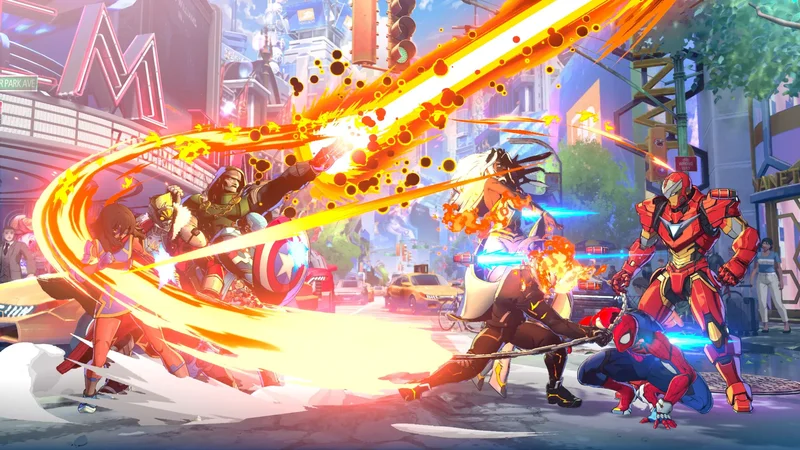
Like its spiritual predecessor, Marvel Tokon is a tag fighting game. While you actively control a single “point” character, you can call in the rest of your team to perform assist attacks or swap out with your current leader. As for the most obvious element that separates Tokon from what came before, you control four characters instead of three. That may not sound like a big increase, but it foreshadows something essential: tagging is really important.
Without the tag system, the central fisticuffs feel a bit limp. While Marvel Tokon has hints of the horizontal mobility found in air-dashing-focused “anime fighters” (think Dragon Ball FighterZ) or the superjumping verticality of Marvel vs. Capcom, these characters are on the weaker side without their buddies. This lower upfront power level is probably why initial reactions to Tokon were pretty tepid; if you’re not making the most of calling in assists, you’re not engaging with everything these bouts have to offer. However, once you start to get a grip on coordinating your team, each match becomes a multilayered battle of high-flying projectile wars and dastardly pressure sequences.
While teamwork is necessary, this doesn’t mean the individual characters are poorly designed. Each superhero has unique abilities that smartly reflect their in-comic personas and make them feel unique. Captain America tactically bounces his shield to control space, Loki sends out illusory clones to trick opponents, Black Panther overwhelms with speed, and J. Jonah Jameson was right, because Spider-Man is a damn menace.
At the start of each match, you only have two of your four team members available. As you lose rounds or perform a “wall break” by using certain moves in the corner, you gain access to the rest of your buddies. All four characters share a single health bar, meaning that unlike traditional tag games, where you start with your full squad and gradually lose allies until you’re down to Captain Commando and a dream, here things move in the opposite direction as you build forward momentum. This slow build creates a sense of progression throughout a fight, as both players become more powerful until the screen is full of projectiles and screaming dudes in spandex. When finally at full strength, it’s incredibly satisfying to cover unsafe attacks with perfect assist calls, sandwiching your foe like they’re a big bad getting wombo comboed in a climactic finale.
Here’s where Marvel Tokon’s clever balancing act between different target audiences comes into play. While the game has beginner-friendly considerations like autocombos and only forces you to learn a single point character, it also offers depth for those who want to control their team like a synchronized super group. Getting this down feels a bit like patting your head and rubbing your stomach at the same time, as you call in backup to cover your point characters’ weaknesses. Or you can constantly tag out allies to put them in advantageous positions, switching the point character to make the most of each teammate’s strengths — hit them with Spider-Man, who’s great at mix-ups, and then switch into Blade for a high-damage corner combo. Initial worries that this game seems too “dumbed down” have quickly bit the dust, especially after fighting game pro SonicFox recently terrorized the game’s biggest tournament yet with diabolical Green Goblin setups.
Even without leaning into advanced techniques, Marvel Tokon’s resource system sets up for interesting on-the-fly decisions. There’s a meter that lets you do EX moves and supers, as well as the Assemble Gauge, which is tied to calling in assists to extend combos or pressure. Do you go for max damage to win the round, or prioritize a wallbreak to unlock your fourth fighter earlier and make things easier in the long run? Do you spend all your meter on a big sequence, or keep some in the tank to aid in your next mix-up attempt? For a game that’s so hectic, it can also be surprisingly cerebral.
Beyond the tactical depth, these battles ooze style thanks to Arc System Works’ ever-impressive visual direction. By combining classic comic influences with anime maximalism, Marvel Tokon finds its own sense of cool. Slick character designs make it tempting to learn how to play virtually every member of the cast. Iron Man’s Proton blasts and Cap’s vibranium shield land with kinetic force, as the sharp animation work gets across the impact of each heightened blow. Deadpool embodies a loving approach to the source material, referencing like ten other fighting games in a single flashy combo while spouting well-delivered one-liners. (I relate to him every time he yells “Hey, I blocked that!” after getting hit.) Arc System Works rarely misses when it comes to over-the-top presentation, but even by that high standard, Tokon delivers.
A more surprising area where the game succeeds is its Episode Mode. While not as mechanically ambitious as Street Fighter 6’s World Tour, Tokon’s single-player nails something most fighting games are bad at: compelling storytelling. The narrative consists of five separate episodes, each following a different pre-made team of four heroes — or, in one team’s case, villains. These stories are delivered through a mix of anime cutscenes and motion comics illustrated by different artists.
What really holds it all together is author Kieron Gillen’s (Uncanny X-Men, Young Avengers, Phonogram) script. His tightly written one-offs deliver satisfying character arcs and surprisingly poignant moments, demonstrating a fundamental understanding of what makes each of these heroes tick. While the gameplay side of these episodes is only fine — battling bots will never match going toe-to-toe against flesh-and-blood opponents — these tightly constructed short stories deliver five to six hours well spent.
Unfortunately, there’s a Galactus-sized problem that hangs over the PC version of Marvel Tokon: This game is a technical mess, even after post-launch updates. I ran into near-constant crashes in Episode Mode, including one that caused a game-breaking error where I couldn’t get past the opening menu until I deleted my save file and started over. Not great!
More troubling is the game’s inconsistent framerate, something that is frankly unacceptable considering that timing is everything when it comes to fighting games. Even if you’re one of the lucky few hooked up to a $4,000 graphics card, this won’t save you when playing online. If your opponent has frame-rate issues, it can lead to choppy online matches on your end, even with a perfect internet connection. The game also seems to have matchmaking problems, especially in ranked mode, with players reporting fifteen- to twenty-minute wait times in heavily populated areas. While Arc System Works deployed a post-release patch that mildly improved frame rate and CPU utilization for some, this PC port is still nowhere near acceptable.
It’s a shame that you need a Tony Stark-tier supercomputer to run Marvel Tokon: Fighting Souls, because at its core, the game brings something new to the table. It strikes a smart balance between eras, drawing on classic Marvel flair while introducing a new kind of anime-inspired chaos via its four-versus-four battles. Arc System Works and Sony have a lot of work to do to salvage the PC port, but at least the game has the raw potential that makes it worth doing. Here’s hoping a future patch will save the day.
Marvel Tokon: Fighting Souls is out now on PlayStation 5 and Windows PC. The game was reviewed on Windows PC using a download code provided by Arc System Works. You can find additional information about Polygon’s ethics policy here.