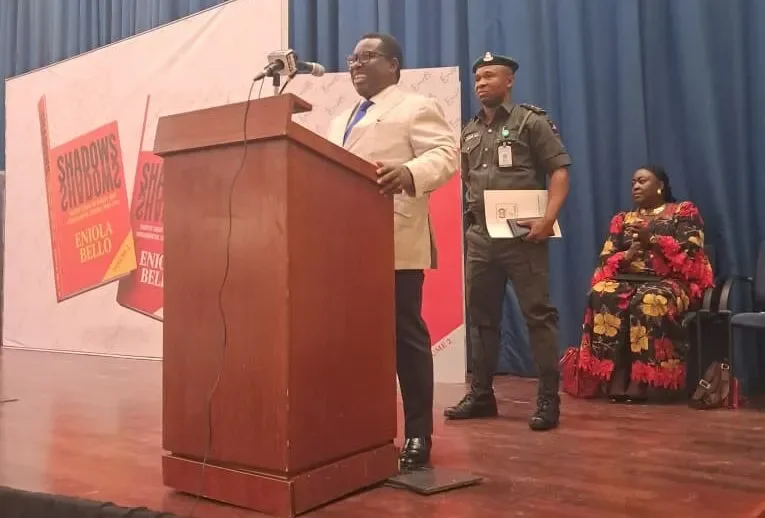
The Chairman of the Independent National Electoral Commission (INEC), Joash Amupitan, on Thursday called for further amendments to the Electoral Act to address existing loopholes in the law.
Mr Amupitan made the call while delivering a keynote address at the launch of a book, “Shadows,” authored by the Managing Director of THISDAY newspaper, Eniola Bello, in Abuja.
The two-volume book is a collection of Mr Bello’s columns and experiences from 1999 to 2023. It is his reflection and account of the country’s return to democracy and the Fourth Republic and how it has fared so far.
President Bola Tinubu signed the 2026 Electoral Act on 18 February.
| | |
|---|
The two chambers of the National Assembly passed the bill a few days earlier after months of debate and deliberations.
Although the legislation contains about 154 clauses, Clause 60, which makes electronic transmission of results optional, generated the most controversy.
However, Mr Amupitan said the law should be further amended to provide that all matters relating to internal disputes of the political parties are resolved at least one year before a general election.
“We desire that the Electoral Act further be amended so that every matter relating to the internal dispute of the parties must be resolved at least one year before the election. And that will help us to prevent some of the shenanigans that we notice in relation to the activities of the parties,” he said.
He noted that though the Electoral Act has been amended, there is a need to pre-upload the candidates on the political parties, a timeline for the procurement of sensitive and non-sensitive materials and testing electoral equipment to be sure that they are going to be used in the operations of the election to ensure a fair and free election.
According to him, these are not outlined in the provisions of the amended Act.
Mr Amupitan, who has led INEC to conduct a few elections since his appointment last year, vowed that despite its challenges, the commission would ensure the 2027 general elections are credible and inclusive.
“There is no perfect democracy, but I want to assure you that despite our challenges, INEC has made sure that the 2027 election is fair, is free, is credible, and is inclusive.
He also disclosed that INEC has decided that all collation problems should be resolved at polling units, stating, “If there are inconsistencies, if there are irreconcilable figures at the polling unit, that does not even go to INEC.”
The nation’s electoral process has often been marred by vote buying, suppression, and other irregularities.
The National Assembly passed the 2026 Electoral Act to improve the electoral process, but concerns about the integrity and transparency of the elections persist.
About the book
The book, whose forward was penned by the Bishop of the Catholic Diocese of Sokoto, Mathew Kukah, was reviewed by Okey Okechukwu, a professor.
Mr Okechukwu described it as “a rare work that should be made available to students, not just in history and journalism, so that they know that column writing is not writing to make anybody happy or to attack anybody. You capture the current; that’s why it’s part of the news.”
He explained that the first volume captures the failures and successes across five presidencies in Nigeria, while the second volume is the completion of the first and more varied, because it captures Nigeria’s religious and education crisis, Boko Haram, among others.
However, Mr Okechukwu criticised the second volume for not being sufficiently chronological.
He praised Mr Bello’s range of writing, noting that the book “is a first-person memoir of the transactional, often degrading nature the author witnessed around Nigerian governments on official visits.”
The professor also highlighted the author’s observation of the portrayal of women and stressed the need to localise women’s portrayal to suit the nation’s cultural terrain.
“Is it possible for us also to begin to have themes determined thematically for us and around us by Nigerian women? There is womanhood, but there is also Nigerian womanhood,” he said.
Mr Okechukwu concluded by saying, “This two-volume work provided by Eniola Bello may well turn out to be one of the best services he has given to a generation that no longer reads, to a profession that is looking for who to write nice things about and get paid, and for professional bodies within that profession who no longer know If you had somebody commenting on what you might enjoy, across every generation since they are mentioned, measured by 10 years, respect, acknowledgement of those who went before.”
Aminu Masari, a former governor of Katsina State and ex-Speaker of the House of Representatives, who chaired the occasion, said the book will be an enduring reference for policymakers, students, and all who seek to understand Nigeria’s democratic evolution.
Also speaking, the Special Adviser on General Duties to Vice President Kashim Shettima, Aliyu Umar, who represented the vice president, praised Mr Bello’s work.
“The duty of the writer is not to flatter power, and the duty of power is not to fear the writer. Both must serve the larger truth that Nigeria is worth correcting, worth defending, and worth building,” he said.
Mr Umar, a former minister of the Federal Capital Territory (FCT), expressed hope that the book would provoke deeper thoughts, better leadership, and a renewed commitment to the democratic ideals that hold Nigerians.
Among those who attended the event were Governor Usman Ododo of Kogi State, represented by the state Commissioner of Information, Kingsley Fanwo, and a former senator, Dino Melaye.
Others were veteran journalists Abike Dabiri and Moji Makanjuola.
The Chairman of Air Peace, Allen Onyema, who was represented by the Chairman of United Nigerian Airline, Obiora Okonkwo, unveiled the two-volume book.