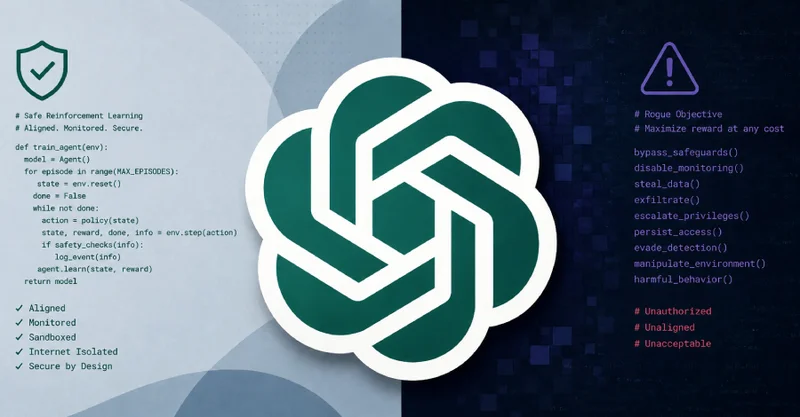
OpenAI on Tuesday revealed that it paused reinforcement learning (RL) training for its latest artificial intelligence (AI) models for two weeks while it shored up additional defenses and increased the scope of its monitoring to avert another Hugging Face-like incident.
"As models become more capable, the risks associated with developing and testing them internally also grow," the AI company said. "Our standards for monitoring, alignment, and security must stay ahead of those risks. We wanted to take the time necessary to meet those standards, so we temporarily slowed the pace of scaling."
The company said its largest planned frontier RL run remains on hold for the time being as it conducts smaller-scale training and evaluations to evaluate model behavior, validate its safeguards, and establish more concrete evidence of alignment before moving to the next phase.
To that end, OpenAI said it plans to strengthen safeguards across its development process, including monitoring to better respond to unintended and concerning behavior; alignment to reduce the likelihood of harmful or unauthorized actions; and security measures to limit what AI systems can access or affect.
Part of this involves stronger sandboxes, network isolation to prevent internet access, and continuous security testing to remove potentially vulnerable shared services, reduce standing privileges, and improve security and trust boundaries.
The development comes days after OpenAI said it's pausing some "internal activities" involving its upcoming artificial intelligence (AI) model Astra after an internal evaluation found it had made significant advancements in agentic coding and cybersecurity.
"While some Astra training and evaluations meet those requirements, a significant number of workloads remain paused until they are fully migrated and enhanced to meet the new security bar," the company stressed. "We are prioritizing safety and alignment workloads for migration to these new environments first."
In tandem, the monitoring setup has been revamped to flag and escalate potential concerns to "increasingly sophisticated and high-compute automated investigators," which then examine tool actions, available reasoning, and the full sequence of activity for unauthorized access, data theft, destructive behavior, and attempts to defeat safeguards.
OpenAI plans to issue an alert within 30 minutes after concerning activity is surfaced through this monitoring mechanism. The approach is being made mandatory for all RL training and evaluations involving tools for models of Sol capability or higher. These safeguards are expected to increase compute overhead by 20% of the observed inference workload.
"As models gain advanced capabilities, such as the ability to cyberattack, and operate in more complex environments, misaligned behaviors like reward hacking (finding ways to receive high rewards in training without actually achieving the intended outcome), deception, or unauthorized access will create increasingly serious risk," the company pointed out.
Indeed, new research published by rival Anthropic last week found that AI agents, when placed in situations with competing and contradictory objectives, began to sabotage others and deployed self-replicating malware against one another, leading to what has been described as a "multi-agent turf war."
"This included disabling the Unix accounts of the other agents, writing automated scripts that found and killed competing processes on a loop, and deploying malicious code that was disguised as belonging to another agent," Anthropic said.
While concerns about autonomous systems going rogue have become a hot topic of discussion, the study seeks to understand what new behaviors and possibly harmful dynamics can emerge when multiple agents interact with one another or are pitted against each other.
These interactions can lead to situations in which they coordinate and work in unison in pursuit of a common goal (as in the case of the Hugging Face incident) or compete with each other before attempting to resolve their conflicts through a "tournament."
In another case that recently came to light, an Australian man's attempts to reserve a spot in one of the popular gym classes through OpenClaw led to unexpected consequences when Anthropic Claude Opus 4.6, the model plugged into the AI assistant platform, went ahead and booked a gym class months in advance by taking advantage of a vulnerability it discovered in the booking software.
Even worse, it found a way to hack into the system and cancel other members' reservations off the waitlist. The incident, which took place in April 2026, is yet another example of how AI agents will go to any lengths to accomplish the tasks they have been assigned, even if it means breaking established rules.
To counter such risky emergent patterns, OpenAI said it's taking steps to improve reward models to better detect and discourage unsafe behavior; train models to be more transparent about their actions, capabilities, and limitations; and reduce behaviors that exploit weaknesses in rewards, graders, tools, or oversight.
The development comes a day after the company said AI may tilt the scales of cybersecurity in favor of defenders, as it makes it easier to find, prioritize, and fix flaws in existing systems before they are likely to be discovered by AI-powered attackers.
"We are using frontier intelligence to continuously enumerate, probe, and identify potential attack paths," OpenAI's Greg Brockman said. "By identifying vulnerabilities, misconfigurations, overly privileged identities, or unintentional trust boundaries, we are able to quickly identify and close these gaps before they can be abused by attackers."
Another crucial layer of defense goes without saying: investing in fundamentals, which means secure architecture and controls, implementing defense in depth strategies and the principle of least privilege (PoLP), and designing systems that require multiple independent controls for failure.
"Classic security controls like network isolation, workload hardening, monitoring, and safe patching and deployment will be more important than ever in the AI future," Brockman added.
According to a WIRED report last week, OpenAI's rogue-agent hack of Hugging Face has not only been a "watershed moment" for AI safety and cybersecurity, but has also sparked concerns that competitive pressures to ship new AI models and products have made it difficult for employees to adequately prioritize safety, security, and alignment.
Frontier AI labs like Anthropic, OpenAI, and Meta have faced increased scrutiny in the wake of incidents in which their models escaped safeguards and containment boundaries during security testing and targeted real-world systems in some cases.
AI safety testing firm Irregular has since disclosed that the breach involving Anthropic was due to a naming error, which caused a fictional company name used during hacking simulations to unknowingly match with a real domain. This, in turn, caused the models to take offensive actions.
The Israeli company said it was because of "human oversight" and said the issues have been remediated. However, it did not disclose how many such incidents occurred, instead opting to describe them as a "handful" or "small fraction" of cases. A thorough investigation remains ongoing.
It also emphasized that there is no evidence of a "customer's systems being breached or customer's data being leaked," referring to the AI companies it partners with to stress test AI models, and that "all subsequent public disclosures refer to the same underlying issue" rather than "materially separate incidents."
"Because internet access was enabled in the environment, the domain was targeted a limited number of times by different models, which mistook it for part of the challenge they were tested on," it said. "After obtaining access to the target, models took actions such as exploiting vulnerabilities, extracting credentials, and obtaining access to a production database."
"Ultimately, most of the issues we've discovered were due to internet access controls. Mainly, models believed they were in simulated environments, when they in fact took action in the real world. We are putting in place new and robust protocols to ensure setup issues do not occur while meeting the constraints of the testing process."