Six days on Idaho’s Middle Fork changed how I think about rivers, energy and stewardship
Halfway through our six-day journey down Idaho’s Middle Fork of the Salmon River, my wife Tracy and I joined five others for a hike up Loon Creek toward a natural hot spring.
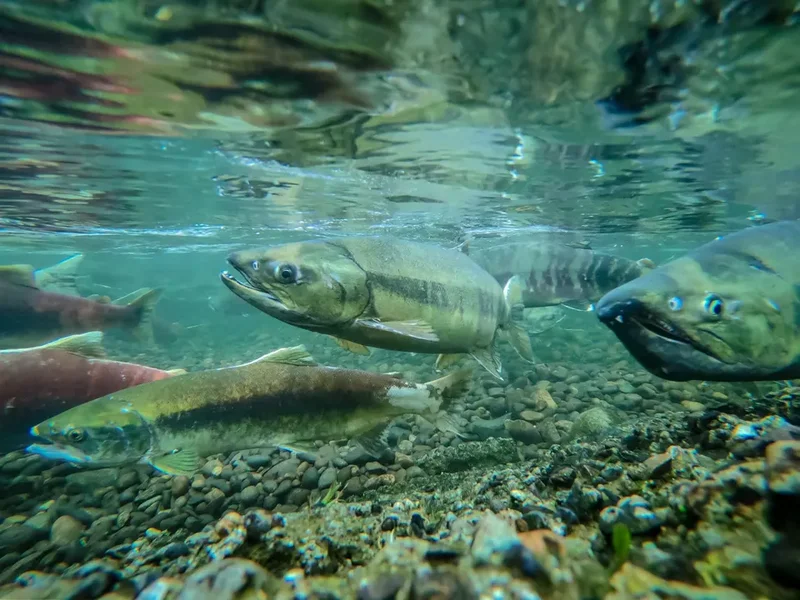
The trail was narrow. As we climbed, we found ourselves roughly 40 feet above the creek, looking through the trees at the clear water below. Then someone stopped. Holding almost motionless in a small pool were five enormous dark shadows.
We knew immediately they were salmon. We had been fly-fishing for trout every day from rafts and McKenzie-style drift boats, and nothing we had caught was remotely that large. The seven of us gathered along the trail and stared down.
By then Tracy and I had spent several days talking about what we were seeing: the changing forests, wildfire, climate change, the extraordinary power of moving water, biodiversity and the Indigenous history of these canyons. Most influentially, Sammy Matsaw Jr., a Shoshone-Bannock Tribal member traveling with us, had been teaching all of us to see this landscape differently.
Those five salmon suddenly pulled much of it together.
How had they gotten here? And why were so few now completing the same extraordinary journey?
Into the canyon
Our trip with The Nature Conservancy had begun the previous evening in Salmon, Idaho, where wildfire smoke hung over town. Early the next morning, we climbed into small aircraft for the flight into Indian Creek, our wilderness launch point.
Our group deplanes after landing on a short dirt airstrip by the Indian Creek river bottom, our wilderness launch point for our six-day Idaho rafting trip. We were immediately secluded upon arrival – disconnected from screens and the outside world.
I am a pilot, although I was very much a passenger that morning, and the approach got my attention. Our experienced canyon pilot descended between the mountains, made a sharp dogleg around the canyon wall on final approach, then at the last second lined up with a short dirt airstrip tucked along the river bottom beside Indian Creek. It was a beautiful piece of canyon flying.
We had entered the roughly 2.3-million-acre Frank Church–River of No Return Wilderness. This was Tracy’s and my first extended wilderness river trip, although we had previously made several long horse- and mule-pack journeys into Montana’s Bob Marshall Wilderness, another breathtaking roadless landscape.
The Middle Fork descends through dramatically changing country. Our guidebook describes three ecological regions along its full course, from higher alpine forests through the more open ponderosa pine landscape around Indian Creek, and finally into a deep lower gorge culminating in Impassable Canyon, described there as the third-deepest canyon in North America.
For the next six days we fished, hiked, camped and repeatedly plunged through cold-water rapids. There were no roads paralleling the river and, for most of our journey, little evidence of modern civilization. Much of what surrounded us appeared extraordinarily intact.
That observation would become important: the salmon’s destination was still here.
The power in the water
You experience the physics of a river differently from inside a raft.
*Our rafts lined up at the riverbank before departure. Photo: David Banks. *
We would accelerate toward a rapid, climb one wave and drop sharply into the next, then rise again like a wild roller coaster without rails. Cold water splashed and sometimes crashed directly over us. We were soaked and exhilarated by the shock of the water and the speed of the descent, while our experienced guide rowed continuously, reading the current and expertly maneuvering around massive boulders against which the river seemed to throw its full force.
Again and again, I found myself thinking about the colossal energy flowing around us. Water was dropping thousands of vertical feet through this watershed, moving every second of every day. It was impossible not to imagine capturing some of that continuous, powerful force and converting it into energy that people could use to live safer, healthier and more prosperous lives.
Hydroelectric power had always been fundamentally positive in my mind. We live in Tennessee, a state profoundly shaped by the Tennessee Valley Authority and the dams that brought electricity, navigation, flood control and economic development to much of our region. Hydropower is renewable and produces electricity without burning fossil fuels. At a time when America needs substantially more power while also reducing carbon emissions, those characteristics matter.
The Middle Fork did not make me anti-dam. It made me look at dams more completely.
The landscape reinforced that complexity. Fire has always been part of these mountains, but the recent scale of burning has been striking. Our guidebook records wildfire forcing closure of the Middle Fork to recreational floating for the first time in 2000 and again in 2007. When fire strips vegetation from steep slopes, intense rainstorms can send rock and sediment tumbling into the river. Since 2000, the guidebook identifies more than 15 debris flows that altered the Middle Fork channel, in some places creating or reshaping the very rapids carrying us downstream.
Climate change did not invent western wildfire. Natural climate variability, historical fire suppression and forest management all matter. But hotter, drier conditions increase the risks associated with severe fires. We are seeing that around the country today.
Climate also complicates the equation. Salmon depend on cold water, making protected, high-elevation habitat increasingly valuable as lower rivers warm. Yet a changing climate also increases the importance of reliable, carbon-free electricity.
Therein lies part of the challenge.
Sammy taught us to see
Among the 19 people on our trip, Sammy became our storyteller and interpreter of place. A combat veteran and a Ph.D.-trained water scientist, a Shoshone-Bannock Tribal member with Oglala Lakota heritage through his mother’s family, Sammy brought a unique understanding and perspective as the Nature Conservancy’s Columbia Basin Program Director.
Sammy taught throughout the day and into the evening, never in anything resembling a formal lecture. He talked while we floated and fished, during hikes and around camp. Even the professional river guides, people who spend much of their lives in these canyons, gathered around to learn from him.
When we stopped at petroglyphs and pictographs, we clustered around Sammy as he described what he saw and what the figures might mean to his relatives who had occupied these canyons generations before us. He did so with striking humility, reminding us that he was offering his interpretation, shaped by Tribal history, family and oral tradition, rather than claiming certainty about every image left in stone.
*These pictographs, ancient indigenous forms of art and storytelling using red ochre pigments to paint on rock surfaces, were brought to life to us by Sammy Matsaw Jr. Photo: Tracy Frist. *
He told us his people were known as the Sheepeaters and described a rich Native life within these canyons, intimately connected with wildlife, plants, ceremony, the river and importantly salmon.
What Tracy and I initially experienced as wilderness, Sammy taught us to see as ancestral homeland.
Sammy and his wife Jessica co-founded River Newe, a nonprofit focused on intergenerational, land-based education for Tribal youth. He told us how Native children return with the program to this river, floating and fishing in the landscape of their ancestors.
Through Sammy, salmon became much more than a population to count. They connected food, culture, wildlife, water, generations and place.
Something about the setting allowed all of us to listen differently. There was no cell service, no Starlink, no computers or iPads and no news coming in. The satellite phone was for emergencies. For the first time in my life, I spent six consecutive days completely disconnected from the outside world.
I noticed the difference. I listened longer. Tracy and I talked more deeply. We followed conversations without interruption and paid greater attention to whatever was in front of us. Solitude River Trips, our excellent outfitter, describes this disconnection and immersion in nature as part of the distinctive Middle Fork experience. For me, the effect was simpler: there was more room to think.
Each evening, after a full day of fishing, hiking and rapids, the Solitude guides somehow produced wonderful meals beside the river. Then all 19 of us pulled our chairs into a circle around a campfire.
Carlos Fernandez, The Nature Conservancy’s Colorado State Director and one of our hosts, often helped frame the evening discussion. David Banks, our Chief Conservation Officer, and Nicole Silk, our Global Director of Freshwater, brought broader conservation and freshwater perspectives. Sammy repeatedly returned us to place, culture and history.
Within 15 or 20 minutes the canyon would become dark, our faces illuminated by the fire while the river rushed beside us. We talked about what we had experienced that day: salmon and biodiversity, wildfire and climate change, clean energy, stewardship, Indigenous history, our connection with nature, and what we owe generations that will inherit these places.
Tracy and I chose to sleep outside rather than inside our tent. The river remained audible all night. Halfway through the trip, we woke beneath the dark Idaho sky and watched the Perseid meteor shower cross above the canyon.
It is difficult to imagine a better setting for thinking about one’s place in a much larger, interconnected system.
The extraordinary round trip
Which brings me back to those five fish holding in Loon Creek.
A Chinook born in one of these cold mountain tributaries begins life in freshwater and eventually moves downstream through the Middle Fork, the Salmon, the Snake and the Columbia before reaching the Pacific Ocean. It may spend years growing at sea before something remarkable happens: the surviving adult begins the journey in reverse.
For Snake River salmon, the freshwater migration can approach 900 miles and climb thousands of feet into Idaho’s mountains. Along the route stand eight major federal dams, four on the lower Columbia and four on the Lower Snake.
What captured my imagination was not simply the upstream migration but the complete round trip. The young fish has to reach the ocean. Years later, it has to find its way home again.
Pacific salmon possess an extraordinary homing ability. As juveniles they imprint on characteristics of their home waters; as returning adults they use, among other mechanisms, olfactory memory to navigate toward the watersheds from which they came. After years in an ocean covering millions of square miles, they can return to their natal river system.
Then they spawn and die.
Even death completes part of the ecological circle. Nutrients accumulated in the Pacific return with salmon to inland waters and food webs, linking fish, aquatic insects, birds, mammals and forests, all interconnected with one another. Therein lies the balance and harmony of nature.
In a very real sense, a salmon carries the ocean back into the mountains.
Standing above Loon Creek, another paradox became difficult to miss. Much of the destination remained intact: cold water, protected tributaries, forest and spawning habitat.
We have protected much of the destination. What has become precarious is the journey.
Four dams and a difficult choice
That journey eventually takes us downstream to Ice Harbor, Lower Monumental, Little Goose and Lower Granite, four federal dams on the Lower Snake River. Built during the great postwar era of American infrastructure development, from the 1960s into the early 1970s, they primarily extended commercial navigation deep into the inland Northwest while also generating hydroelectric power.
The argument for keeping them deserves respect.
Their turbines have roughly 3,000 megawatts of peak generating capacity, although average historical generation has been much lower, about 1,200 megawatts. They also provide valuable grid services. Just as important, their locks create the final stretch of an inland waterway reaching Lewiston, Idaho. Agricultural products, particularly wheat, are among its principal cargoes.
Farmers and communities have built businesses and transportation systems around that infrastructure.
But the biological evidence deserves equal seriousness.
After decades of fish ladders, spill, hatcheries, bypass systems and vast public investments in mitigation, several wild Snake River salmon populations remain deeply depressed. The National Oceanic and Atmospheric Administration (NOAA) identifies restoring a free-flowing Lower Snake through breaching of the four dams as a major action for rebuilding healthy and harvestable salmon, while also making clear that no single action is enough. Habitat restoration, hatchery and harvest reform, water quality and other measures remain essential.
“Breaching” sounds technical. It essentially means removing enough of the earthen portions of these dams to allow the river to flow freely through the sites, while portions of the concrete structures could remain.
The question is not whether these dams have value. They do. The question is whether we can responsibly replace the human benefits they provide while restoring an ecological connection that cannot simply be built somewhere else.
Other rivers offer useful lessons.
On the Klamath River in southern Oregon and northern California, four large hydroelectric dams were removed by 2024 after decades of Tribal leadership, negotiation and scientific work. Removal brought real short-term disruption, particularly from sediment, but it reopened hundreds of miles of habitat and salmon quickly began appearing in waters that had been inaccessible for generations.
The Klamath is not the Snake. Its dams provided far fewer economic services. What it demonstrates is narrower but important: reconnect good habitat and migratory fish can respond with astonishing speed.
In Maine, we at The Nature Conservancy are pursuing a different model on the Kennebec River. We have agreed to acquire four operating hydroelectric dams with the long-term goal of restoring a healthier, more connected river. The key phrase is “long-term.” The dams can continue operating while industrial water needs, municipal revenues, community concerns and regulatory issues are addressed.
Prepare the transition before removing the infrastructure.
That lesson also plays out closer to home. In the Appalachian mountains of southwest Virginia, Tracy and I have a home and care for a large tract of working and forested land. Across Appalachia, tens of thousands of dams and other barriers, many of them small and aging, fragment some of America’s richest freshwater ecosystems. At The Nature Conservancy, we are working with partners to reconnect those systems selectively, not because every dam is bad, but because some structures have outlived the purpose for which they were built.
In Tennessee, where Tracy and I live, that work is already tangible. The Lower Citico Creek dam in the Cherokee National Forest was removed in 2025 after years of study and collaboration, reconnecting 76 miles of upstream perennial habitat. The same year, Harms Mill Dam on the Elk River came down after a multiyear planning and permitting process.
These Appalachian dams are obviously not the four Lower Snake dams. Their scale and economic consequences are entirely different. But the principle travels: infrastructure deserves neither automatic preservation nor automatic removal. It deserves periodic re-examination.
Prepare first
After six days on the Middle Fork, and after looking more deeply at the science and experience of other rivers, I came away increasingly persuaded that our country should begin serious preparation for the eventual removal of the four Lower Snake River dams.
Preparation is the critical word.
We should not remove functioning infrastructure and promise to solve the consequences afterward. Replacement electricity and grid services should be operating first. Rail and grain-handling capacity should be adequate before river navigation is eliminated. Irrigation needs must be resolved, and farmers and communities that would bear the greatest transition costs should see tangible investment before the river changes.
Tribal Nations should not be treated as stakeholders waiting to be invited into this conversation. They have led salmon recovery efforts for decades and have already played a central role in the Lower Snake debate. Any transition should build upon that leadership, honor treaty obligations and keep Tribal Nations central to its design.
The standard should be demanding: objective readiness criteria, replacement infrastructure that actually works, continued restoration throughout the basin and an inclusive process that recognizes the legitimate interests of communities built around the existing system.
Then decide and act.
The objective is not dam removal for its own sake. It is a Northwest capable of supporting abundant salmon, reliable clean energy, prosperous communities and functioning rivers.
Near the end of our Loon Creek hike, Tracy and I climbed into the hot springs, alternating between the mountain-warmed water and the cold creek. But my mind kept returning to those five salmon below us.
Sammy had spent the week teaching us that the canyon was not empty wilderness. It was ancestral homeland, part of a living system of people, wildlife, water and place. Six days without the outside world had given Tracy and me unusual time to talk about what stewardship means.
The four Lower Snake dams were built by Americans solving the problems of their era. They extended navigation, produced electricity and contributed to economic opportunity. We should respect those accomplishments.
But stewardship does not require freezing every decision made by previous generations in place. Sometimes it means protecting what they built. Sometimes it means adapting it. And sometimes, after careful preparation, it means removing a barrier when we can preserve its useful benefits another way.
Those five salmon had traveled hundreds and hundreds of miles, navigated an extraordinary combination of natural and human obstacles and climbed thousands of feet toward the cold waters where their lives began.
They had found their way home.
Our challenge is to do the difficult, inclusive work necessary to make that journey possible again at scale.