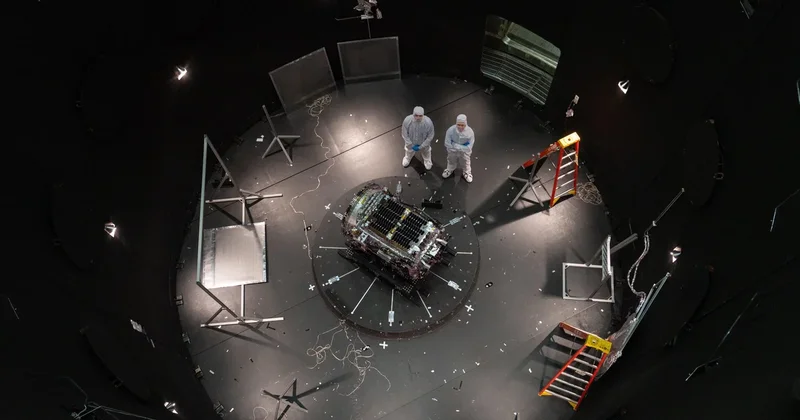
The mission to save NASA's sinking Swift Observatory was called off Wednesday, dooming the telescope to a fiery reentry later this year.
NASA and Katalyst Space Technologies announced the news more than a month after the startup's Link spacecraft rocketed away to the telescope's rescue.
Katalyst said Link will not attempt to capture Swift and boost it to a higher orbit because of problems with controlling the spacecraft. NASA said this means the telescope will plunge through the atmosphere after more than 20 years of tracking some of the biggest explosions in the universe, like gamma-ray bursts and exploding stars.
NASA in an attempt to raise the telescope to a safer, longer-lasting orbit. Intense solar activity caused it to lose altitude faster than expected. The rescue spacecraft went into an uncontrollable spin a few weeks after its liftoff in early July. While flight controllers managed to slow Link's tumble, issues continued to plague its pointing and positioning in orbit.
"This is not the outcome we were working toward, but it does not change why this mission was worth attempting," NASA Administrator Jared Isaacman said in a statement.
As a consolation prize, Katalyst will continue to operate Link in proximity with the telescope to demonstrate capabilities for future rescue operations.
Katalyst CEO Ghonhee Lee said it was an ambitious mission on an aggressive timeline that was thrown together in under a year.
"We took on this high-risk, high-reward challenge and are proud of the milestones we reached along the way," Lee said in a statement. "We have already learned a tremendous amount."
Launched in 2004, Swift's science instruments were turned off earlier this year to slow its descent. It was orbiting 216 miles high as of last week. The satellite is predicted to reach an altitude of 186 miles in October.
Designed for a two-year mission, Swift has been slowly falling to lower and lower altitudes over the past two decades because of interactions with traces of the extreme upper atmosphere that extend out into the realm of low-Earth orbit.
Solar storms can heat up the atmosphere, periodically causing it to swell, increasing the "drag" on the spacecraft, and Swift is not equipped with thrusters to counteract that downward pull.
The observatory is currently falling about 5 miles per month, a descent that will slowly but surely pick up speed as it drops lower and lower into thicker regions of the upper atmosphere.
Shawn Domagal-Goldman, Astrophysics Division director at NASA, told "CBS Mornings" in June that nothing pinpoints gamma-ray bursts like the orbiting Swift Observatory.
"A nuclear weapon going off doesn't even compare to the magnitude of energy that comes out of these things and it's literally the biggest explosions in the universe," Domagal-Goldman said.
NASA's Hubble Space Telescope could benefit from an orbital boost and had been next in line for a rescue attempt had this mission gone well. The 36-year-old Hubble is also dropping in orbit because of all the sun's recent outbursts and is expected to reenter the atmosphere in the 2030s if nothing is done. It wasn't immediately known whether Hubble is now out of luck.