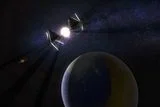
The sporadic dimming of a star more than 1,400 light-years from Earth has left astronomers scratching their heads for years. All kinds of theories have been thrown out to comprehend why KIC 8462852, more commonly known as Tabby’s Star, experiences such pronounced dips in brightness.
The most prominent theory contends that a giant, uneven ring of dust encircles Tabby’s Star. Another, however, instead proposes that the star has a nearby planet as a companion. And then, there’s the most buzzworthy theory of them all — one raising the notion that a megastructure built by an advanced alien civilization orbits the star.
Find out how these theories stack up against each other, and what could be the true answer to the mystery of Tabby’s Star.
Why Tabby's Star Is So Strange
Although KIC 8462852 was observed as early as 1890, its dimming was only recently reported for the first time in a 2016 paper published in the Monthly Notices of the Royal Astronomical Society. The star’s informal names — "Tabby’s Star” and “Boyajian’s Star” — were inspired by Tabetha S. Boyajian, the lead author of the paper. It also has one more nickname, the “WTF Star,” a reference to the paper’s subtitle, which reads “where’s the flux?”
The “flux” in question alludes to the star’s unusual dips in brightness, which were originally detected by citizen scientists from the online group Planet Hunters who had delved into data from NASA’s Kepler mission.
The star, which is slightly brighter than the sun, occasionally dims by up to 20 percent, only to later recover back to its baseline brightness. To make matters more complicated, the back-and-forth dimming and brightening occurs at irregular intervals, lasting days or weeks, according to Arizona State University.
Astronomers suspected that the dimming had to be the result of material passing in front of the star, and have since come up with a hodgepodge of theories to take a crack at explaining what's really happening here.
Read More: JWST Revealed the Early Universe — The Roman Space Telescope Will Help Us Understand How It Evolved
Alien Solar Panels or a Huge Ring of Dust?
Out of all the theories surrounding Tabby’s Star, there’s one elephant in the room: the theory that an alien megastructure is orbiting the star.
Early speculation broached the idea that the dimming could be the result of a Dyson swarm, a hypothetical collection of orbiting solar panels envisioned by late British-American physicist Freeman Dyson. This kind of structure, in Dyson’s view, could theoretically harvest a star’s energy and power an advanced alien civilization, if something like it were to exist out there.
As exciting as this theory sounds, all evidence points to it being merely a sci-fi pipe dream. There has been no evidence of technological signals from the system, meaning the dimming is most likely due to natural causes, according to the SETI Institute.
A more plausible explanation is that Tabby’s Star is surrounded by an uneven ring of dust. In a 2017 study from The Astrophysical Journal, researchers found less dimming in infrared light from the star than in its ultraviolet light. Any object larger than dust particles, according to the NASA Jet Propulsion Laboratory, would dim all wavelengths of light equally when passing in front of the star.
While the dust ring would explain long-term dimming trends, it wouldn’t explain the shorter, more extreme dips in brightness.
A Potential Planetary Companion
Another theory posits that a debris disk orbiting Tabby’s Star could be made of material from a destroyed exomoon. A 2019 study from the Monthly Notices of the Royal Astronomical Society used simulations to propose that an exomoon from a long-gone, nearby planet could have been pulled into the orbit of Tabby’s Star, where it would’ve then been torn to pieces.
The latest theory, however, argues that there actually might be a planet or a brown dwarf (an object between a star and a planet) orbiting Tabby’s Star after all. In a 2026 study from the Monthly Notices of the Royal Astronomical Society, researchers analyzed data from NASA's Transiting Exoplanet Survey Satellite (TESS) and made new radial velocity measurements that potentially point to a companion object. The object, the researchers estimate, could be about nine times more massive than Jupiter.
We still don't have a definitive answer to explain the dimming of Tabby's Star, but more insightful data is on the way, as astronomers are actively observing the star. The planned Gaia Data Release 4 from the European Space Agency, slated for a December 2026 release, may at least help researchers confirm whether or not a planetary companion is truly orbiting Tabby's Star.
Article Sources
Our writers at Discovermagazine.com use peer-reviewed studies and high-quality sources for our articles, and our editors review for scientific accuracy and editorial standards. Review the sources used below for this article:
- Monthly Notices of the Royal Astronomical Society:Planet Hunters IX. KIC 8462852 – where's the flux?
- Arizona State University: What's up with Tabby's Star? Still an enigma, says ASU astronomer
- SETI Institute: The Mysterious Star KIC 8462852
- The Astrophysical Journal:Extinction and the Dimming of KIC 8462852
- NASA Jet Propulsion Laboratory: Mysterious Dimming of Tabby's Star May Be Caused by Dust
- Monthly Notices of the Royal Astronomical Society:Orphaned exomoons: Tidal detachment and evaporation following an exoplanet–star collision
- Monthly Notices of the Royal Astronomical Society:Evidence for a giant companion orbiting Tabby’s star