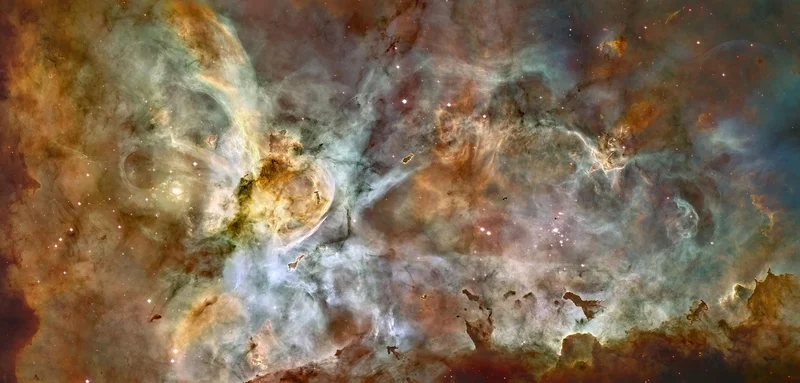
The Carina Nebula (NGC 3324), located about 7,500 light-years away in the constellation Carina (the Keel), is one of Hubble's favorite places to image. Like many locations in our cosmic background, the NASA/ESA/CSA James Webb Space Telescope (JWST) has also visited this scenic nebula to obtain images using its advanced infrared instruments. The resulting image (shown below) was featured as the ESA's Picture of the Month.
The Carina Nebula, measuring about 260 light-years across, is famous for being the nearest high-mass star-forming region in the Milky Way. This proximity allows astronomers to study the full range of star formation and houses some of the most massive stars in our galaxy. Along with tens of thousands of protostars, the nebula also lets astronomers study how stars shape their environment. The image showcases these hot, massive young stars and the billowing dust clouds shaped by stellar "winds" (radiation pressure).
The nebula is also home to some incredible objects, including the Cosmic Cliffs that were part of Webb's first-ever image release. These "Cliffs" are actually the edge of a gigantic, gaseous cavity that was carved from the intense ultraviolet radiation and stellar winds from the piercing protostars located in the center of the nebula. The feature highlighted in the Image of the Month is called the "Treasure Chest," an isolated cloud of gas and dust with a dark, dense head and extended tail. These clouds are called "cometary globules" because they often resemble comets.
Webb image of the "Treasure Chest" feature inside the Carina Nebula. Credit: ESA/NASA/CSA/M. Reiter
The Treasure Chest, however, looks more like a wooden chest with its lid wide open, with a compact cluster of young stars within that resemble shining jewels. Scientists estimate the cluster contains about 70 stars, the most massive of which are rare blue-white O-type stars that are very hot (with surface temperatures of 30,000 Kelvin) and roughly 19 times as massive as our Sun. These stars give the Treasure Chest its ethereal glow, beautifully captured in this image by Webb's Near-Infrared Camera (NIRCam).
The key to the Treasure Chestâs structure is Eta Carinae, the brightest object in the nebula, located 39 light-years to the northwest. While not visible in the image, Eta Carinae is a well-known binary system, with one star being roughly 100 times as massive (and 5 million times as luminous) as the Sun. Astronomers also estimate that the star cluster is about 1.3 million years old, and some individual stars are known to have circumstellar disks that will form new planets. Over time, the starlight of these young stars will dissipate the clouds that make up the Treasure Chest, revealing the entire cluster.
Further Reading: ESA