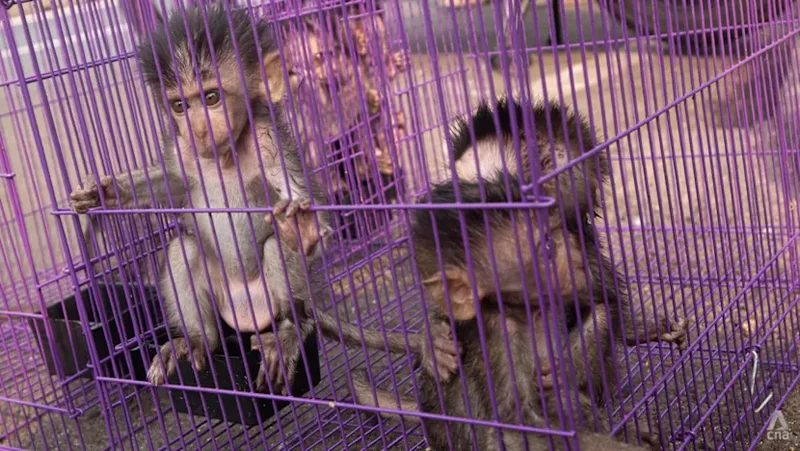
Indonesia’s renewed macaque export push pits research demand against conservation concerns
Officials say the move benefits local communities and can help manage human-wildlife conflicts, while animal welfare groups warn it risks undermining protection of the species classified by an international conservation authority as endangered.
JAKARTA: Indonesia is renewing a push to supply long-tailed macaques for biomedical research, setting its first export quota in four years as it looks to tap into international demand.
The government has also inaugurated a new breeding facility in Lampung province, with officials pointing to the United States as the main market and China as another potential destination.
The push has reignited debate over the trade in long-tailed macaques, which are classified as endangered by the International Union for Conservation of Nature (IUCN).
Animal welfare groups have criticised the moves as undermining the protection of long-tailed macaques and out of step with moves in some countries to reduce the use of primates in research.
But local officials have defended the latest moves, stressing that strict controls are in place to govern the breeding and export of the animals, while pointing to their potential economic benefits and the need to manage conflicts between the primates and local communities, which have seen the long-tailed macaques attack and injure people as well as wipe out an hectares of crops before the harvest.
LAY OF THE LAND
Named for their distinctive long tails, long-tailed macaques, or macaca fascicularis, are native to Southeast Asia, including Indonesia.
The international conservation authority says the long-tailed macaque are endangered because of a loss of their habitats as well as hunting and capture from the wild. It estimates that the global population has declined by around 40 per cent in the past 40 years and could fall by another 50 per cent in the next 40 years.
In contrast, Indonesia has classified the species as of “least concern” in its own national conservation assessment conducted in 2024.
The findings, published in the Ministry of Forestry’s 2025-2029 conservation plan report, said long-tailed macaques were found across much of Indonesia, with wild populations considered stable and even showing signs of overpopulation in some areas.
Data collected between 2019 and 2024 estimated nearly 49,000 long-tailed macaques across surveyed sites in Indonesia, with the largest numbers recorded in South Sumatra (12,722), Lampung (9,781) and Jambi (8,342).
In June, Indonesia set a 2026 export quota of 1,920 long-tailed macaques, according to records from the Convention on International Trade in Endangered Species of Wild Fauna and Flora (CITES) - its first recorded quota for the species since 2022, when the figure stood at 1,680.
The annual quota sets a limit on exports for that year as part of CITES measures to protect wild populations. Such quotas are voluntary, however, and exports may still take place in years when none is set, subject to the required permits and assessments.
A month later, on Jul 31, the government formally opened the breeding facility in Mesuji regency in Lampung. Operated by PT Bio Medika Nusantara Indah (BMNI), a private company, it can house up to 4,000 macaques. Mesuji regent Elfianah Khamamik said the Lampung facility sits within a 50ha site.
“Of the 50ha of vacant land by the forest and river, 4.9ha are being used for the breeding facility. We now have colony and quarantine enclosures,” Elfianah told CNA.
BMNI director Reki Chandra said the Mesuji facility currently houses 804 long-tailed macaques captured in Mesuji, Tulang Bawang and West Tulang Bawang to serve as breeding stock.
Their first-generation offspring, known as F1 animals, are intended for export for research.
According to a 2023 review published in the Journal of Medical Primatology, long-tailed macaques have become the most widely used non-human primates in toxicity testing over the past few decades, because of its many genetic and biological similarities to humans. Primate researchers say such breeding programmes help ensure the macaques are healthy and have well-documented genetic backgrounds and health records.
Abdul Kadir Karding, head of the Indonesian Quarantine Authority (Barantin), said the US is currently the main export destination while China could also become a market, although negotiations over export requirements are still underway.
“Potential demand in China is around 20,000 macaques a year, compared with about 10,000 in the United States,” Karding was quoted as saying by national news agency Antara at the facility’s inauguration.
Reki, the BMNI director, expects the Mesuji facility to export around 1,000 macaques a year, with each animal fetching between US$3,000 and US$4,000, depending on its quality.
OUTCRY FROM ANIMAL WELFARE GROUPS
Animal welfare groups in Indonesia and abroad have criticised the government’s new export quota and breeding facility.
After the Lampung facility opened, US-based non-profit Lady Freethinker (LFT) launched a petition urging the Indonesian government to suspend plans to breed and export long-tailed macaques. As of Saturday (Aug 15), it had garnered more than 37,000 signatures.
LFT is part of a coalition including Action for Primates, Jakarta Animal Aid Network, Natha Satwa Nusantara, Animal Lawyer Indonesia and Animal Friends Jogja. Action for Primates is based in the United Kingdom, while the latter four are Indonesian groups.
The coalition issued a joint statement on Aug 3 making the same call.
"They are intelligent, social animals, but they are captured in horrific ways, separated from their families, caged, transported, and used as test subjects in painful experiments," said LFT founder and president Nina Jackel.
“Restarting exports risks condemning thousands more animals to suffering for a system the world is increasingly moving beyond. Indonesia should halt these exports and protect its native macaques from commercial exploitation.”
Jakarta Animal Aid Network co-founder Femke den Haas said the government’s latest move marked a reversal of earlier progress in protecting long-tailed macaques.
“We had started to see progress, with greater attention being paid to their protection. Jakarta, for example, banned street monkey performances, while Bali has prohibited residents from keeping them as pets,” Femke told CNA.
Long-tailed macaques are not a protected species under Indonesian law, although their capture from the wild, breeding and trade remain regulated. Some local governments have gone further, introducing measures aimed at curbing their exploitation.
Bali, for example, urged residents in 2025 not to keep the macaques as pets, banned street monkey performances and tightened oversight of hunting and the wildlife trade.
Jakarta has cracked down on street monkey performances since 2013, while Surakarta has also banned them.
The coalition also raised questions over how the Mesuji facility sources its macaques. BMNI director Reki was quoted by local news outlet Sumsel News as saying at the facility’s Jul 31 inauguration that local residents could sell wild macaques to the facility for 200,000 rupiah (US$11) each.
“This raises concerns about the source of breeding animals and the potential laundering of wild-caught individuals into commercial breeding operations,” the coalition said.
Elfianah, Mesuji’s regent, denied that the macaques were being bought from residents, saying any money given was merely a “token of appreciation” for those who handed over wild animals.
She said some residents had received special training from Lampung’s Natural Resources Conservation Agency to capture wild macaques considered a nuisance.
DOES RESEARCH STILL NEED MACAQUES?
Long-tailed macaques have become the most widely used non-human primates in toxicity testing over the past few decades, according to a 2023 review published in the Journal of Medical Primatology.
The species is widely used because of its many similarities to humans, from genetics and anatomy to biological processes and responses to treatment, said Fitriya Nur Annisa Dewi, head of the Primate Research Center (PSSP) at IPB University.
She added that breeding programmes help ensure the macaques are healthy and have well-documented genetic backgrounds and health records.
“Starting a study with an unhealthy animal, or one infected with a particular pathogen, can bias the results because the disease itself may affect the research,” she told CNA.
Scientists said long-tailed macaques continue to play an important role in biomedical research, even as efforts grow to reduce the use of animals.
“The key is to ensure that conservation efforts go hand in hand with effective regulations governing breeding programmes, permits and export quotas, while safeguarding animal welfare throughout the entire process,” Fitriya said.
OFFICIALS DEFEND THE PROGRAMME
Indonesian officials have defended the breeding programme as tightly regulated while pointing to the benefits it could bring to local communities.
According to Barantin chief Karding, macaques intended for export must spend around two years at the breeding facility, be physically healthy and free of disease, with the entire process subject to oversight by multiple authorities.
“Exporting these macaques is not something that can be done arbitrarily. BRIN (the National Research and Innovation Agency) has to issue a recommendation on how many animals can be exported, while the Ministry of Forestry determines which species can be bred,” Karding said at the facility’s inauguration.
“So there are quite a few procedures that have to be followed.”
Similar breeding facilities are also located in Sulawesi and the Thousand Islands in Jakarta, Karding said. Such facilities are only developed in areas considered suitable for breeding long-tailed macaques, he added, without specifying what these conditions are.
Elfianah said the Lampung facility provides a source of income for nearby communities, with residents able to sell corn, papayas and fresh fruit to feed the macaques.
She added that the breeding facility is also expected to create jobs for local residents, with plans to develop an animal hospital and a release area for long-tailed macaques that do not meet export requirements.
“There are also plans to turn the area into a tourist attraction. I’m sure people will be curious to see the macaque breeding facility,” she said.
BMNI director Reki stressed that the macaques are not taken from forest areas, but from places where conflicts with local communities are common.
“Most of them come into conflict with local communities, and because there are so many of them, they can become pests ... the company’s presence is helping save these macaques while preventing conflict between humans and animals,” Reki was quoted as saying by local news outlet Tribun News at the Lampung facility’s inauguration.
HUMAN-MACAQUE CONFLICTS
Human-macaque conflicts have been documented across several parts of Indonesia, including Mesuji.
One of the latest reported cases took place between late July and early August in Tembilahan, Riau, where long-tailed macaque attacks injured 19 people.
Several studies in Indonesia suggest that human-macaque conflicts are not simply a matter of population size. Changes to their habitats, growing proximity to human activity, the availability of food on farms and people feeding the animals have all been identified as contributing factors.
“Long-tailed macaques live in groups. They can wipe out an entire hectare of crops,” said Mesuji regent Elfianah.
“Farmers have resorted to shooting or electrocuting them to drive them away. It’s heartbreaking.”
Muh Yakub, a macaque exporter from the Selayar Islands in South Sulawesi, said long-tailed macaques there have become overabundant and frequently come into conflict with local communities by raiding farms.
With few other options, he said, some residents have taken matters into their own hands, killing macaques that raid and feed on their crops.
“Every year at village planning meetings, people don’t ask for electricity or roads. The only thing they ask for is for the macaques to be eradicated,” Yakub said.
“Imagine tending your corn for months, only to have the macaques wipe it out just as it is ready to harvest.”
He argued that setting larger quotas for wild macaques that can be captured for breeding and eventual export would help ease the problem, adding that the government has been too restrictive thus far.
“Since I started the breeding business in 2021, I have only been given a quota to capture 1,046 macaques,” said Yakub, who owns Gowa-based exporter PT Anak Atol Asugi.
“I was only able to start exporting in 2024, when I shipped 540 macaques to the United States. I haven’t made another shipment since.”
The wild macaques sourced by his company come from the Selayar Islands before being transported to a breeding facility in Subang, West Java.
Barantin head Karding said the new breeding facility in Mesuji could be one way to address human-macaque conflicts.
“This offers a way to reduce the risk of the animals becoming pests in residential areas, while also generating measurable economic benefits,” Karding was quoted as saying by local news outlet Tribun Lampung.
But Femke of Jakarta Animal Aid Network cautioned against automatically labelling macaques as pests and removing them when conflicts arise.
“We understand that it can be very difficult for farmers to deal with wildlife around them, but we need to find a win-win solution,” she said.