Korean food products have drawn global attention, with certain product labels like Buldak sparking a rare consumer frenzy and online fandom movement transcending nations and borders. From instant noodles to snacks, baked goods, fruit and manufactured seafood, Korean food products have become strategic items for retailers outside Korea.
K-Market in Vietnam, a network of 150 directly managed medium-sized supermarkets, specializes in K-foods and other Korean products. The largest Korean-run retailer in the country also operates a logistics center in Ho Chi Minh City and Hanoi, facilitating product distribution to stores in the country’s largest economic hubs in the northern and southern regions.
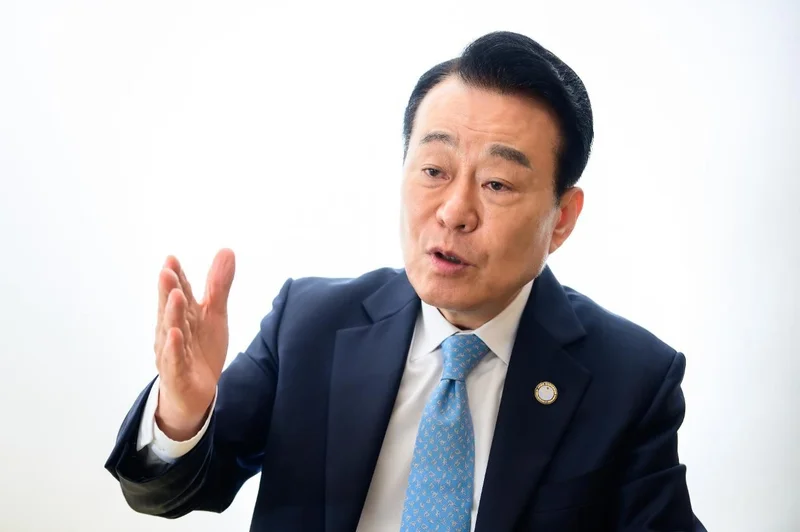
Having run K-Market for 20 years, Chairman Ko Sang-goo, however, worries about the company’s future. At the battlefront in the country’s retail industry, the business guru compares himself to a Korean soldier fighting global retailers in Vietnam. He now sees Japanese and Chinese brands scaling up in the country’s retail sectors and increasing their market shares. To him, Korean products are no longer a market driver. Seeing global retailers from other East Asian economic powerhouses stirring the local market in Vietnam, he now fears K-food will be overshadowed.
“Hallyu is no longer safe in Vietnam. It will never last forever,” Ko said in an interview with The Korea Times in Seoul. “Japan, China and Thailand have expanded businesses there. And how much they have scaled up is just uncanny. It is contrary to how Korean firms are loosening their grip in Vietnam. Look at Emart, which has sold entire shares of its Vietnamese subsidiary to Vietnam’s Thaco Group, giving up its business in the country.”
Aeon Mall is a clear example threatening Korean products in Vietnam. Japan’s Aeon Group has launched nine large Aeon Malls in Vietnam, and three each around Hanoi, Ho Chi Minh City and Da Nang. Each mall has supermarkets and a food court filled with Japanese foods. The group said it will expand the malls to 100 by 2030. Sumitomo Corp.’s FujiMart is another major Japanese retail brand in the country, a supermarket chain jointly invested by Vietnam’s BRG Group. Now concentrated around Hanoi, FujiMart, according to the Japanese operator, will increase to more than 50 locations by 2028. FamilyMart and Aeon Group’s Ministop are major convenience store brands operating locally with Japanese labels.
Chinese firms have also launched major retail brands in Vietnam. Miniso, an everyday item store with affordable prices, is visible inside major local shopping malls, where it has introduced products in collaboration with Sanrio and Disney. Mixue has now established more than 1,000 ice cream and milk tea chain stores, while Alibaba Group’s Lazada and TikTok Shop are major e-commerce platforms there.
“Aeon Mall is huge, almost twice the size of Lotte Mall in Hanoi. Vietnam’s Thaco Group, meanwhile, still uses the Emart brand but when their contract ends in nine years, Thaco will most likely stop using the Korean brand and I doubt Emart will reenter the country. Giving up Vietnam means giving up the massive Southeast Asian market,” Ko said.
K-Market has become a barometer retail platform in Vietnam, according to Ko, verifying Korean products’ local popularity faster than rival retailers and drawing companies wishing to sell via K-Market. He said that together with Lotte Mart, K-Market is currently the last major retail platform in Vietnam distributing Korean products.
“We have seen Aeon Group’s MaxValu supermarket chain and FujiMart opening right next to our stores because our stores’ areas have high marketability. Their stores always bustle with young consumers,” Ko said.
Government’s role
Ko said he has been shouldering financial burdens from running the company on his own without the necessary support from the Korean government. To him, this is a problem on a national scale which must be fixed on behalf of other Korean-run private companies operating overseas. He compared the problem to Japan where the government implemented a systematic business model in which companies active overseas receive sufficient financial support from the government so that they can continue expanding.
Ko’s ire targeted the Korea Agro-Fisheries & Food Trade Corp. (aT), an agency under the Ministry of Agriculture, Food and Rural Affairs that is dedicated to accelerating global trade of Korean agricultural and seafood products. He said the agency has been neglecting its role of supporting exports by not providing sufficient benefits to Korean firms operating overseas such as K-Market.
“For Korean companies overseas, state-run trade facilitators like aT must provide financial support such as low-interest loans or trade partner matchmaking so they can keep expanding. But the agency has so far been reluctant to commit loans to us, demanding various eligibility conditions. Due to the lack of government support, I had to spend 50 billion won ($35 million) of my own money to build the logistics centers in Hanoi and Ho Chi Minh City. Those facilities will help other Korean firms export to the ASEAN region,” Ko said.
Ko compared the Korean government’s negligence to the Japanese government and its trade-boosting agencies including the Japan External Trade Organization, J-Bridge and the Japan International Cooperation Agency. He said these Japanese agencies jointly provide Japanese companies active overseas with incentives and financial safety nets so that their global business expansion can be sustained.
“Loan interest in Vietnam was over 8 percent which was a very high rate. Even though Korean government agencies provided low-interest loans to private companies in Korea, Korean firms active overseas like us haven’t experienced these benefits. They also required Korean firms overseas to meet so many conditions for loans or lowering of interest rates. Meanwhile, loan interest in Vietnam spiked from a little over 4 percent to over 8 percent due to the United States’ war with Iran. I’m now busy paying back interest to banks without earning much and investing in my business,” Ko said.
“Japanese agencies, on the other hand, are going all out supporting Japanese firms overseas, providing loans with no interest, providing a guarantee for loans and involving Japanese brands whenever signing partnerships with Vietnamese firms to promote their own national brands to local consumers. That’s why Aeon Malls are filled with Japanese brands. When aT signed a partnership in 2024 with Vietnam’s Mega Market to put more Korean products on their shelves, it depressingly reminded me of the fact that the Korean agency did not make similar effort for Korean firms in Vietnam like us. Think about it. When Korean retailers overseas like us are destined to sell K-foods, Vietnamese retailers can stop selling Korean products and switch to other countries' products whenever they want. I don't understand why aT signed that partnership with Mega Market instead of us.”
Ko met Korean Minister of Agriculture, Food and Rural Affairs Song Mi-ryung in Vietnam in July and agreed to share K-Market’s logistics centers and local trade networks for increasing exports of Korean products to Vietnam and other ASEAN nations. The deal demonstrated K-Market became a critical tool for the Korean government in expanding Korean exports to the ASEAN regions.
“Logistics is an expressway for retail distribution, especially in Vietnam. The longitudinally elongated country is right next to Cambodia and Laos and their trade is mostly done by land. We built the logistics centers in Hanoi and Ho Chi Minh City minding the importance of land-based transportation in Vietnam and connections to Phnom Penh and Vientiane,” Ko said.
“Cambodia’s recent war with Thailand has made Cambodia a potential market for Korean firms because Thai firms have shut down their operations in Cambodia including 7-Eleven and Cafe Amazon. If the Korean government committed actual support to Korean retailers in Vietnam like us, it would be a good opportunity for us to expand our K-food businesses to Cambodia.”