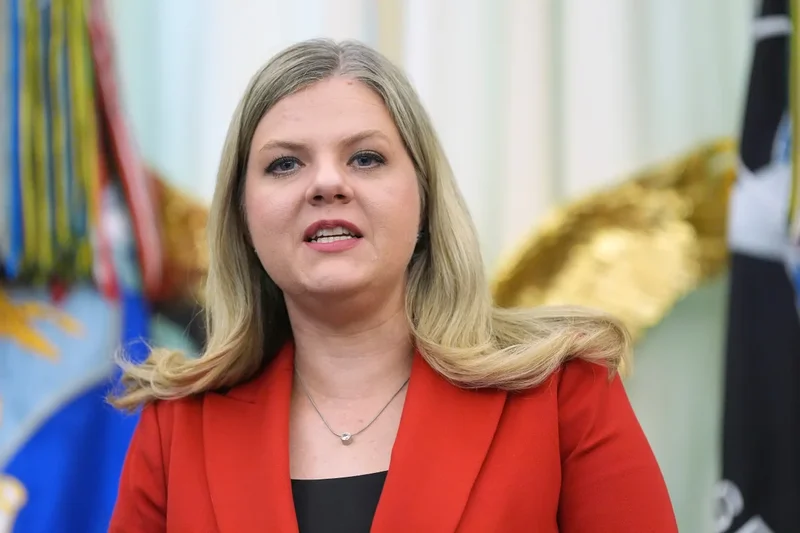
A White House health adviser who previously called on the Food and Drug Administration to limit access to abortion drugs has been nominated to lead the agency.
Dr. Heidi Overton, a 37-year-old physician, is a deputy assistant to the president who serves on the White House Domestic Policy Council. Her nomination places a key figure in managing President Donald Trump’s health agenda at the helm of the federal regulatory body overseeing pharmaceuticals, medical devices and food safety.
Overton has called the overturning of Roe V. Wade “a huge victory for life,” dismissed abortion rights as “radicalism” and championed false claims regarding the safety of abortion medication, according to reproductive rights and abortion advocacy organization Free & Just.
Her nomination follows months of behind-the-scenes friction within the administration over the scope and pacing of sweeping health policy changes championed by the “Make America Healthy Again” movement led by Health and Human Services Secretary Robert F. Kennedy Jr.
Internal tensions surrounding Overton’s role surfaced prominently during the drafting of an executive order to ease federal regulations on psychedelic therapies, such as ibogaine.
The initiative began after podcaster Joe Rogan contacted Trump directly in April to advocate for ibogaine’s potential to treat addiction and trauma. Trump signaled support, texting back, “‘Sounds great. Do you want FDA approval? Let’s do it,’” as reported by The Atlantic.
However, as the draft order moved through the Domestic Policy Council, Overton led a process to revise and streamline the document in consultation with the Department of Justice and the Department of Veterans Affairs. Her revisions reduced the draft from roughly 1,400 words to about 900 words, stripping out provisions for a dedicated official for psychedelic therapy and scaling down a proposed $250 million research fund to a $50 million state partnership.
The edits drew pushback from MAHA advocates, including Bryan Hubbard, CEO of Americans for Ibogaine, and Rogan, both of whom briefly threatened to withdraw from the signing ceremony over the modifications.
Critics outside the administration labeled Overton’s process an impediment to presidential intent, with one source telling The Atlantic, “As an unelected bureaucrat, Heidi Overton sought to use her pen to override the intended exercise of presidential power. It was a derogation of representative democracy.”
Administration leadership, however, has defended Overton’s approach as essential for ensuring that complex executive directives meet legal and scientific standards.
“In President Trump’s administration, the Domestic Policy Council is the White House office that is and should be depended on to make sure things are correct, legally durable, done with policy consistency, and, in this case, medically sound,” White House Chief of Staff Susie Wiles told The Atlantic. “Any suggestion that Heidi Overton or the Domestic Policy Council is slowing things down is being made by an uninformed person. Things move at a light speed in this administration.”
Overton’s policy portfolio has spanned several high-profile initiatives across the administration.
She worked on coordinating the administration’s revised federal nutrition guidelines — which shifted away from refined grains toward proteins and whole foods — and managed interagency debates surrounding the reclassification of marijuana from Schedule I to Schedule III under the Controlled Substances Act. She also managed White House coordination on a revised childhood vaccination schedule introduced earlier this year.
Despite past policy disagreements between HHS and the Domestic Policy Council, Kennedy praised Overton’s contributions.
“She brings exceptional dedication, meticulous attention to detail, and strategic leadership to every policy she touches, turning our vision into meaningful results for the American people,” Kennedy told The Atlantic in a statement.
Kennedy also noted during the psychedelics signing ceremony that while her advice was “often frustrating,” it was “always right.”
A Johns Hopkins-trained surgeon with a doctorate in clinical investigation, Overton joined the Trump administration during her residency in 2019 to assist with the national COVID-19 response. She later joined the America First Policy Institute before returning to the White House for Trump’s second term.
If confirmed by the Senate, Overton will assume control of an agency at the center of ongoing debates over drug approval standards, gray-market peptide regulation and federal nutrition policies.