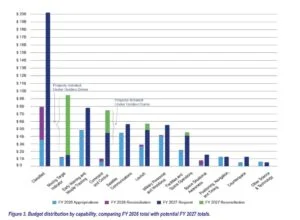
The Administration is requesting $71 billion for the U.S. Space Force in FY2027, more than twice what it has now. An analysis by the Aerospace Corporation concludes it is the highest proposed budget increase for any military service in 75 years. Congress still has to allocate the money, however, a combination of funding through the appropriations process plus a yet-to-be introduced reconciliation bill. Meanwhile, with FY2026 quickly coming to an end without congressional action on either appropriations or reconciliation, the Space Force could be constrained to a much lower level.
Sam Wilson, Director of Strategy and National Security at Aerospace’s Center for Space Policy and Strategy, charts the dramatic proposed increase for the USSF in a new report. Classified activities account for the largest increase. Moving-target-indicators, missile warning, and command and control are also slated for substantial increases.
Tracking the USSF budget is challenging. Last year DOD said the FY2026 budget request was $40.1 billion: $26.3 billion in the “base” appropriations request plus $13.8 billion via reconciliation in the One, Big Beautiful Bill Act (OBBBA). But Department of the Air Force charts presented this spring show $32 billion total. The comparable number for FY2027, $71.1 billion, includes both the base request of $59 billion plus $12 billion in an expected reconciliation bill, so presumably the $32 billion for FY2026 similarly reflects both funding sources.
What happened to the other $8 billion for FY2026 is unclear. Wilson told SpacePolicyOnline.com that some of the money probably went to the Golden Dome project, but it’s difficult to trace what happened.
“It is hard to track the money that was proposed in the FY 2026 budget submission for reconciliation with the funding that actually went to reconciliation for FY 2026 because the Pentagon created a Golden Dome funding account, so some of the funding that was proposed for the Space Force for reconciliation in FY 2026 surely went to the Golden Dome funding account. We can see what was proposed for the Space Force for reconciliation in FY 2026 and what ended up going to the Space Force in FY 2026 for reconciliation, but it’s hard to say where the funding went that was proposed but did not end up in the Space Force budget.” — Sam Wilson
As for FY2027, the total USSF request is $71.3 billion — $59.2 billion through appropriations plus $12.1 billion through reconciliation. There may be more money elsewhere in the DOD budget, too. Wilson told SpacePolicyOnline.com that Golden Dome includes $4.5 billion in space projects that could go to the USSF, though that’s not certain.
The $12.1 billion is part of the Administration’s FY2027 $350 billion request for defense via reconciliation. Whether that will come to fruition is unclear. Reconciliation is a unique process that allows legislation to pass the Senate with a simple majority instead of 60 votes, avoiding a filibuster. Since the first in 1980, no Congress has passed more than two. This Congress already has passed two, last year’s OBBBA and this year’s Save America Act. Prominent Republican Senators, including Sen. Susan Collins (R-Maine), chair of the Senate Appropriations Committee, are casting doubt that a third bill can pass.
Even without it, the USSF would have at least $59 billion if appropriators agree. The House Appropriations Committee approved 94 percent of that base request according to Wilson, “suggesting there is congressional appetite for such an increase.” That growth is “distinct from Golden Dome — a sharp contrast with FY2026, in which the proposed Space Force budget relied heavily on the broader missile defense initiative.”
But the House hasn’t passed the bill and the Senate Appropriations Committee hasn’t even reported it yet. As the end of FY2026 draws near without congressional approval of either appropriations or a third reconciliation bill, what the USSF will ultimately have available to spend on October 1 “remains highly uncertain” according to Wilson.
Congress is already working on a Continuing Resolution (CR) to keep the government operating after October 1 since the chance of passing appropriations by then seems highly unlikely, but CRs usually keep departments and agencies at their previous year’s level. For the USSF, that could mean the $26 billion in the FY2026 base budget, or the $32 billion adding what they ultimately got through reconciliation. Either way that’s far short of the FY2027 proposed budget. As Wilson notes, “A long continuing resolution could complicate the service’s ability to plan and execute a budget that could rise dramatically as multiple legislative processes unfold.”