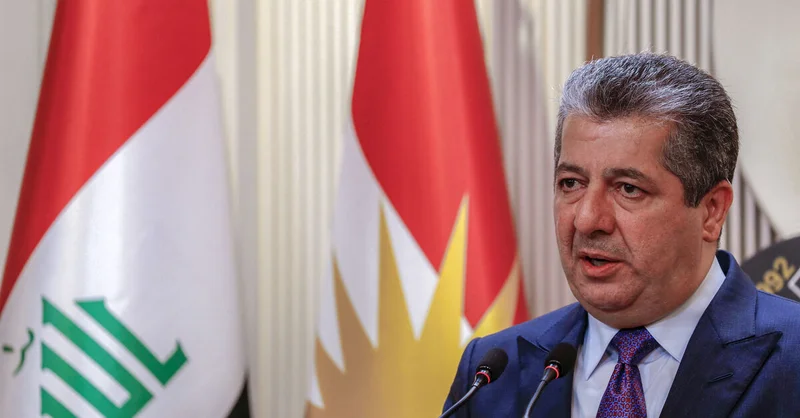
Barzani calls for enhanced air defense for Kurdistan Region to counter drone attacks
Iraqi Kurdistan Region Prime Minister Masrour Barzani backs US-led regional economic integration efforts and lauds US partnership in an exclusive interview with Al-Monitor.
Masrour Barzani, prime minister of the Kurdistan Regional Government of Iraq, is seeking to enhance the region’s air defense capabilities in light of the continued threats from armed drones emanating from Iran or from Iran-linked militias operating in Iraq.
The most recent attack, which occurred on Monday, targeted both Barzani’s private office and the home of the director of the KRG Security Council.
There have been more than 1,000 such attacks on the Kurdistan Region since the start of the US-Israel war with Iran on Feb. 28.
“We have not provoked or threatened the security of any of our neighbors,” said Barzani in an exclusive and wide-ranging interview with Al-Monitor. “Why they’re attacking us is a question that I think has to be addressed to them,” he added, referring to Iran.
“They're just trying to intimidate us and maybe drag us into something that we strongly resist, and we don't want to be a part of this conflict," he said.
Asked about Iranian denials of responsibility for the attacks, Barzani responded, “I think that's for the Iranian authorities to find out how such drones that nobody else has could be used by someone else” to attack outside their country.
He expressed concern over the drawdown of remaining US training and support forces stationed in Iraqi Kurdistan and the redeployment of US Patriot air defense systems.
“We haven't been able to acquire effective systems that can protect us against these threats,” said Barzani, noting that efforts are underway to obtain such capabilities.
He added, “So far we've been relying on the support that our friends, the Americans, thankfully, have been providing for the region, which has been very successful in intercepting most of the incoming missiles and drones."
“We are vulnerable, and these attacks can't continue. Withdrawal of these air defense systems will definitely put us at risk," he said. “I'm using this opportunity to call on our friends, all of our friends, to help us build these capabilities so that we can defend ourselves."
Barzani said he considers Iraqi Prime Minister Ali al-Zaidi “a genuine and trusted leader and friend, and he is doing the right thing for the country. We have expressed our full support for him and for what he is doing, whether it's tackling corruption or trying to bring all the groups under the rule of law and the disarmament of the militias.”
Asked what he expects after the Sept. 30 deadline Zaidi has set for remaining armed Iraqi militias to disarm, Barzani said he hopes the armed groups comply before that date.
“I don't think that anybody wants to see a military confrontation or any sort of chaos in the country,” Barzani said. “But of course, the government has to do what it needs to do to protect its people, to protect its sovereignty and also to defend the country,” he said, adding that it will be a very difficult mission.
Asked whether militia compliance depends on developments between the United States and Iran, Barzani acknowledged that “people always link the issues in Iraq with what's going on in Iran, which for some obvious reasons is true.”
“But this is an Iraqi issue, and the Iraqis need to first of all think of their own national interest and the security and stability of their own country, regardless of how the conflict with Iran continues or unfolds," he said.
Barzani also voiced strong support for the Trump administration’s efforts to promote regional stability and economic integration and highlighted cooperation with American companies, particularly in the energy sector.
“We’ve always been very welcoming to American companies, and it has actually been our initiative, from the start, to sign contracts with US firms, which encouraged Baghdad to do the same,” he said. “We need to not only bring more companies, but to provide an environment where their investments, their staff and their interests are protected in our region."
Barzani also lamented that a new KRG has yet to be formed 20 months after the October 2024 regional elections.
"I will continue to extend my hand of friendship and ask everyone to come and join us to form the government, which is in the best interest of the people of Kurdistan," he said.
In closing, Barzani returned to the importance of the Kurdistan Region’s relationship with the United States.
"I know the US has decided to withdraw its troops from Iraq, and we support the US to make its own decisions. We only hope that the withdrawal will not leave a security vacuum in the region. We want to continue our strong relationship with the United States beyond security cooperation. We want to expand our economic partnership and political relations. The Kurdistan Region will remain America’s most trusted and reliable partner in the region."
The following is a full transcript of the interview, lightly edited for grammar and consistency.
Al-Monitor: You referred to the Aug. 17 drone attacks on your office and the home of the KRG director of the Security Council as "a dangerous escalation and direct threat to the security and stability of the Kurdistan Region." It should be added that the region has suffered more than 1,000 armed drone attacks by Iran or Iran-linked militias since the war began, and even before. What do you see as the motivation for these attacks?
Barzani: First of all, we condemn these unjustifiable, unprovoked attacks, and as I have mentioned before, there have been more than 1,000 attacks throughout this period, attacking not only the American bases but also our infrastructure, our energy and some of our bases, and recently the residences. The last attack was against my private office.
Our position has been very clear from day one: that we did not want to be a part of this conflict. We have not provoked or threatened the security of any of our neighbors. Why they're attacking us is a question that I think has to be addressed to them.
We also need explanations. We need clarification from their side why these attacks are happening against Kurdistan when Kurdistan has not been a threat to the security of any of the countries in the region.
The way that we see it, they're just trying to intimidate us and maybe drag us into something that we strongly resist, and we don't want to be a part of this conflict.
But we are responsible for protecting our people and our infrastructure and will continue to do so. And I hope that the international community and the federal government of Iraq will also support us in terms of protecting the sovereignty and the integrity of the country as a whole and Kurdistan in particular.
Al-Monitor: Iran’s foreign minister condemned the attacks and claimed Iran was not responsible.
Barzani: Yes, that's what we heard, and they have officially condemned it. And also, the vice president [of Iran] said the same thing. All we know is that these drones are Hadid-110 turbo Iranian made, and they came from Iran.
Then who has fired them? Who is behind them? Who is responsible for them?
I think that's for the Iranian authorities to find out how such drones that nobody else has could be used by someone else, and they can launch them inside Iraq against targets outside the country. So that's a question that I think the Iranian authorities must answer and tell everyone who is responsible for these attacks.
Al-Monitor: Iran’s speaker of the parliament, Mohammad Bagher Ghalibaf, is in Iraq. Do you expect this to be raised — the drone attacks on Iraqi Kurdistan?
Barzani: Yes, I do believe that it will be raised because Prime Minister Zaidi has been very supportive. He has already condemned the attacks and has asked for an investigation into this aggression. So I assume that they will be talking about this and also some of the topics that are of importance to both sides.
Al-Monitor: Al-Monitor broke the story on the US withdrawal of Patriot missiles and personnel from the Kurdistan Region ahead of the target date of Sept. 30. How has this affected your security situation?
Barzani: Well, as you know, we've been targeted by 1,000 drones and missile attacks, so we are not assuming that our security and stability is threatened. It is threatened, and there have been attacks. There have been casualties. There have been damages to our infrastructure and facilities.
Of course, we've been trying and asking our friends, including the United States, to provide us with adequate air defense systems against these incoming drones and missiles.
Unfortunately, we haven't been able to acquire effective systems that can protect us against these threats. So far we've been relying on the support that our friends, the Americans, thankfully, have been providing for the region, which has been very successful in intercepting most of the incoming missiles and drones.
But of course there have been occasions where they couldn't intercept all of them because the perimeter, or the area to be protected, is very limited.
So we are vulnerable, and this is a region that unfortunately is located in a very turbulent area in the Middle East. And these attacks can't continue.
Withdrawal of these air defense systems will definitely put us at risk. So we don't want this withdrawal to leave a security vacuum that will leave us unprotected.
We hope that we can find a way with our friends that we can possess and acquire air defense systems, early warnings, anti-drones and some sort of defensive capabilities so that not only can we protect ourselves, but also everybody that lives in Kurdistan, our energy sector, our infrastructure and the entire region.
That's very much needed, and I'm using this opportunity to call on our friends, all of our friends, to help us build these capabilities so that we can defend ourselves.
Al-Monitor: And you've begun these conversations, to enhance and develop those capabilities for yourself, with the US government? Is this an ongoing conversation?
Barzani: Yes, of course. I mean, the US is a friend; they are our partners. They've been providing security and protection for us, and of course we've asked and raised this issue with them and will continue to ask for their support so that we can be provided with adequate defensive systems.
Al-Monitor: Tom Barrack, the US ambassador to Turkiye and US envoy to Iraq and Syria, in condemning the Aug. 17 attacks, referred to you personally as “our friend and a valued partner” and to the KRG as "our trusted Kurdish ally.” There is a record of trust, cooperation and goodwill between Washington and the Iraqi Kurds, including opposition to and toppling Saddam Hussein, support for Iraq’s democratic transition, battling ISIS and more. Is the US-KRG partnership as valuable today as in the past? Or more? How would you define it?
Barzani: Of course, our relationship is very valuable. We are very proud to be US allies and partners, and I'm very grateful to Ambassador Barrack and his statement and support.
That means a lot to me personally, and he's been a wonderful friend, an ally, and he knows the region very well. He's been trying to help stabilize the entire region, not only Iraq but Syria and a wider region, and I'm very pleased that we can work with him and share our ideas about how we can stabilize the country, and also with the prime minister in Iraq and all of our other allies.
We are in constant contact. But as you know, the US has always been a trusted friend and ally to Kurdistan and the Kurds. In particular, we are very appreciative and grateful to everything that the Americans have done for us, and we think that now more than ever, this relationship is very important.
We know that there is going to be a reduction of the American forces in the region, but we hope that our relationship will go beyond that point and will continue in different forms.
But I cannot emphasize enough the value of the relationship that we have with our American friends.
Al-Monitor: You have many times expressed your support for Iraqi Prime Minister Zaidi. How would you characterize that relationship, especially compared to the previous Iraqi government? What do you see as the challenges ahead?
Barzani: I see Prime Minister Zaidi as a genuine and trusted leader and friend, and he is doing the right thing for the country.
We have expressed our full support for him and for what he is doing, whether it's tackling corruption or trying to bring all the groups under the rule of law and the disarmament of the militias.
I mean, that's something that Iraq needs today, so he has our full support. We have been supporting him.
There are obviously other issues that the country suffers from, like the economy and some of the problems of the past.
He's trying to find ways to solve these problems and tackle them, and he has our support. We've been unconditionally supporting him until now and will continue to do so to hopefully bring more stability to the country and provide more security to all of Iraq’s peoples, including in Kurdistan.
Al-Monitor: What happens in Iraq after Sept. 30, the deadline for when the remaining armed militias are to hand over their weapons?
Barzani: Well, I hope that everybody will abide by the law and the decrees of the prime minister if he decides that everybody has to basically submit unaccounted arms and forces to the government.
The government has to basically claim the ownership of these weapons, and these groups have to be integrated into the security forces of Iraq.
I hope everybody listens and they will cooperate with the prime minister. If not, I think then they have to bear the responsibility for the consequences.
I don't think that anybody wants to see a military confrontation or any sort of chaos in the country, but of course the government has to do what it needs to do to protect its people, to protect its sovereignty and also to defend the country.
So, if the prime minister doesn't get the cooperation from all sides, it will be a very difficult mission.
Al-Monitor: And a lot depends on what happens with regard to the United States and Iran, does it not, in terms of whether the conflict escalates or there's some type of resolution?
Barzani: Well, people always link the issues in Iraq with what's going on in Iran, which for some obvious reasons is true. What happens in the region has an impact and affects the situation inside Iraq.
But this is an Iraqi issue, and the Iraqis need to first of all think of their own national interest and the security and stability of their own country, regardless of how the conflict with Iran continues or unfolds.
The Iraqi people need to think of their own national interests, and they have to support the prime minister, who is trying to bring Iraq out of the, you know, all these miseries and all of these problems and challenges that it faces.
Al-Monitor: The KRG, under your leadership, has been a vital partner in supporting US policy of stability and integration in Iraq, Turkiye and Syria, including as an invaluable interlocutor in addressing the Kurdish questions in Syria and Turkiye. How do you see the Kurdistan Region’s role in this regard, and how has it impacted your relations with both countries?
Barzani: Well, we have good relations with Turkiye, as you know, and now we have good relations with the government of Syria as well. We have historical relations with the peoples on both sides of the border. We have long experience; there is a lot of history involved. There is, you know, we have common interests, and so there are a lot of common values and interests that we share with the countries around us. And in this case, you're talking about Turkiye and Syria. We have been trying to be a constructive, positive element to help the process of the peace initiative in Turkiye and also reintegration and, let's say, you know, a whole new system in Syria. Our role has been to support those countries, and so far, I think we are happy with what we've been doing and what we've achieved.
Al-Monitor: On the economic side, the Trump administration has given priority to US companies assisting in Iraq’s economic and energy development, including in the Kurdistan Region, in support of regional integration among Iraq, Turkiye and Syria, including the expansion of regional pipeline networks. Last year, Al-Monitor hosted a major conference on the Kurdistan Region’s energy potential, featuring you, Secretary of Energy Chris Wright, and top experts and business leaders, all testifying to this role and potential. And under your leadership, the KRG has already taken a major step by implementing a mechanism, backed by Washington, where the KRG committed with US and international oil companies to sell oil via the Iraq State Oil Marketing Organization. Such a mechanism confirms your willingness and role as a major player in the export of your energy resources to the wider region. I take it that the KRG looks, over time, to deepen its partnership with the US government and US companies in support of the US policy of regional economic integration?
Barzani: Yes, of course. Let me start by saying that we strongly share the policy of President Trump of commerce and not conflict.
We do believe that economic strength will help the security and stability of the region. The strength of economic trade and relationships with neighboring countries, and with international companies, is going to help bring more stability and protection to the entire region. So we very much support this policy, and we have done our part in terms of increasing our trade with the neighboring countries and also inviting more American companies to the Kurdistan Region, not only in the energy sector. Of course, the energy sector is a key sector that the American companies are involved in, but also agriculture, infrastructure, technology and many other sectors that we need.
We hope that the American companies would look at Kurdistan as an attractive place to invest and work with us, because it will be a beneficial partnership beyond just the security relations that we have with the United States. Economic ties can help the security [situation].
Our economic trade with the countries around us is going to significantly reduce tensions and will bring more peace and prosperity to the region.
We tried in the past, of course. We had some issues with the previous government in Baghdad that reduced our trade with Turkiye. We hope that this is going to be resolved, and we will resume trade with Turkiye and also with Syria. There is potential, and there are huge opportunities.
This progress has been consistently interrupted by the drone and missile attacks, sometimes by deliberate decisions to limit the growth of the economy in Kurdistan, which eventually can help the growth of the economy of Iraq and the entire region.
So what we want is to let us utilize these opportunities, these resources that we have in Kurdistan to build more and to contribute more to the economic prosperity and eventually, like I said, to the security and stability of the region. American companies are always welcome.
We’ve always been very welcoming to American companies, and it has actually been our initiative, from the start, to sign contracts with US firms, which encouraged Baghdad to do the same.
So bringing more American companies to invest in the country is very important for both sides, but equally important is to protect these investments and infrastructure that are built throughout the country.
So we need to not only bring more companies but to provide an environment where their investments, their staff and their interests are protected in our region.
Al-Monitor: You have been generous with your time. Last question. Can you give us an update on events in the Kurdistan Region? What are the reasons for the delay in government formation? How is this delay affecting governance and your relationship with Baghdad?
Barzani: It is very unfortunate that we have not been able to form the government after more than 20 months. But that was not our desire. Personally, it has been my will to form the government immediately.
It was our partners that unfortunately did not share the same view with us. We wanted, at the very beginning, to have an inclusive government. We wanted the PUK to be our main partner in the formation of the next government.
Unfortunately, they wanted to wait until after the Iraqi elections. They had different expectations, but after the election results, it was our party that received the largest votes, not just in Kurdistan but in all of Iraq.
We hoped that would have encouraged the formation of the government, but it did not.
Not forming the government has negatively impacted us, and even our partners and friends all around the world are encouraging us to do so. We also want that. We had elections, and the parliament should have convened and started to operate.
However, we are the only ones calling for the reactivation of the parliament. We are asking for the parliament to resume its work. Those preventing that from happening and holding the parliament hostage should be held accountable.
Personally, I’m very disappointed and frustrated that up until now the parliament has not been activated and we don’t have government formation. But I will continue to do everything I can to form the next government. I hope that all of our friends, partners and other parties will look to the greater national interest of the Kurdistan people above their personal or party interests.
I will continue to extend my hand of friendship and ask everyone to come and join us to form the government, which is in the best interest of the people of Kurdistan.
I just want to emphasize one more thing, about the withdrawal of the American troops.
I know the US has decided to withdraw its troops from Iraq, and we support the US to make its own decisions. We only hope that the withdrawal will not leave a security vacuum in the region.
We want to continue our strong relationship with the United States beyond security cooperation. We want to expand our economic partnership and political relations. The Kurdistan Region will remain America’s most trusted and reliable partner in the region.