It’s 5pm on a Friday afternoon when a close girlfriend pings me with a message. ‘Emergency. Get ready now. I’ve just walked past a table full of hot men in suits at the pub and I’m sure they checked me out. I’m running home to change, then I’m picking you up.’
Now this was music to my ears. She had managed to entice me with three of my favourite things: Friday drinks, men in suits and an excuse to flirt.
I jumped up and pulled on my best ‘casual drinks at the pub’ outfit: Jeans, a cute top and heels to make the whole thing slightly sexier. Then I poured myself a quick glass of wine for Dutch courage.
It had been months since I’d had a proper night out with a single friend and oh God, how I needed it.
We arrived at the pub and spotted the businessmen immediately. A quick scan of their ring fingers ruled out several but, happily, the bar was roughly 70 per cent male.
I made a mental note that after-work drinks at a pub, rather than a fancy wine bar filled entirely with women, might be one of the few remaining ways to meet men in the wild.
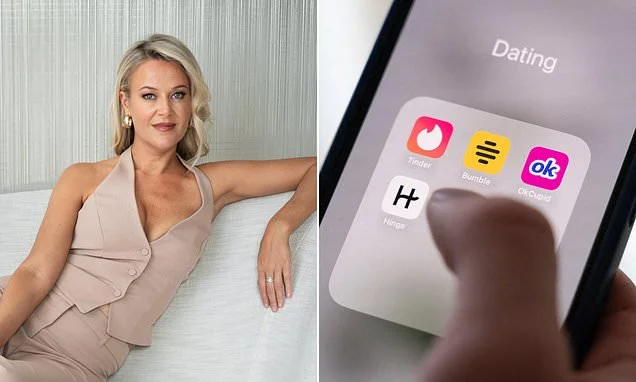
And my problem is, I don’t have many options left but to meet them In Real Life. For I’ve been banned from every dating app available.
Yes, all of them. Bumble. Hinge. Tinder. Happn. Why? Given I’ve never behaved badly on any of them, my best guess is that dating apps follow the first rule of Fight Club: You do not talk about dating apps.
I’ve been banned from every dating app available. Why? My best guess is that dating apps follow the first rule of Fight Club: You do not talk about dating apps, writes Jana Hocking
Which is hard when you write a sex and dating column for a national newspaper read by millions of people. I can hardly not talk about my experiences online.
In fact, my crime, I suspect, has been raising uncomfortable questions about the safety of these apps. Questions like how, in 2026, can someone still join a dating app using a fake name and stolen photographs, then lure another person on to a date under an entirely false identity?
I know how easily that happens because my own photographs have been stolen and used on fake dating profiles more times than I can count.
At one stage, it was happening almost weekly. Followers would send me screenshots of accounts using photographs lifted from my Instagram or articles, usually attached to a different name and an entirely invented life.
I’ve been ‘Anna’, 26, which was flattering, and ‘Hannah’, 48, which was not so flattering (I’m 41!). And various other non-existent women, all using my photos.
Somewhere out there, indeed, several fake versions of me were apparently dating more successfully than the real one.
It was funny until I considered the people being tricked into speaking to ‘me’ were sharing personal details and potentially arranging to meet someone who didn’t exist. Catfishing and romance scams are alive and well and often launched on dating apps. And yet, the solution could be so simple: Verification.
Yes, it’s an option on these sites, but it’s not compulsory. Tightening the rules wouldn’t magically remove every creep and con artist, but mandatory identity checks would make catfishing harder and give users some confidence that the person on the screen actually exists.
Catfishing and romance scams are alive and well on dating apps. And yet, the solution could be so simple: Verification. Yes, it’s an option on these sites, but it’s not compulsory
Last year, one of the major dating apps took me to lunch and asked me to stop raising this issue in my columns. When I said I wouldn’t stop until it strengthened its safety measures and made verification non-negotiable, its head publicist told me, and I quote: ‘But our numbers would drop dramatically.’
And there it was.
The app knew verification could make users safer, but it also knew it might shrink its membership figures.
Sometimes the consequences are far more serious than one horribly awkward date or a ghosting. Britain’s National Crime Agency analysed 671 stranger rapes and serious sexual offences that began through a dating site or app between 2003 and 2021, and found that 83 per cent of the victims were female and almost half the named suspects already had a criminal conviction.
There is surely a connection between these facts and the rapid decline of online dating among women in the UK. In a turn of events that should surprise precisely no one, people are abandoning the biggest dating apps in dramatic numbers.
Since 2023 there’s been a double-digit percentage decline in UK users across all the main apps. Tinder’s UK user base dropped from 2.5million in May 2023 to 1.5million in May 2025, while Bumble is down to 1.1million from a 1.5million UK high.
This month, indeed, Bumble confirmed a 16.4 per cent year-on-year decline in its global paying user base, and a scary 95 per cent loss of its market value since a high in 2021. The people who remain aren’t exactly brimming with enthusiasm either.
Almost half of Britons asked in a YouGov survey said their experience of the apps was ‘bad’ and a worrying 61 per cent had come across profiles they thought were fake.
Across the biggest names in online dating, the message is becoming difficult to ignore: Singles are tired of swiping.
I should know. I’ve spent more than a decade on these apps, which is long enough to remember when Tinder still felt exciting.
In the early days, it was like being handed the guest list to an enormous singles party. You could match with someone over breakfast, exchange a few messages and be sitting across from them at a bar that evening.
Now, Tinder feels like the clearance bin of online romance. You have to rummage through chaps looking for a pen pal, an ego boost, an affair or somewhere to send the unsolicited photographs they’ve been keeping in their camera roll. Many think it’s now acceptable to post bios that read ‘Just ask’.
I’ve spent more than a decade on these apps, which is long enough to remember when Tinder still felt exciting. Now, it feels like the clearance bin of online romance, writes Jana
Then came Bumble, promising to put women in control by making us send the first message. In theory, it sounded empowering. In reality, it gave us another piece of admin.
We chose the match, studied his profile, came up with an opening line and waited patiently for him to reply, often with, ‘Hey’. If he replied at all.
Now even Bumble appears to be quietly admitting that women are tired of doing the work. The app has relaxed its famous women-message-first rule, allowing men to initiate exchanges for the first time, presumably in an attempt to halt the precipitous decline in users.
Hinge is probably the best of the bunch and the only one bucking the downward trend in terms of membership.
The profiles reveal more, the prompts make starting a conversation easier and the people using it generally seem more interested in relationships.
Still, it suffers from the same strange paralysis as every other app. People match and never speak, which is one of the most common complaints among my friends.
Or if they do, they exchange messages for weeks without suggesting a date.
The trouble is, and has always been, these apps give the impression that everyone is just one more swipe away from matching with someone taller, hotter or geographically closer. That there’s always a better option.
So, instead, I turned to In Real Life dating – but, alas, that revealed an unforeseen consequence of the initial success of the apps. Men don’t chat women up any more.
On our hopeful night at the pub, my friend and I caught the attention of a couple of suited men, and yes, there was decent eye contact and clear approval of each other. Yet not one of them actually approached us.
And not to toot my friend’s horn (toot toot) but the girl is all legs and blonde hair. She should have had them lining up!
It wasn’t until I got home that I discovered one had appeared in my Instagram direct messages. ‘Hey, I’ve been following you for a while and was pleased to see you at the pub tonight. I didn’t get a chance to come and say hi, so thought I’d try my luck on here.’
Interesting.
He had seen me, and yet the only place he felt comfortable approaching me was... online. Again and again, men feel more confident sidling up to a woman digitally than they do in the flesh. For someone fed up with the apps, it’s a Catch-22.
And that was how I ended up doing something rather drastic: Using social media to find a man instead. With an empty Saturday night stretching ahead of me, I decided to take my courage in my hands – not that I need it – and advertise for a date on Instagram.
Fed up of the apps, Jana announced to her Instagram that she was accepting date applications
With no date and apparently no shame, I did what any dating columnist banned from every app would do: I posted a carousel (series of pictures) asking for one, writes Jana Hocking
My requirements were hardly outrageous. He had to be single – a detail that should go without saying, age-appropriate and he had to interested in an actual relationship
People are already repurposing various platforms for exactly this. The business network LinkedIn has become a particularly popular means of mixing work with pleasure, with a remarkable one in eight users in a US survey this year saying they’d formed a romantic relationship through it.
No one’s looking at LinkedIn on a Saturday, however, so I chose Instagram. With no date and apparently no shame, I did what any dating columnist banned from every app would do: I posted a carousel (series of pictures) asking for one.
My requirements were hardly outrageous. He had to be single – a detail that should go without saying (one glance at the creepy married men roaming freely through my direct messages would explain why it didn’t). He had to be age-appropriate, although the older men remain alarmingly confident, and he had to be interested in an actual relationship.
Then, because I had already taken things this far, I added a questionnaire asking men to tell me about themselves and pitch their ideal first date.
Then I put my phone down and wondered whether I had just publicly humiliated myself.
When I checked again, my inbox was overflowing. Some men had clearly skimmed the brief, with many opening lines like: ‘Are you really banned from every app?’ Sir, that very fact was clearly described in the carousel I spent far too long putting together.
Plenty were decades outside my requested age range and used gross words like ‘sweetheart’. Others wanted children despite the fact I had explicitly said I was child-free by choice.
Several sent highly sexual responses, apparently believing the quickest route to a first date was to describe what they hoped would happen at the end of it. Calm down, Fabio. If you have to tell me how good you are
in bed, there’s a fair chance you’re not.
Then there was the man who told me he was ‘separated in spirit’ from his wife, although one quick glance at the loved-up pics of them on his profile would beg to differ.
Yet among the chaos were thoughtful messages from funny, interesting men who had clearly taken the time to read what I had written.
Four stood out immediately. One was a blast from a man I met in New York last year (yes, in the wild – a rare beast) who told me he would be in town next month for a three-month stay and would love to take me out. He even followed it up with an advanced restaurant booking. Bravo.
Another came recommended by a dear friend, which offered the kind of character reference no dating app could provide.
‘He’s so lovely and is a big golden retriever at heart,’ she assured me.
The third gave answers that aligned so closely with what I wanted that I found myself reading them twice.
And the fourth, well he’s just so darn hot, I had to pursue it. I know, shameless.
For the first time in ages, dating felt fun again.
Instagram gave me something the apps rarely do: Context. I could scroll through years of someone’s life, see how they spoke to people and check whether we had mutual friends. A profile filled with family, work, holidays and regrettable old haircuts told me far more than six carefully selected photographs and a conversation starter claiming the way to his heart was ‘good banter’.
Of course, Instagram has fake profiles and married men, too. My inbox proved that social media hasn’t discovered a magical new species of emotionally available male.
It did, however, remove some of the coldness of swiping. The men responding already knew my sense of humour, I didn’t have to have that awkward ‘I’m a sex and dating columnist’ chat on my first dates, because it’s pretty darn clear on my profile.
Plus, my online soul-baring allowed me to skip the nonsense and list exactly what I was looking for. Perhaps LinkedIn will be next, although approaching someone beneath a post about quarterly growth feels a little less sexy. On the upside, at least you can tell if they can hold a job.
As for whether my Instagram experiment will lead to love, it is far too early to say. But it has already produced several men I’m genuinely interested in meeting, which is more than the dating apps have managed in quite some time.
The suited man at the pub may have been too nervous to cross the room, but he had no trouble finding me online once he got home. Perhaps digital dating isn’t disappearing entirely – it’s just moving where people can see more of the person before deciding to swipe right.
Insta and LinkedIn may even be the best accidental dating apps on the market. I’ll let you know how it works out...